

Feature lists offer a useful first comparison, but they do not show who owns the code, controls game rights, verifies redemption decisions, or determines where a platform can operate. Those details can decide whether a package is ready to deploy or still requires the operator to build or contract for key components.
Providers are grouped here by delivery model: turnkey, white-label, bespoke, modular player-account management (PAM), and content supply. Published capabilities are separated from matters operators should verify through contracts, technical demonstrations, and references. This distinction matters in a fragmented regulatory environment. Platform features do not establish that an operating model is lawful in every state, and a free-entry route alone does not resolve that question, as Venable's analysis of state actions against sweepstakes casinos explains.
The most useful shortlist is not necessarily the one with the most features. It is the one that fits the operator's build-versus-buy needs and can be checked against concrete requirements. That means comparing delivery models while confirming code ownership, game rights, state availability, and redemption responsibilities. A vendor's published capabilities describe its offer; contracts and operational evidence help establish what the buyer will receive.
Table of Contents
- 1. GammaSweep
- 2. NuxGame
- 3. GiG SweepX
- 4. OHS Gaming
- 5. TIGSweepstakes
- 6. TRUEiGTECH
- 7. Tecpinion
- 8. Capermint
- 9. Sweepium
- 10. Vivo Gaming
- How the Sweepstakes Gaming Software Providers Differ by Delivery Model, Pricing Disclosure, and Launch Claims
- Turning Vendor Claims Into a Verified Shortlist
1. GammaSweep
GammaSweep presents itself as a turnkey social-sweepstakes casino platform, combining core software with pre-integrated operational services. Its published feature set includes separate Gold Coin and Sweeps Coin ledgers, game aggregation, configurable promotions, payment and identity-verification integrations, geolocation, responsible-play controls, and operational analytics. That breadth may suit an operator that would rather evaluate a combined stack than coordinate multiple vendors.
The company states a six-week median launch time. Treat that as a vendor claim, not a delivery commitment, until GammaSweep defines what counts as launch, which integrations are included, and what the operator must supply. Ask for references from comparable deployments and for performance evidence covering uptime, concurrent sessions, and operational support.
Practical rule: A broad platform reduces the number of integration relationships, but it doesn't transfer the operator's legal responsibilities.
Pricing isn't public. GammaSweep describes a setup fee plus revenue share, so the contract should specify the revenue base, any minimums, third-party charges, and termination costs. Buyers should also confirm code ownership, game-provider rights, state availability, and who makes and audits redemption decisions.
For a platform that may include external game content, compare the proposed rights and integration scope with the operator's existing supplier agreements. The PAGCOR B2B provider application process is a useful reminder that provider status and platform functionality are separate diligence questions. GammaSweep's website describes its offering; the launch plan and legal allocation still need to be documented directly.
2. NuxGame
NuxGame places sweepstakes features within a wider iGaming platform, a model that may appeal to operators weighing a social-casino product alongside broader casino or sportsbook operations. Its published sweeps functions include separate Gold Coin and Sweeps Coin balances, support for AMOE and no-purchase-entry workflows, redemption request and verification management, mobile play, promotions, referrals, loyalty tools, and analytics.
The wider product suite is a potential advantage only if the operator needs those adjacent capabilities. A buyer focused on sweepstakes alone should compare the cost and operational complexity of the full platform with a narrower solution, and establish whether the sweeps module can be contracted and operated independently.
NuxGame publicly describes AMOE and redemption workflows, but those descriptions don't establish how they behave in a live deployment. Ask the vendor to demonstrate the entry route from registration through eligibility checks, ledger updates, and audit records. Then test a redemption scenario, including manual review, a rejected request, and a documented appeal path.
Don't treat a software workflow as a legal opinion. The operator still needs state-specific advice and a clear owner for compliance decisions.
Pricing and a sweepstakes-specific launch timeline aren't published. Confirm which payment, game, identity, and compliance integrations are included, and which require separate contracts. The software itself can't determine whether a particular configuration is lawful in every state.
NuxGame's platform information provides a starting point for scoping. Procurement should turn that description into a written schedule of modules, dependencies, service responsibilities, and acceptance tests.

3. GiG SweepX
GiG SweepX is Gaming Innovation Group's social-sweepstakes platform, combining dual wallets, prize-redemption management, a custom front end, gamification, and content-management technology integrated with GiG's platform. This delivery model may suit operators seeking a customized player experience within a broader platform environment. Buyers should establish which components are included and which depend on other systems.
According to GiG's SweepX information, GiG has announced a live deployment with partner Primero under the Goldrush City brand. The example gives buyers a specific deployment to discuss, but does not establish that another operator would receive the same configuration, terms, or operating results. Ask which elements were standard, which were bespoke, and what relied on partner systems.
Public product details provide limited operational specificity. Request a demonstration of wallet reconciliation, redemption review, exportable event-level records, and promotion configuration. In particular, test whether promotions can be changed without code modifications.
Ownership and rights also need clear contractual terms. Establish who owns the custom front end, content-management configuration, and commissioned integrations, and whether these can be transferred if the relationship ends. GiG's broader iGaming experience alone does not establish sweepstakes compliance or state availability.
Use SweepX product information to frame questions about current capabilities, pricing, commercial terms, and sweepstakes-specific references. For a separate look at content-provider accreditation, review the PAGCOR game-content provider accreditation requirements. Accreditation and platform functionality are distinct considerations, so verify each against the operator's intended setup.
4. OHS Gaming
OHS Gaming offers white-label, turnkey, and bespoke sweepstakes software. Its published platform capabilities include a Gold Coin and Sweeps Coin wallet, PAM and player-management tools, reporting, game aggregation across slots, table games, and live-dealer content, plus fiat and crypto payment integrations. The choice among delivery approaches is useful for buyers comparing a hosted launch with a more customized build.
Those labels need precise definitions in a proposal. “White-label” may describe branding on a shared platform, while “bespoke” may refer to selected custom modules rather than ownership of the underlying code. Ask OHS Gaming to itemize what is proprietary, what is licensed from third parties, and what can be exported or transferred if the relationship ends.
The published feature range also raises a scope question: whether game aggregation, payments, and identity checks are included in the quoted service or merely supported through integrations. Buyers should request a dependency map and a sample operating report, then verify how separate transaction and redemption records can be reconciled.
OHS Gaming publishes guidance for comparing deployment models, but no fixed price is public. Timelines and experience figures described by a vendor aren't independent benchmarks, so the contract should tie delivery dates to defined milestones and acceptance criteria.
Its sweepstakes platform information can help shape an initial requirements discussion. Before selection, compare licensing fees with third-party costs and clarify responsibility for game rights, geolocation configuration, fraud monitoring, and operational support.
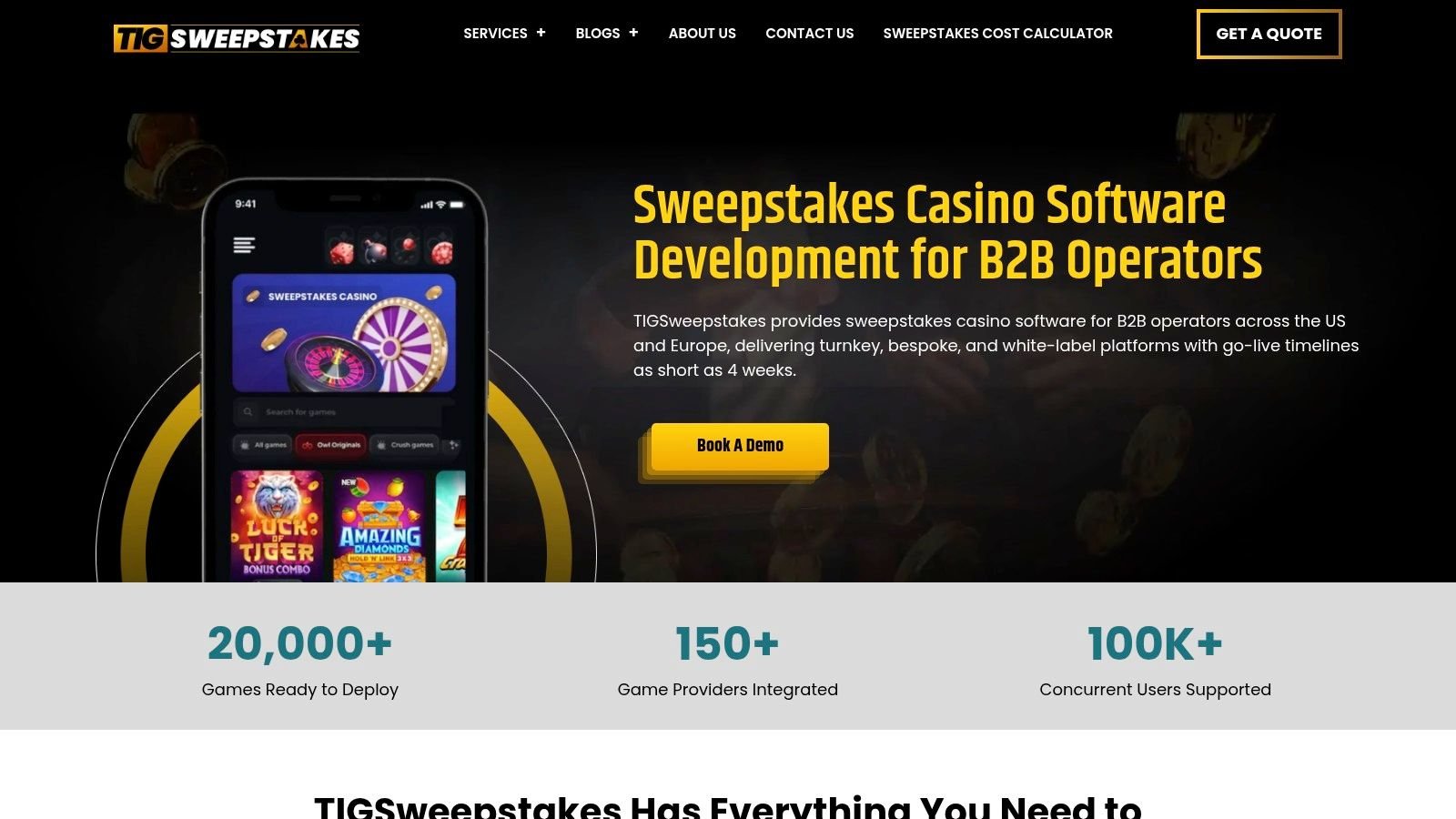
5. TIGSweepstakes
TIGSweepstakes markets turnkey, white-label, and bespoke software, with published functions for wallets, promotions, player management, and reporting. It also describes geolocation, KYC/AML, and audit-related tools, and says source-code ownership is available for some builds. That stated option makes it relevant to operators seeking more technical independence, but ownership only has value when the contract identifies exactly what transfers.
A buyer should ask for a schedule covering code repositories, documentation, deployment scripts, third-party libraries, game integrations, and intellectual property. The agreement should distinguish ownership of custom work from rights to the vendor's existing platform and any content supplied under separate licences. It should also explain who maintains security updates and fixes after handover.
TIGSweepstakes offers multiple delivery models, but the practical trade-off is between provider dependence and the operator's capacity to manage software. A source-code transfer doesn't automatically provide a functioning, supportable platform if the operator lacks technical staff or cannot replace licensed components.
Ownership test: Ask the vendor to identify the assets that transfer, the assets that remain licensed, and the services required to keep the product running.
Pricing isn't public. Launch-time, game-count, and scale figures are vendor claims requiring independent validation. Request a demonstration of the compliance-related workflows and ask who reviews geolocation decisions, verifies redemption requests, and maintains audit records.
TIGSweepstakes' published offering is a starting point, not a substitute for contractual detail. Operators evaluating game supply should separate platform code from content rights and confirm the role of any aggregator, using the PAGCOR game aggregator accreditation requirements as a distinct diligence reference.
6. TRUEiGTECH
TRUEiGTECH offers sweepstakes platform development alongside a separate PAM and back-office proposition. Its published capabilities include Gold Coin and Sweeps Coin wallet support, game and lobby management, promotions, analytics, KYC/AML, age-gating, and fraud monitoring. That combination makes it worth examining for operators that may need a complete build or may already have a platform and want to assess a management layer separately.
The modular option can reduce the need to replace existing systems, but only if the PAM can exchange reliable data with the operator's wallet, game providers, payment services, and reporting stack. Ask for API documentation and a live walkthrough of player-state changes, ledger reconciliation, role permissions, and audit-log exports.
TRUEiGTECH describes multiple delivery options, including custom development. Buyers should therefore separate standard product functions from paid development and identify whether integrations are included, separately contracted, or dependent on third parties. A feature list that says “integration” doesn't specify the implementation work or who supports failures across system boundaries.
Pricing isn't published. Rapid-launch or scale claims should be tested against a project plan that names dependencies, migration responsibilities, and acceptance criteria. Operators also need to confirm who configures state controls and owns final decisions on eligibility and redemption.
The vendor's sweepstakes technology information can support a technical discovery session. For buyers considering a standalone management layer, the PAGCOR gaming system administrator requirements provide a useful prompt to clarify system administration roles and responsibilities.
7. Tecpinion
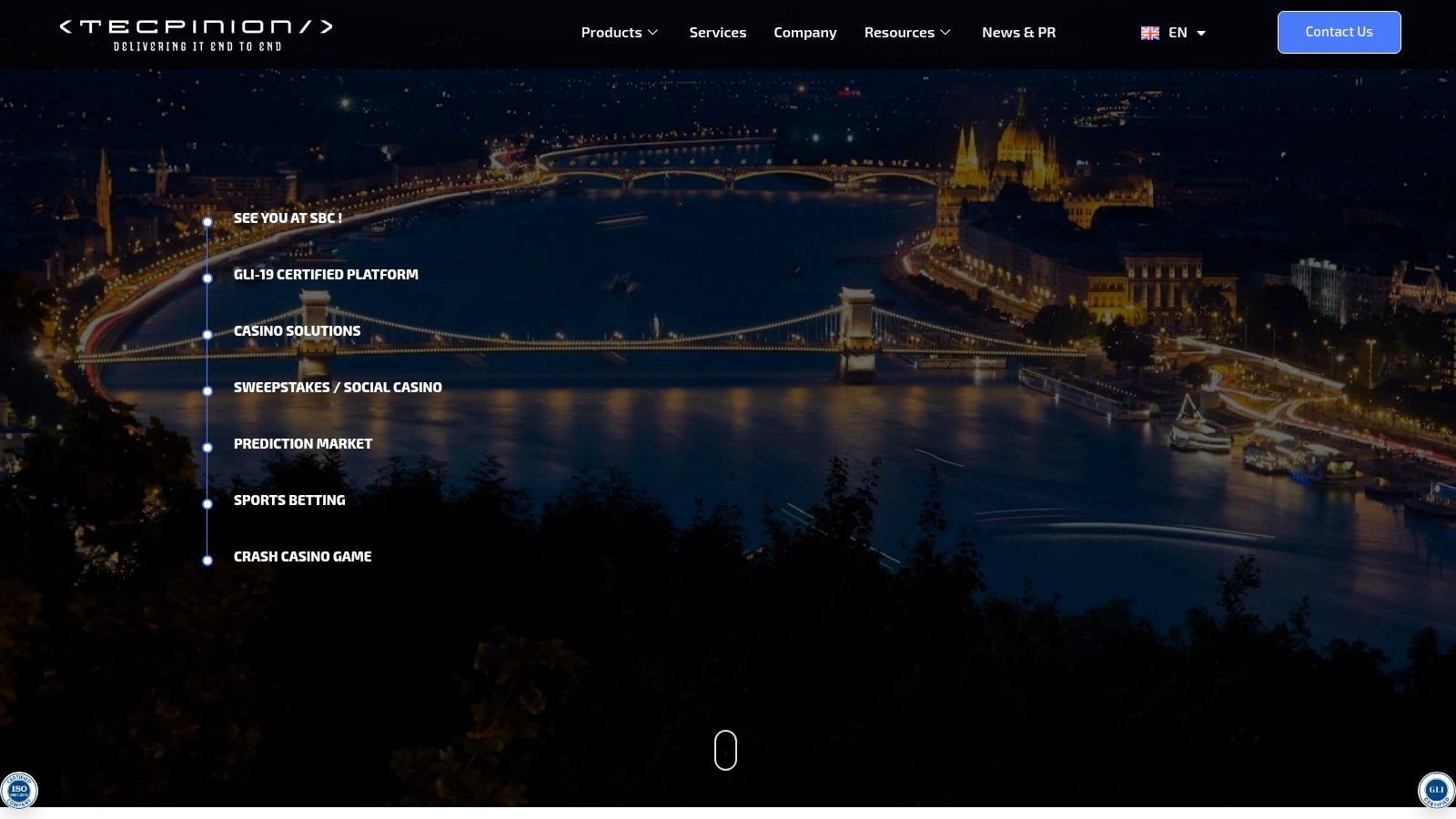
Tecpinion offers turnkey, white-label, and custom sweepstakes builds, with published features spanning virtual currencies, AMOE, prize redemption, tournaments, leaderboards, affiliate tools, mobile apps, and web compatibility. It also describes AI-oriented analytics, including recommendations and fraud detection. That breadth may suit teams looking to combine player engagement tools with operator-facing functions.
AI descriptions deserve a practical test rather than a feature-count score. Ask Tecpinion to demonstrate the data used by a recommendation or fraud-detection function, explain which decisions remain under operator control, and show how the system records alerts and outcomes. Without that detail, “AI” doesn't tell a buyer whether a tool is explainable, configurable, or useful for a specific operation.
The engagement features also need to connect cleanly to the underlying rules. Tournaments, bonuses, and affiliate promotions can affect entries, balances, and eligibility, so the demonstration should show how each action appears in player ledgers and audit records. Operators should also test whether reporting can be exported and reconciled against payment and redemption data.
Ask for the workflow, data fields, and exception handling behind each claimed capability, not just a product tour.
Pricing and independently verified performance data aren't public. Game-provider rights, integration responsibilities, and launch scope should be written down before procurement. A mobile app and web offering may also involve separate release and maintenance responsibilities that the proposal should identify.
Tecpinion's platform details can guide the initial demonstration. Treat customization and AI capabilities as claims to validate against the operator's actual product requirements and internal technical capacity.
8. Capermint
Capermint positions itself as a software developer for white-label, turnkey, and custom sweepstakes builds, rather than as a game aggregator. Its described components include dual-currency wallets, AMOE workflows, geofencing, KYC, redemption functions, and back-office tools. It also describes source-code handover for contracted builds, which may appeal to operators with specific technical requirements or existing game-content relationships.
The trade-off is that bespoke engineering can require more internal oversight than a hosted, integrated product. An operator may need to coordinate content suppliers, verify game rights, manage deployment, and maintain custom components. Capermint's role should be distinguished from that of any game provider or distributor, especially if the project assumes the buyer will bring existing content agreements.
The contract should define what “source-code handover” includes and whether it covers the full product, only custom modules, or selected deliverables. Confirm access to documentation, build processes, environments, and third-party components, as well as who handles security updates and operational incidents after delivery.
Pricing isn't public. Custom work can also make project estimates difficult to compare unless proposals use the same requirements and acceptance tests. Ask for a phased plan that separates core wallet and redemption functionality from optional features, and document how each phase will be approved.
Capermint's software development information describes the company's delivery positioning. It may fit buyers seeking a developer rather than an all-in-one content source, provided the operator has a clear plan for game licensing, integrations, and ongoing technical ownership.

9. Sweepium
Sweepium describes itself as a B2B platform and game aggregator focused on social and sweepstakes gaming. Its offering promotes branded platform launches, provider content, operational support, and marketing services. The company publishes a six-to-ten-week launch estimate, which buyers should treat as a planning claim until they see a scope, dependencies, and current partner availability in writing.
Aggregation may reduce the number of separate game integrations an operator has to manage. It can also create dependence on the aggregator for content access and integration support, so the operator should identify which providers and titles are available for its proposed configuration. Ask for the relevant game rights, the jurisdictions they cover, and any limitations on branding or distribution.
Public technical documentation and pricing aren't detailed. Buyers should request an architecture overview, examples of reporting and wallet reconciliation, and a reference from an operator with a comparable deployment. Clarify whether marketing and operational support are included in the commercial proposal or are separate services.
Sweepium's platform information can begin the discussion, but it doesn't replace technical or commercial diligence. In particular, verify that the quoted launch scope includes the desired content, payment integrations, and redemption workflows, rather than assuming that the presence of aggregation covers every third-party relationship.
For buyers comparing an aggregator's role with formal accreditation and fee considerations, the PAGCOR B2B accreditation fees are a separate reference point. Confirm the current licensing and operating requirements relevant to the planned business directly with appropriate advisers and authorities.
10. Vivo Gaming
Vivo Gaming is a live-casino content supplier, not a complete sweepstakes operator platform. Its published live-dealer catalogue includes roulette, blackjack, and baccarat, with API or Data Feed API integration and shared or dedicated table options. The operator retains control of sweepstakes mechanics and currency handling, so Vivo may suit an existing platform seeking live content rather than a replacement for its PAM, wallet, or redemption system.
That boundary is central to the buying decision. The operator must confirm that its own platform can map game events into the intended player experience and maintain the necessary records. Integration testing should cover session handling, game availability, reporting, and what happens when a connection fails or a player's account state changes during a session.
Vivo describes integration support, but the commercial scope and availability depend on onboarding and the operator's model. Ask which API is proposed, what data it returns, what support is included, and whether any table arrangement changes the integration or operating responsibilities. The contract should also state which party handles game content rights and operational escalations.
Vivo's live gaming information can help an operator assess content fit. It shouldn't be compared as a like-for-like alternative to turnkey software providers: the buyer still needs a platform that manages currencies, eligibility, promotional entry, geolocation, and redemption compliance.

How the Sweepstakes Gaming Software Providers Differ by Delivery Model, Pricing Disclosure, and Launch Claims
| Item | Delivery model | Pricing published | Stated launch timeline | Best suited for |
|---|---|---|---|---|
| GammaSweep | Turnkey platform with pre-integrated services | Setup fee plus revenue share; amounts not public | Six-week median, per company | Operators seeking a broad, integrated platform |
| NuxGame | Sweepstakes module within a wider iGaming platform | Not publicly listed | Not published | Operators considering sweeps alongside casino or sportsbook products |
| GiG SweepX | Platform with dual wallet, custom front end, and content-management tools | Not publicly listed | Live deployment announced in January 2025 | Operators seeking an established platform supplier and public deployment example |
| OHS Gaming | White-label, turnkey, or bespoke software | No fixed price published | Not published | Buyers comparing hosted and custom delivery approaches |
| TIGSweepstakes | Turnkey, white-label, or bespoke software | Not publicly listed | Not published | Teams seeking delivery flexibility or potential source-code ownership |
| TRUEiGTECH | Turnkey platform, custom development, or modular PAM/back office | Not publicly listed | Not published | Operators seeking a full platform or a separate management layer |
| Tecpinion | Turnkey, white-label, or custom software | Not publicly listed | Not published | Operators prioritizing customization and engagement features |
| Capermint | White-label, turnkey, or custom software development | Fixed package pricing not published | Not published | Operators seeking bespoke development or code handover and sourcing content separately |
| Sweepium | B2B platform and game aggregation with branded setup | Not publicly listed | Six to ten weeks, per company | Social and sweepstakes operators seeking platform and content aggregation |
| Vivo Gaming | Live-casino content integrated into an existing platform | Not publicly listed | Not applicable; content integration required | Operators adding live-dealer games to an existing platform |
Turning Vendor Claims Into a Verified Shortlist
No single provider is the right answer for every operator. A company seeking a hosted launch may weigh GammaSweep, Sweepium, or Tecpinion differently from one that needs source-code ownership, where TIGSweepstakes or Capermint may merit closer review. An operator that already runs a platform and only needs live-dealer content may find Vivo Gaming more relevant, because it supplies games rather than a complete sweepstakes PAM.
The delivery model should lead the comparison. Turnkey and white-label options can reduce the operator's integration burden, but may increase reliance on a vendor for changes and ongoing service. Bespoke builds can provide more control over the product, but require explicit agreement on code, intellectual property, maintenance, and third-party components. Modular PAM can be a better fit when an operator wants to preserve existing systems, provided the interfaces and responsibilities are documented.
Before shortlisting, request written answers on pricing structure, code and IP transfer, game licensing, state-by-state availability, redemption verification, and independent references. Require a demonstration of separate currency ledgers, AMOE workflows, geolocation decisions, audit logs, and redemption exceptions. If the platform depends on payment or identity services, name each provider and specify which party handles outages, disputes, and data access.
Legal review should examine the actual product mechanics, not just vendor labels. The FTC's sweepstakes guidance states that legitimate sweepstakes must be free to enter and that payment must not be presented as required for entry or as improving a person's odds. For Florida-facing promotions, the Florida Department of Agriculture and Consumer Services' filing guidance describes a filing threshold for prizes above $5,000, with filing at least seven days before a promotion begins. California's Assembly Bill 831 legislative materials show how proposed restrictions can extend to supporting suppliers and infrastructure partners. These are not interchangeable rules, and an operator should obtain jurisdiction-specific advice before launch.
Treat every launch timeline and performance figure in this comparison as a claim to verify. Build a procurement plan that connects requirements to named owners, evidence, and contract terms, then plan your IT consulting strategy around the integrations and technical responsibilities the chosen model leaves with the operator.





Join thousands of gaming professionals receiving the latest iGaming news, regulatory updates, and market insights.
