

The UK Gambling Commission's published fee schedule shows how far licensing costs can scale with the activity and revenue involved: a remote betting intermediary with annual gross gambling yield of £1.6 billion or more pays an annual fee of £951,056, plus £206,119 for each complete additional £200 million above that threshold (UK Gambling Commission fee schedule). That figure reframes gambling license requirements as more than an application checklist. A licence defines what a business may do, where it may do it, and which operational controls it must maintain after approval.
For operators, suppliers, investors, and affiliates, the first decision is therefore not which country to enter alone. It's which licence layer applies to each activity, and whether the planned platform, suppliers, payments, marketing, and player-protection controls fit within that layer. The comparison below separates verified cost signals from items that require direct confirmation with the relevant regulator.
Table of Contents
- Licence Requirements by Jurisdiction at a Glance
- Matching Licence Scope to Each Activity
- Core Documents Every Application Needs
- Capital, Fees and Ongoing Cost Commitments
- Technical, AML and Safer-Gambling Controls to Evidence
- How to Apply Step by Step and Avoid Delays
- Keeping a Licence Valid After Rules Change
- Choose the Right Licence Layer Before You Commit Budget
Licence Requirements by Jurisdiction at a Glance
| Jurisdiction | Regulator | Licence Type | Core Requirements | Published Cost Signal |
|---|---|---|---|---|
| Great Britain | Gambling Commission | Remote operating licence | Ownership and group structure, business plan, proof of funds, six months of bank statements, three-year projections, remote technical standards | Application and annual fees are tiered by annual gross gambling yield |
| Malta | Malta Gaming Authority | Gaming-service licence | Complete submission; the non-refundable application fee must be paid for the application to be considered complete | €5,000 one-time application fee; annual licence fee is paid in advance and is non-refundable |
| Ontario | iGaming Ontario with AGCO | Operator registration and operating agreement | Operator registration with AGCO and an operating agreement with iGaming Ontario | Costs sit across two separate instruments held with two bodies* |
| New Jersey | Division of Gaming Enforcement | Internet gaming authorisation | Background investigations of principals and key employees | Application and recurring fees set by the Division of Gaming Enforcement* |
| Curaçao | Gaming Authority Curaçao | Online gaming licence | Application, suitability, and operational requirements set by the authority | Fee schedule set by the authority* |
| Philippines | PAGCOR | Online gaming licence | Application, technical, and operating requirements set by PAGCOR | Application, renewal, and other regulatory fees set by PAGCOR* |
*These jurisdictions publish no fixed schedule. The regulator confirms current figures in writing during the application, so treat each entry as a quote to obtain before budgeting.
Reading the comparison
A licence type determines the requirement set. A country may require separate approvals for an operator, a software supplier, a technical platform, or a physical casino premises. A single product can also touch several licence layers when, for example, an operator uses separately licensed software and a third-party platform.
Read the requirements column as the operating perimeter. The documents a regulator examines at entry describe the controls the licence holder must keep in place afterward, which is why a filing-ready submission and a licence-ready operation are different things.
Great Britain's model demonstrates the depth of an operating-licence assessment. The Gambling Commission expects evidence about ownership, funding, business plans, and operational controls, with additional technical materials for remote businesses. Its fees depend on licence category and annual gross gambling yield, so the cost signal is a tiered scale rather than a single flat price.
Malta publishes a clear application-fee figure, though the total cost still depends on licence class. The Malta Gaming Authority states that the €5,000 application fee is non-refundable and must be paid for an application to be considered complete (Malta Gaming Authority guidance on licence fees). The annual licence fee is paid in advance, is non-refundable, and differs between gaming-service and critical-gaming-supply licences under the applicable regulations.
The remaining four regimes confirm figures during the application process itself, and each structure explains why no single page can carry the number. Ontario splits the commitment across two instruments: an AGCO operator registration and an iGaming Ontario operating agreement, each carrying its own conditions. New Jersey's costs scale with the investigation, since every principal and key employee undergoes a background check. Curaçao consolidates authorisation into one online gaming licence under a single authority, while PAGCOR charges across several fee categories covering application, renewal, and other regulatory items. Written confirmation from each regulator should reach the business before the budget locks or a market-entry date is committed.
Shortlist rule: Select two or three regimes that match the target customers, product, and channel. Then test each against the document, capital, and control requirements before treating the headline licence as a viable market-entry route.
Matching Licence Scope to Each Activity
| Activity | Licence Layer | Boundary That Applies | Trigger or Condition |
|---|---|---|---|
| Remote casino or betting offered to customers in Great Britain | Remote operating licence | Customers located in Great Britain | Any remote gambling facility made available to them |
| Remote gambling software supplied to licensed operators | Remote gambling software licence | The supply and installation chain | Supplying software, even where a related operator is licensed |
| Full remote gaming-machine technical platform | Remote gaming-machine technical licence | The technical platform and its environment | Separate licence may be required even where a related operator holds an authorisation |
| Casino premises adding entitlements under the 22 July 2025 rules | Premises licence varied to add entitlements | Casino plan identifying the table-gaming area | Up to 80 machines where the area is at least 280 square metres and machines don't exceed five times the tables |
| Outsourced platform operations under a white-label model | Licence holder's operating licence | Licence holder's regulated perimeter | Outsourcing doesn't remove the licence holder's responsibility |
| Target-market marketing and affiliate activity | Market-specific promotion rules and any applicable operator authorisation | Target market and the relationship with the licensed operator | Confirm promotion rules and any licensing obligations with the regulator or counsel |
This matrix separates the licence perimeter from the operational perimeter. The first is the formal scope of an authorisation. The second is what the business does in practice across markets, products, channels, premises, platforms, suppliers, payments, and customer journeys. A mismatch between them can leave an activity outside the permission the business assumed it had.
A concrete example is the UK casino-premises change. Regulations effective 22 July 2025 allow qualifying converted casinos to hold up to 80 gaming machines if the gambling area is at least 280 square metres and the machine count doesn't exceed five times the number of gaming tables. The Gambling Commission says operators seeking those entitlements must apply to vary the premises licence so the casino plan identifies the table-gaming area (UK casino premises regulations). The change illustrates why a business shouldn't assume new permissions automatically expand an existing licence.
Scope the operation before buying the technology
Before platform selection or market-entry spending, the business should map:
- Target markets: where customers are located and which authority governs the offer.
- Product and channel: casino, betting, bingo, in-person, remote, or a combination.
- Premises and platform: physical venue, hosted platform, technical environment, and system interfaces.
- Suppliers and payments: game providers, software suppliers, payment flows, and settlement responsibilities.
- Marketing and player protection: affiliate arrangements, promotions, responsible-gambling controls, and who maintains evidence.
For a business evaluating crypto infrastructure for iGaming, the same scoping exercise should include the payment flow and the parties responsible for controls and records. A technology choice doesn't itself determine which licence applies; the regulated activity and the market do.
For Philippine-facing businesses, PAGCOR-related supplier accreditation questions also sit within their own scope. The PAGCOR game aggregator accreditation requirements provide a focused reference point for distinguishing an operator's permission from a supplier's role.
The practical test is simple: name the licence layer and regulator for every activity before committing technology spend. If an activity can't be mapped to both, the scope is still unresolved.
Core Documents Every Application Needs
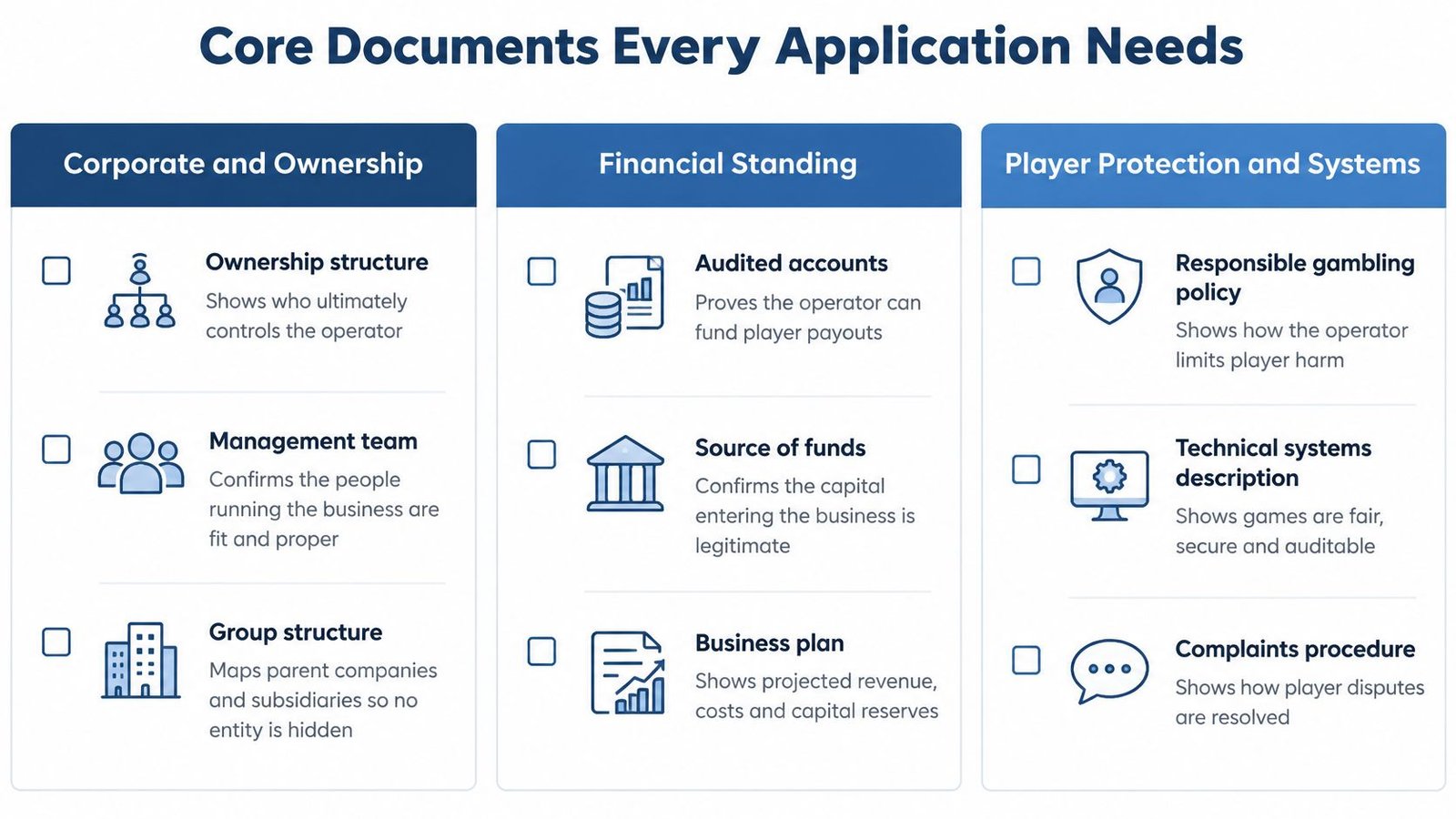
The UK Gambling Commission's application requirements show why a licence file is an evidentiary case, not a registration form. For an operating licence, applicants provide ownership, management, and group-structure information; relevant incorporation and constitutional documents; gambling policies and procedures; customer terms and conditions; rules of play; a business plan; and operational and financial materials. Remote applicants also supply technical and system information, including remote technical standards, testing-strategy policies, software-supply details, an operational-model map, and an end-to-end system diagram (UK Gambling Commission operating-licence application requirements).
Corporate and ownership
- Ownership, management, and group-structure information: shows who controls the applicant and how decision-making and responsibilities are distributed.
- Incorporation and constitutional documents, where relevant: establish the legal entity and the authority under which it operates.
These documents help the regulator assess ownership transparency and the suitability of the people and entities behind the applicant. If the group chart, corporate filings, and application forms name different owners or entities, the file creates questions before the regulator reaches the operating model.
Policies and player terms
- Gambling policies and procedures: show how the business turns regulatory obligations into operating controls.
- Customer terms and conditions: establish the contractual rules customers are asked to accept.
- Rules of play: set out how games or betting products work and provide a reference for resolving disputes.
The regulator needs more than polished policy language. It needs policies that match the actual products, decision rights, and customer journey. Rules of play should be clear enough to support consistent decisions when a customer challenges an outcome.
Operational and technical
- Business plan: explains the proposed operation and how its commercial model fits the licence scope.
- Remote technical standards and testing-strategy policies: describe how the remote systems will meet applicable technical requirements.
- Software-supply details: identify the providers and the components they supply.
- Operational-model map: shows how staff, suppliers, and processes fit together.
- End-to-end system diagram: traces the technical stack and its connections.
The system diagram is particularly important because it lets the regulator compare the declared scope with the systems that will handle the activity. A diagram that contradicts the supplier details or operating policies can prompt questions that a complete document pack could have prevented.
Submission control: Keep one document index with version numbers, named owners, and dates. Cross-check every entry against the others before filing, especially the system diagram, supplier information, and policies.
Capital, Fees and Ongoing Cost Commitments
The licence fee depends on the activity and projected gross gambling yield (GGY). That makes scope and revenue assumptions budget inputs: an operator adding activities or moving into a higher GGY band can face a different fee schedule.
| Licence or Activity | Application Fee | Annual Fee | Fee Driver |
|---|---|---|---|
| Remote betting intermediary, GGY below £250,000 (Gambling Commission fee schedule) | £6,479 | £5,562 | Annual GGY band |
| Remote betting intermediary, GGY £1.6 billion or more (Gambling Commission fee schedule) | Confirm current application fee for the category | £951,056, plus £206,119 for each complete £200 million above £1.6 billion | Annual GGY |
| Remote casino plus one of bingo or virtual event betting (Gambling Commission fee schedule) | £2,100 additional | £6,250 additional | Activity-combination surcharge |
| Remote casino plus bingo and virtual event betting (Gambling Commission fee schedule) | £4,200 additional | £12,500 additional | Activity-combination surcharge |
| Remote gambling software, GGY below £875,000 (Gambling Commission fee schedule) | £7,212 | £7,394 | Annual GGY band |
| Remote gambling software, GGY £36.75 million to below £130 million (Gambling Commission fee schedule) | Confirm current application fee for the category | £97,549 | Annual GGY band |
| Full remote gaming-machine technical, GGY below £875,000 (Gambling Commission fee schedule) | £1,731 | £1,509 | Annual GGY band |
| Full remote gaming-machine technical, GGY £130 million or more (Gambling Commission fee schedule) | £82,185 | £243,329 | Annual GGY band |
| Malta gaming-service licence | €5,000 one-time | Set by licence category; paid in advance and non-refundable | Licence category |
The marginal fee can materially change a high-GGY budget. At £1.8 billion in forecast GGY, a remote betting intermediary falls within the £1.6 billion-or-more band. One complete £200 million step above the threshold adds £206,119 to the £951,056 base, producing an annual fee of £1,157,175 before any activity-combination surcharge.
Combination charges apply when a remote casino licence covers additional activities. Adding either bingo or virtual event betting costs £2,100 at application and £6,250 annually; including both costs £4,200 and £12,500 respectively (Gambling Commission remote casino fees).
Supplier and technical permissions have separate schedules. For remote gambling software, the published annual fee rises from £7,394 below £875,000 GGY to £97,549 in the £36.75 million-to-below-£130 million band (Gambling Commission remote software fees). For a full remote gaming-machine technical licence, the published annual fees range from £1,509 below £875,000 GGY to £243,329 at £130 million or more (Gambling Commission remote gaming-machine technical fees).
For UK software and technical licences, the first annual fee is due 30 days after issue and is reduced by 25%; later fees are due before each licence anniversary (Gambling Commission fees and payment guidance). Malta's annual fee is paid in advance and is non-refundable, with the amount determined by licence category.
Capital suitability is assessed through the financial evidence in the application. The file may include proof of funding and audited accounts where applicable. Budget forecasts should also account for compliance staffing, technical assessments, independent audits, and legal support. Model fees against the forecast GGY and the next band up to show how a change in revenue could affect ongoing costs.
A separate guide to PAGCOR B2B accreditation fees helps distinguish supplier-facing fees from operator licensing costs.
Technical, AML and Safer-Gambling Controls to Evidence
Remote operators need controls and records that demonstrate how accounts, transactions, games, customer history, and security are managed. Certified games are only the entry point of the review; the UK Remote Gambling and Software Technical Standards also set expectations for customer access to records, deposit-limit operation, randomness, security, and audit evidence. Together, these controls mark the operational perimeter of the licence, the area the holder must keep evidencing for as long as the licence runs.
| Control | Threshold or Period | Evidence to Keep |
|---|---|---|
| Account and gambling history | At least 3 months viewable directly; 12 months available on request | Access logs and record exports |
| Deposit limit reached | Further deposits blocked until the period restarts or the customer changes the limit | Limit-change logs |
| Deposit limit increase | 24-hour cooling-off period before the increase applies | Timestamped change records |
| Independent security audit | Annual third-party audit against specified ISO/IEC 27001:2022 controls; reports produced on request or after major non-conformities where the licence category requires it | Signed audit reports |
| Random number generation | Demonstrably random under accepted statistical methods | Test certificates |
Technical integrity and security
Technical evidence should show how the system protects account security and transaction integrity, records relevant activity, and lets customers access their own history. Under the UK Remote Gambling and Software Technical Standards, customers must be able to view at least three months of account and gambling history directly and obtain at least 12 months on request. For deposit limits, the system must block further deposits after a limit is reached until the relevant period restarts or the customer actively changes the limit, and increases carry a 24-hour cooling-off period.
Game outcomes and random number generation must be demonstrably random under accepted statistical methods. Systems also need to retain activity records, detect collusion or cheating, and support account or session suspension. Where a licence category requires independent security auditing, the evidence includes annual third-party audits against specified ISO/IEC 27001:2022 controls, with reports produced when requested or when major non-conformities are identified.
Each record should tie to a specific system version and control, so a reviewer can match the evidence to the build that was live at the time.
AML and safer gambling
AML evidence should connect the written risk assessment to actual customer and transaction controls: documented assessments, source-of-funds checks, and procedures for managing disputes. The file should trace how a concern was identified, escalated, and resolved. Unresolved trails are where applications fail in practice.
Safer-gambling controls should connect customer information to interventions. A policy must be backed by intervention logs that record the decision, the action taken, and the follow-up, since the regulator is testing whether the operator recognises risk and acts on it, not whether a document exists.
White-label arrangements leave responsibility with the licence holder. Supplier contracts should define who supplies each control, who produces the evidence, and how the operator can obtain it for regulatory review. That boundary between the licence perimeter and the supplier's platform needs to be settled before budgets are committed.
Evidence pack: Keep test certificates, audit reports, AML risk assessments, intervention logs, and supplier contracts together, with a named owner assigned to each record and each item tied to a system version.
For businesses assessing a local supplier or administrator role, the PAGCOR gaming system administrator requirements offer a separate reference point for system-level responsibilities.
How to Apply Step by Step and Avoid Delays
A clean filing reads like an operating file: every answer names an owner, a record and a date. The licence perimeter should be separated from the wider operational perimeter before fees, forecasts and supplier commitments are locked.
Freeze the perimeter before drafting. Owner: compliance lead. Output: a filing sheet naming the applicant entity, permissions requested, activities left outside the licence, and the suppliers relied on for each control.
Project annual GGY accurately. Owner: finance lead. Output: a signed forecast, the chosen fee band, and a short rationale tying expected revenue to products, markets and launch timing.
Assemble the document pack with version control. Owner: document controller. Output: an indexed pack where every item has a named owner, date and version number, so the submission can be reconciled without relying on informal email trails.
Prepare the financial evidence. Owner: finance director. Output: proof of funds, bank statements, audited accounts where applicable, and multi-year projections that show where funds come from, how balances move, and how the operating plan is funded.
Pay the application fee on submission. Owner: finance operations. Output: payment confirmation filed with the submission receipt. In Malta, the non-refundable application fee must be paid before the application is considered complete.
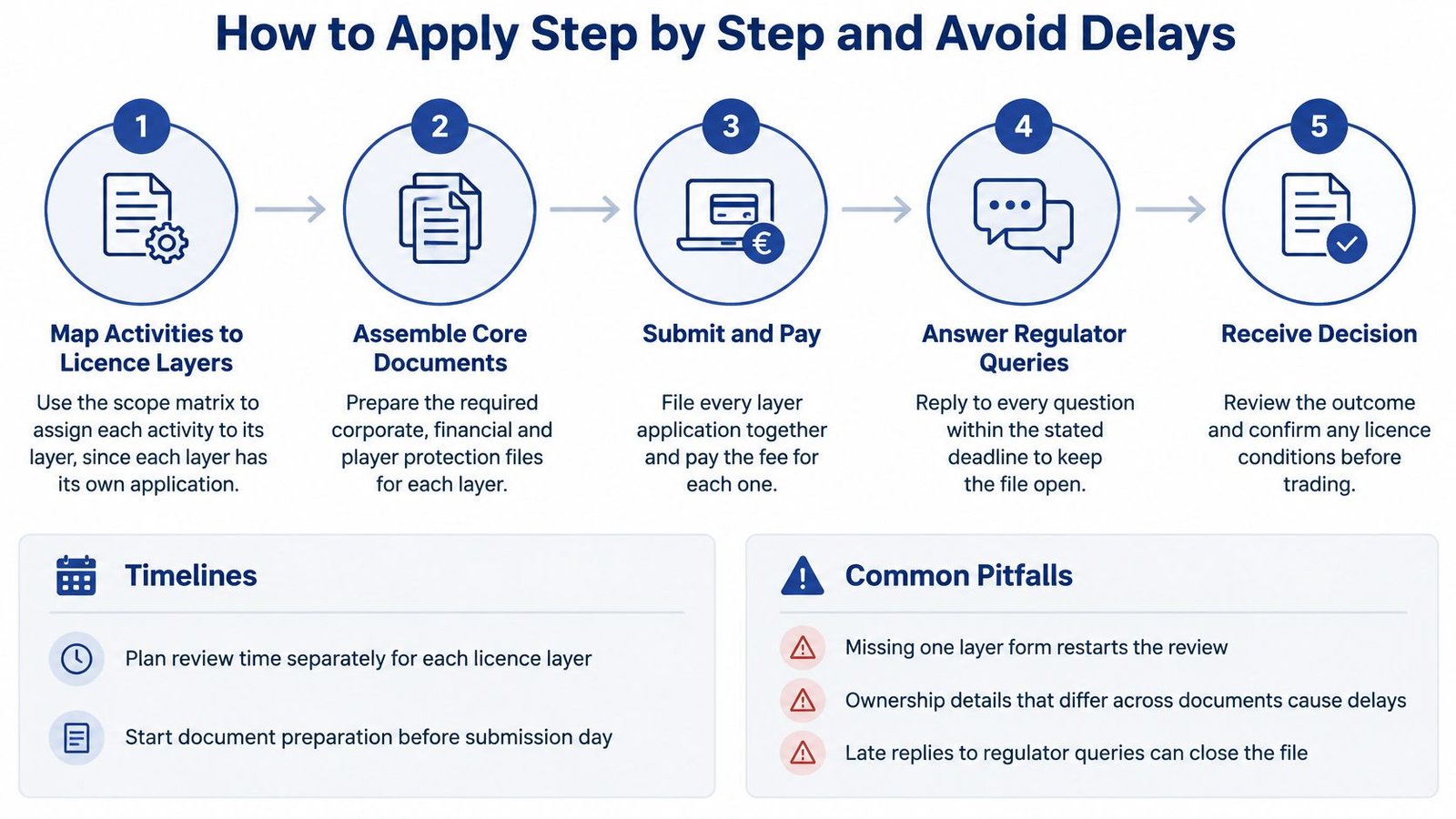
Answer regulator queries with evidence. Owner: named regulatory contact. Output: a response log linking each question to the specific test material, supplier record, policy clause or system setting used in the reply.
Convert issue into a controlled obligation set. Owner: licence manager. Output: a conditions register and first-year calendar covering recurring-fee deadlines, reporting points, approved boundaries and the records needed for inspection.
Timelines and common failure points
Regulators rarely publish one guaranteed processing duration. Plan from the relevant regulator's service standards where they are published, then record actual submission, query and decision dates so the next forecast is built from the operator's own file history. A timetable should allow for document completion and query responses, not only the period after a formally complete application is accepted.
- Unassigned query ownership: regulator questions sit in a shared inbox with no accountable responder.
- Optimistic GGY: the forecast falls below the fee band that the operating model can realistically reach.
- Conflicting system records: the system diagram doesn't match supplier contracts or written policies.
- Missing test evidence: the business plans to test after filing or launch, leaving the application without evidence of technical readiness.
- Unmapped outsourcing: a white-label operator hasn't assigned responsibility for controls, records and regulatory responses.
For businesses handling a supplier-side filing in the Philippines, the PAGCOR B2B provider application process sets out the separate steps involved in provider accreditation.
Keeping a Licence Valid After Rules Change
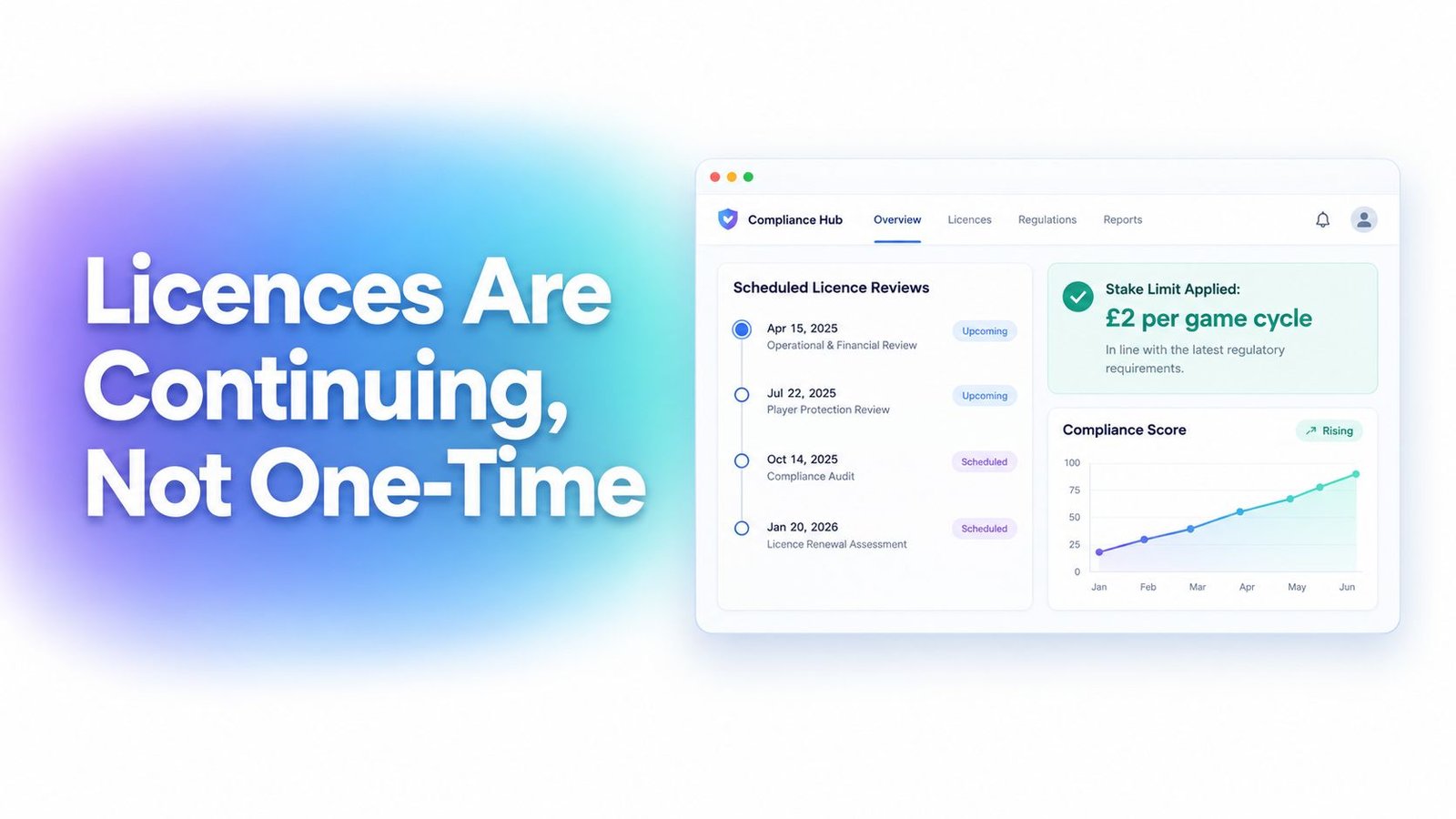
UK online-slots rules effective in 2025 attached stake limits directly to all remote casino operating licences, including licences issued before the rule took effect. The limit is £2 per game cycle for customers under 25 and £5 for customers aged 25 or over, with a six-week transition period (UK online-slots stake-limit regulations). The example challenges a common assumption: a licence isn't a static approval whose conditions change only when the holder submits an application.
Make regulatory change operational
A documented response should move from the rule to the system, customer, and governance record:
- Monitor regulation: assign responsibility for identifying relevant legal and regulatory changes.
- Assess impact: compare the change with the licence scope, products, customer groups, suppliers, and controls.
- Implement technically: translate the requirement into platform rules, system settings, and operating procedures.
- Communicate with customers: update relevant information and notices where the change affects the customer journey.
- Test and retain evidence: record test results and confirm the affected controls operate as intended.
- Obtain board approval: document oversight of the implementation and any unresolved risk.
- Notify or apply for a variation: determine whether the regime requires notification, an amended licence, or a separate authorisation.
Changes to ownership, key personnel, domains, products, payment methods, suppliers, and customer-protection controls can trigger notification or variation duties. The precise route depends on the jurisdiction and type of change. UK local risk assessments must also be updated when an operator applies for a variation or when significant local circumstances change.
The operator should ask three distinct questions whenever rules or operations change: does the change expand the existing licence automatically, require a premises-plan variation, or require a separate authorisation? The answer should be recorded before the affected product or system goes live.
Eligibility at application and continuing suitability are different tests. An applicant can present a credible case at the outset and still fall out of compliance if it doesn't monitor new rules or keep its controls aligned with the licensed operation. For regulatory professionals tracking market developments, PAGCOR regulatory updates provide a jurisdiction-specific reference point, but each operator still needs a process that assesses the rules applicable to its own activities.
The larger risk may be silent non-compliance by an already licensed operator, rather than an initial application rejection. A change log tied to owners, implementation dates, testing evidence, and regulator communications gives the business a defensible account of how it responded.
Choose the Right Licence Layer Before You Commit Budget
Budget follows the licence perimeter. A licence is a continuing boundary around defined activities, so the first decision is whether each planned activity sits inside an existing authorisation or creates a separate regulated perimeter before spend is committed.
For a remote operator serving customers in Great Britain, the threshold is customer-facing remote activity: if it takes bets or runs games for that market, budget for the applicable remote operating licence, with fees modelled by licence type, projected GGY and any activity-combination surcharge.
For a supplier, the test is whether it only sells into licensed operators or performs a regulated function itself. Software supply needs its own remote gambling software licence even when a related operator is licensed; a full remote gaming-machine technical platform can cross into a separate technical licence.
For premises, added gaming-machine entitlements are a scope question: price a premises variation and a plan identifying the table-gaming area unless the existing licence clearly covers the layout.
Affiliate licensing rules vary by market; confirm them with each target regulator before launch, including whether any duty falls on the affiliate or its operator clients.
Decision rule: no activity enters the budget until its licence layer, responsible regulator and any supplier or premises permission are confirmed in writing; fees are then built on the confirmed scope and a credible GGY forecast.





Join thousands of gaming professionals receiving the latest iGaming news, regulatory updates, and market insights.
