
The 2026 global gambling map is defined by fragmentation, not convergence. A regulatory snapshot estimates that 70 to 80 countries have clear online gambling regulations, 40 to 50 remain in a gray area, and about 70 countries maintain a complete ban as of July 2026, according to Slotegrator's global regulatory snapshot. Even among regulated markets, licensing, tax, advertising, technical controls, and consumer-protection obligations remain national or subnational questions.
For operators, affiliates, suppliers, regulators, and investors, legal status is therefore only the first screening criterion. A licensed market can still become commercially difficult after a tax increase, a product restriction, or a costly reporting requirement. This global guide from Top 1 Rank assesses gambling regulations by country in 2026 through that wider lens, with regional comparisons, compliance priorities, and practical market-entry implications.
Table of Contents
- Introduction to Global Gambling Regulation in 2026
- How Gambling Markets Are Categorized Worldwide
- Licensing Regimes and Market Access Requirements
- Key 2026 Regulatory Amendments and Tax Changes
- Compliance AML and Responsible Gambling Obligations
- Country by Country Regulatory Profiles by Region
- Practical Implications for Operators Affiliates and Investors
- Quick Reference Glossary and Navigation Index
Introduction to Global Gambling Regulation in 2026
By April 2026, 38 states plus Washington, D.C. had legalized some form of online gambling in the United States, according to Cosmobet's 2026 country-by-country tracker. That figure illustrates the central problem in comparing gambling regulations by country: legal status is only a starting point. Market access, tax exposure, technical controls, and enforcement risk determine whether an opportunity can support a viable operation.
The July 2026 global snapshot identifies roughly 70 to 80 countries with licensing systems, while countries without a specific framework and countries imposing complete prohibitions remain significant categories (Slotegrator). The practical question is therefore not whether online gambling is legal. Operators must establish whether they can obtain the required license, offer the intended products, process payments, meet reporting duties, and absorb the resulting compliance and tax costs.
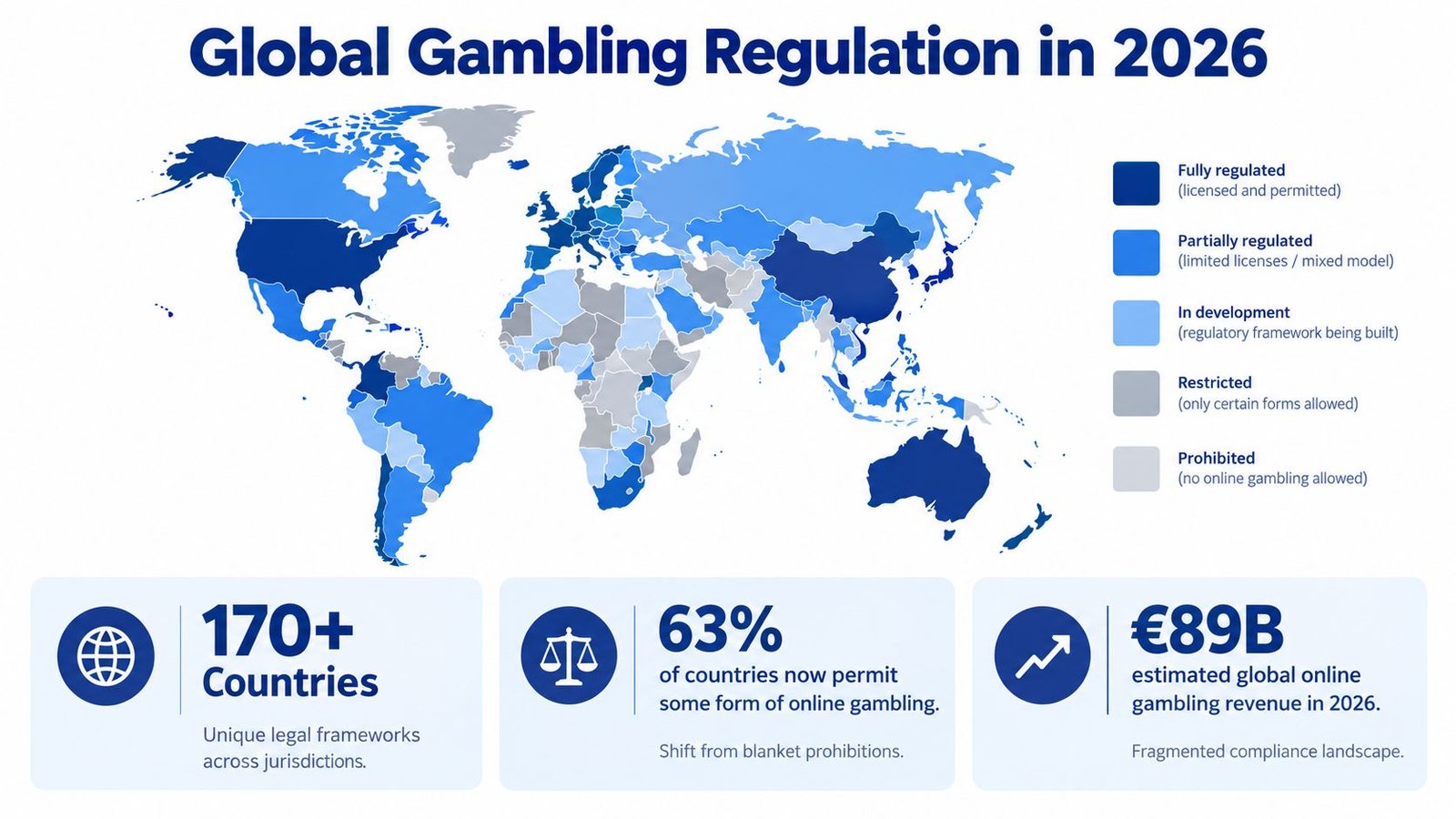
A regulated market may require a local entity, approved technology, national self-exclusion integration, restricted advertising, transaction monitoring, and detailed responsible-gambling controls. These obligations can reduce margins even where demand is strong. Gray markets may provide access to players but leave operators exposed to uncertain enforcement, payment disruption, and licensing risk. Prohibited markets can create fines or criminal liability despite offshore websites remaining technically reachable.
Why country-level analysis remains essential
The United States is not one operating environment. Each state may apply different product permissions, licensing standards, tax designs, supplier rules, and enforcement expectations. European markets show the same issue in another form. The United Kingdom, Netherlands, and Germany all regulate online gambling, yet their tax bases, responsible-gambling tools, advertising restrictions, and technical monitoring requirements differ.
Ireland also shows why implementation timing affects market planning. Remote betting operators and intermediaries move under the Gambling Regulatory Authority of Ireland from 1 July 2026, while in-person operators are scheduled to transition on 1 December 2026, according to Jumio's 2026 global regulatory overview.
Operators, affiliates, suppliers, and investors can apply this guide in three ways:
- Regional screening: Compare nearby jurisdictions before assigning market-entry and compliance resources.
- Topic-based review: Examine licensing, tax, AML, advertising, and responsible-gambling controls separately.
- Investment diligence: Test commercial viability after structural costs, reporting obligations, and enforcement exposure.
The Philippines online casino and PAGCOR framework offers a local reference for assessing how a regulator and licensing authority shape market access. Top 1 Rank uses this country-level and issue-based approach to connect legal categories with the costs that determine whether a market is investable.
How Gambling Markets Are Categorized Worldwide
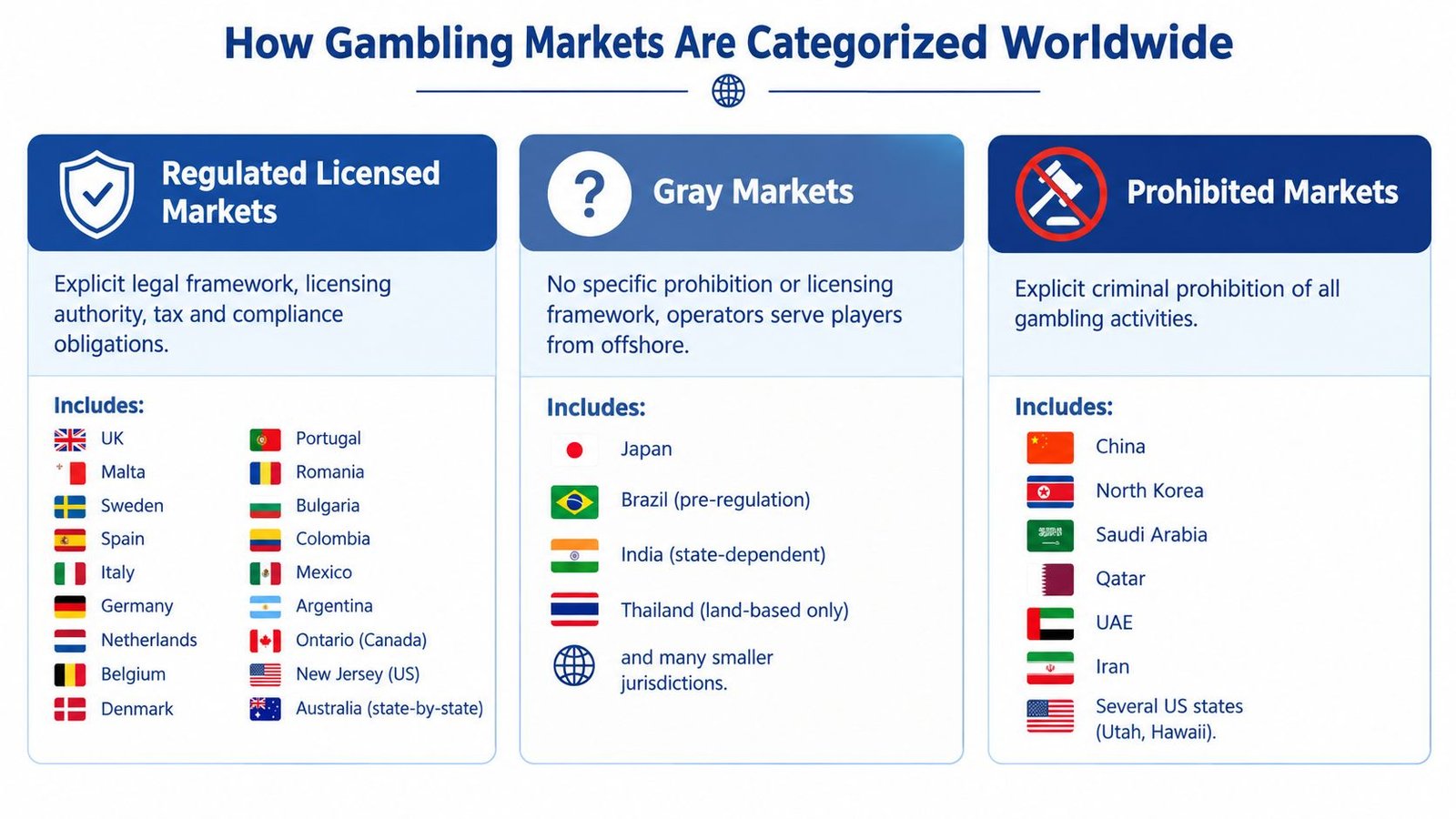
A three-part legal taxonomy is useful for comparing gambling markets: regulated licensed markets, gray markets, and prohibited markets. It provides an initial classification, but not a complete investment view. Product permissions, licensing routes, tax exposure, enforcement intensity, and treatment of offshore operators can change the commercial outcome inside any category.
The three primary categories
Regulated licensed markets have an explicit legal framework, a licensing authority, defined tax obligations, and enforceable consumer-protection requirements. The United Kingdom, Malta, Sweden, Spain, Italy, Germany, the Netherlands, Belgium, Denmark, Portugal, Romania, Bulgaria, Colombia, Mexico, Argentina, Ontario in Canada, New Jersey in the United States, and Australian state markets fit this broad model. Their commercial value still depends on the details. A license may cover only particular products, channels, applicants, or corporate structures, while tax and reporting requirements determine the cost of serving customers lawfully.
Gray markets lack either a specific prohibition or a complete licensing framework for the relevant activity. Offshore operators may serve local players, but uncertainty can affect payments, advertising, geolocation, enforcement, and investor confidence. Japan, Brazil before its regulatory transition, state-dependent India, Thailand for online activity, and many smaller jurisdictions are commonly placed in this category in broad market guides. Gray status is not informal approval. It signals that operators must test the relevant rules, enforcement practice, and expected regulatory direction before committing capital.
Prohibited markets explicitly criminalize all or certain gambling activities. China, North Korea, Saudi Arabia, Qatar, the United Arab Emirates, Iran, and several U.S. states, including Utah and Hawaii, are listed in the supplied market categorization. Offshore availability does not create a lawful market. Depending on the applicable rules, operators may face financial penalties or criminal exposure.
The secondary dimensions operators often miss
The three labels become decision-useful only after four further questions:
- Online versus land-based: A country can permit physical casinos while prohibiting online casino products, or allow betting while restricting casino games.
- Open licensing versus monopoly: Multiple private operators may qualify in one market, while another reserves activity for a state-owned operator.
- Concession versus ordinary licensing: A government may authorize a limited number of operators through tenders rather than accept every qualified applicant.
- Federal versus unitary governance: In a federal system, the national label can conceal different state or provincial rules.
A market database should therefore record product, channel, licensing route, tax base, advertising rules, and enforcement posture instead of marking a country as “legal.” This format also supports a sharper 2026 viability test. Two regulated markets may look similar on paper while producing different returns after tax, certification, reporting, and compliance costs.
The same distinctions apply to affiliates and suppliers. An affiliate promoting a licensed operator must check local advertising restrictions. A game provider may hold business-to-business approval yet require separate product certification or operator integration in each target jurisdiction. PAGCOR's B2B provider application process illustrates how supplier access can depend on regulatory classification, not only on consumer-facing authorization.
Licensing Regimes and Market Access Requirements
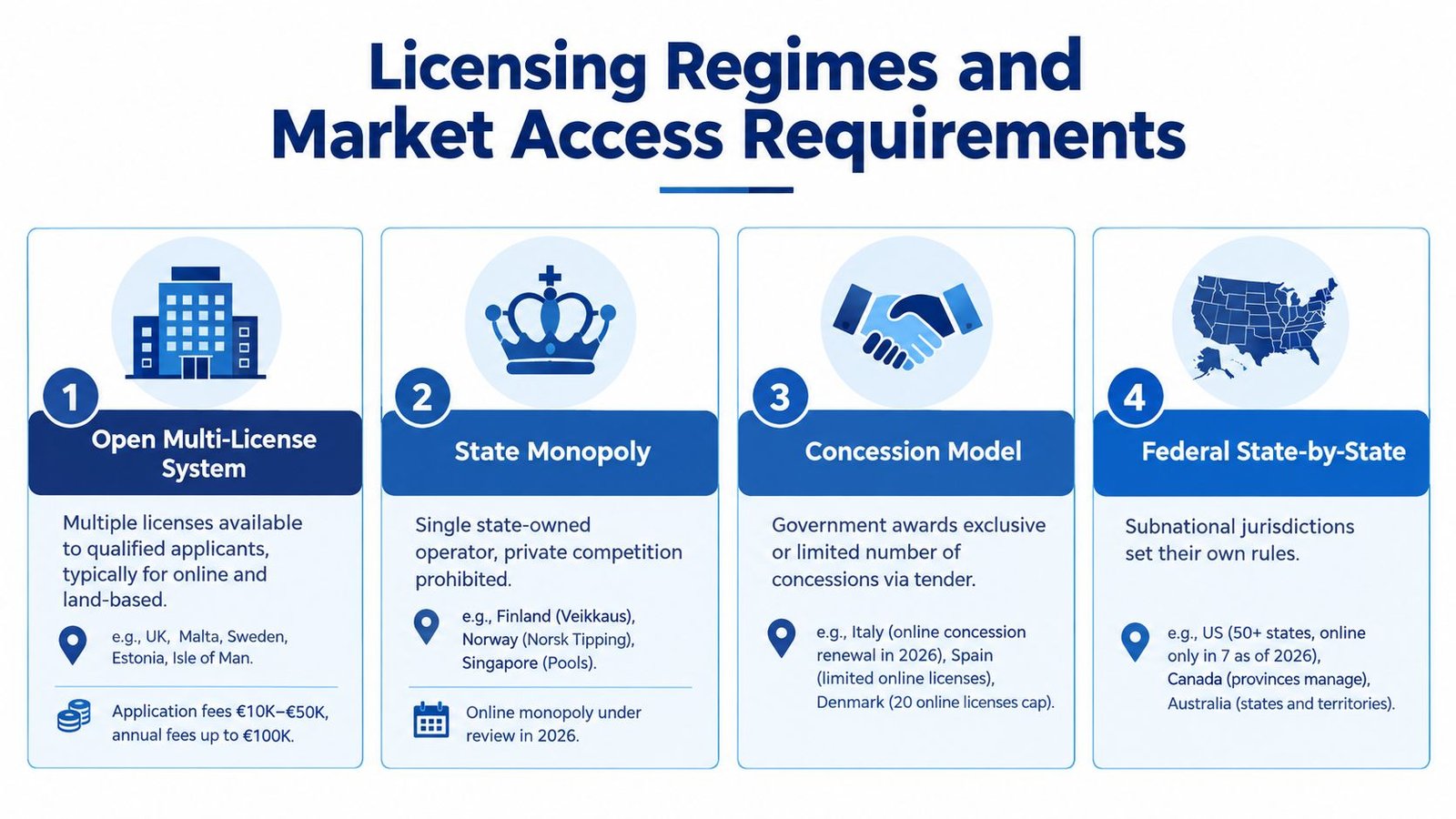
Licensing architecture determines who can enter, how much control the regulator retains, and whether a market rewards scale or exclusivity. Four models recur across the global gambling industry, although individual jurisdictions often combine elements of more than one.
Open multi-license systems
An open multi-license system allows multiple qualified applicants to compete under defined rules. The United Kingdom, Malta, Sweden, Estonia, and the Isle of Man are examples identified in the supplied licensing comparison. This model can provide broader commercial access, but it usually requires detailed corporate disclosure, fit-and-proper assessments, technical certification, responsible-gambling systems, and ongoing regulatory reporting.
For an operator, the advantage is strategic flexibility. Several brands or products can compete, and suppliers can build a broader client base. The disadvantage is that a license doesn't remove local obligations. Operators may still need approved testing, local reporting, payment controls, and marketing review before launch.
State monopolies
A state monopoly places the relevant activity with a single state-owned or state-authorized operator. Finland's Veikkaus, Norway's Norsk Tipping, and Singapore Pools are examples in the supplied comparison. Private operators face a distinctly different market-access question in these systems. They may be excluded from direct consumer operations, limited to technology or supply contracts, or required to wait for reform.
The monopoly model can reduce direct competition, but it doesn't necessarily simplify supplier diligence. A technology provider still needs to understand procurement standards, technical approval, data handling, and responsible-gambling requirements imposed by the state operator.
Concession models
A concession model gives the government authority to award exclusive or limited rights through a tender or renewal process. Italy's online concession renewal, Spain's limited online licenses, and Denmark's stated cap of 20 online licenses are examples included in the supplied comparison (licensing regime reference). Concessions can create scarcity value, but they also introduce renewal risk and dependency on tender calendars.
Federal and state-by-state frameworks
Federal systems distribute control among states, provinces, or territories. The United States, Canada, and Australia each require subnational analysis. The U.S. example is especially significant because 38 states plus Washington, D.C. had legalized some form of online gambling by April 2026, yet that doesn't create one national license or one national product regime (Cosmobet).
Market-entry diligence should therefore examine:
- Applicant structure: Local entity, ownership disclosure, directors, and beneficial owners.
- Technical readiness: Platform certification, game testing, geolocation, and audit access.
- Commercial timing: Application windows, tender dates, renewal cycles, and transitional rules.
- Operational footprint: Local staff, offices, hosting, banking, or approved service providers.
- Supplier dependency: Whether B2B providers need separate accreditation or approval.
The PAGCOR game-content provider accreditation requirements illustrate why suppliers should model accreditation as a separate workstream rather than assume that an operator license automatically covers the full technology stack.
Key 2026 Regulatory Amendments and Tax Changes
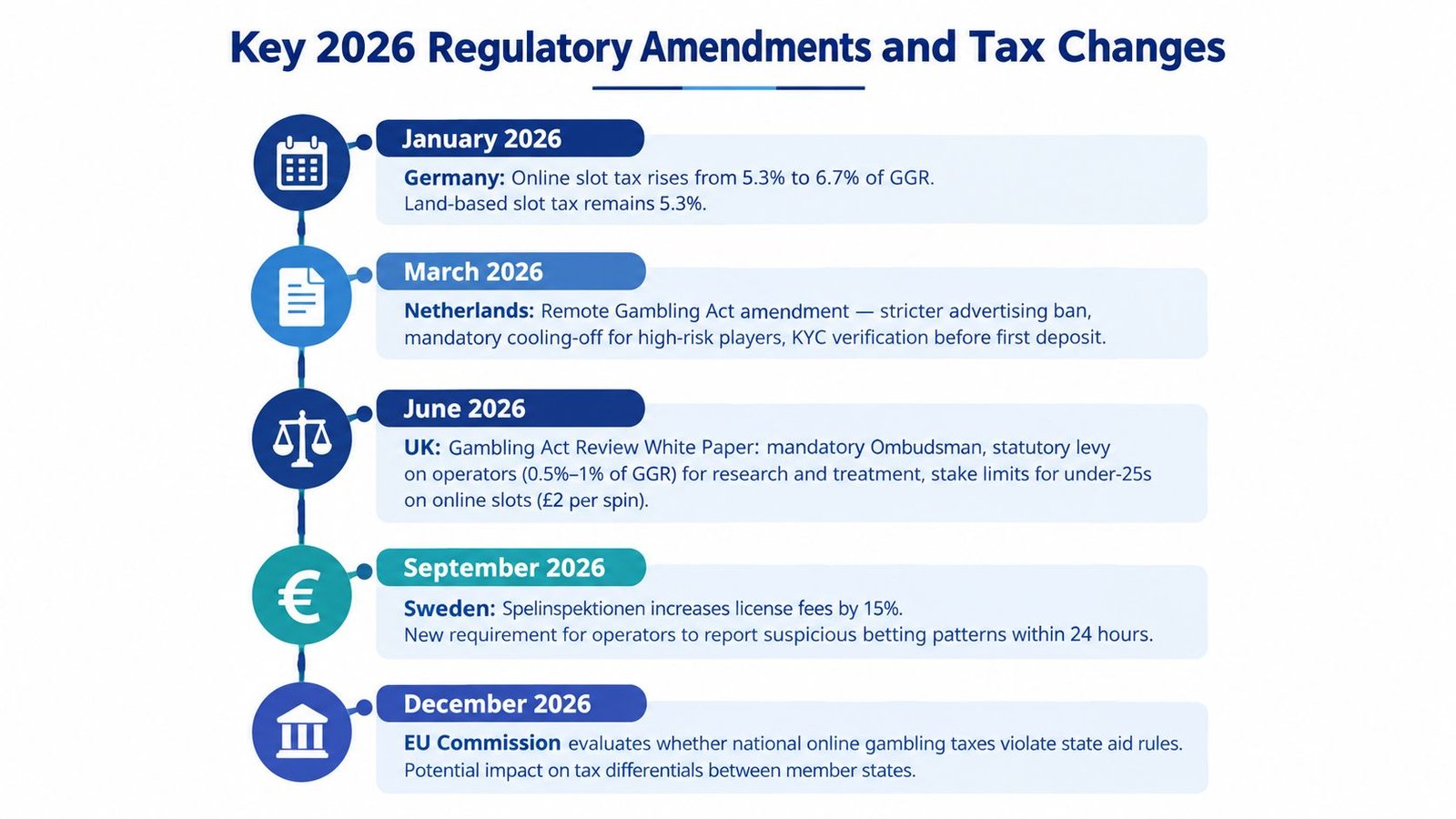
In 2026, market viability depends on the cost of operating legally, not only on whether gambling is permitted. The United Kingdom's Remote Gaming Duty is scheduled to rise to 40% in April 2026, while the Netherlands' gambling tax is reported at 37.8% from January 2026, according to the International Masters of Gaming Law's European regulatory overview. These changes make tax treatment a primary screening tool for operators and investors.
Germany demonstrates why the tax base matters as much as the rate. Its 5.3% stake-based tax covers slots, poker, and sports, while the UK's Remote Gaming Duty applies to profits. A stake-based charge reduces the economics of wagering before the operator reaches its final profit figure. A profit-based charge is more closely tied to the financial result.
Europe's tax and control pressure points
The UK combines higher duty with product and player-protection controls. The market applies a £5 slot stake cap, a £2 cap for ages 18 to 24, and participation in GAMSTOP, according to NuxGame's comparison of 2026 iGaming regulations. Operators must align product settings, age segmentation, customer journeys, and marketing processes with those requirements.
The Netherlands applies 37.8% gross gaming result tax, operates the CRUKS self-exclusion system, and bans untargeted advertising. Tax, player-protection infrastructure, acquisition limits, and reduced marketing inventory should therefore be modelled as one commercial case rather than separate compliance items.
Germany also applies a €1,000 cross-operator deposit cap and state monitoring systems. Its 2021 treaty framework is due for evaluation in December 2026, creating uncertainty for investors testing whether current market economics will persist. Operators should stress-test margins against both the existing tax base and potential changes to market controls.
New authorities and phased transitions
Ireland introduces a phased institutional transition. Remote betting operators and intermediaries move under the Gambling Regulatory Authority of Ireland on 1 July 2026, and in-person operators are scheduled to transition on 1 December 2026. The timetable does not remove the need for preparation. Firms should assign licensing ownership, responsible officers, reporting processes, and technical evidence before the relevant enforcement date.
The Ireland regulatory transition overview provides context for the sequencing, while operators in the Philippines can track related local developments through the PAGCOR regulatory updates for 2026.
India represents a broader structural reset. Its Promotion and Regulation of Online Gaming Act 2025 and accompanying Rules 2026 took effect on 1 May 2026, creating the Online Gaming Authority of India as an attached office of the Ministry of Electronics and Information Technology, according to iGaming Business.
Commercial conclusion: A legal-status database identifies eligibility. A tax-and-control model identifies survivability.
Compliance AML and Responsible Gambling Obligations
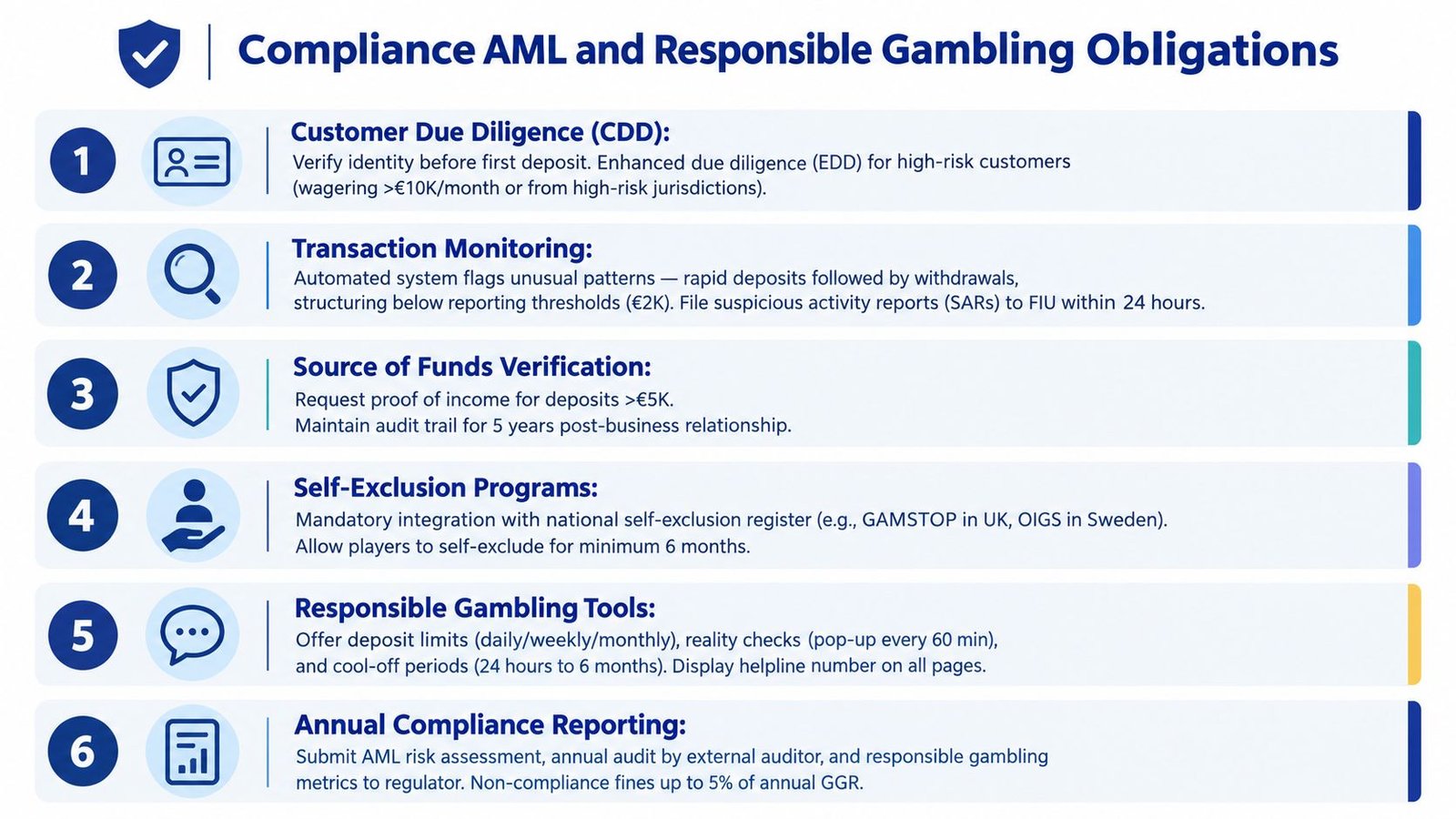
A licence grants market access, but operating viability depends on controls that can withstand regulatory testing. In 2026, those controls cover customer due diligence, payment monitoring, self-exclusion, advertising, intervention, and regulator-facing evidence.
Build the customer-control layer first
Customer due diligence should link identity, age, jurisdiction, payment method, and risk classification. Identity verification should occur before the first deposit, while higher-risk customers require enhanced checks. The supplied compliance framework identifies customers wagering above €10,000 per month and those connected with high-risk jurisdictions as examples requiring closer review.
Transaction monitoring must identify behavior, not merely log payments. Rapid deposits followed by withdrawals, attempts to structure activity below reporting thresholds, and unusual relationships between accounts should create review queues. Suspicious activity reports must then follow the relevant financial-intelligence-unit process and deadline.
Source-of-funds checks complete the financial-risk controls. Operators may require income evidence for deposits above €5,000, with an audit trail retained for five years after the business relationship, under the supplied framework. Documented escalation rules should determine when an alert moves from automated review to compliance investigation.
Responsible gambling is a product function
Self-exclusion must operate throughout the customer journey, from registration and login to payments, promotions, and support. The UK's GAMSTOP system and Germany's cross-operator controls show why an operator's internal account block may not satisfy national requirements, as noted in earlier regulatory material.
Responsible-gambling tools should include configurable deposit limits, reality checks, cool-off periods, visible support information, and intervention procedures. Product teams should test these controls across mobile, desktop, live casino, sportsbook, and customer-support channels. A control that works only in one interface creates an avoidable compliance gap.
A practical operating checklist includes:
- Identity and access: Verify identity and age before the relevant regulated activity begins.
- Risk scoring: Combine customer behavior, geography, payment signals, and account history.
- Monitoring: Investigate unusual deposits, withdrawals, wagering patterns, and linked accounts.
- Player protection: Apply self-exclusion, deposit limits, stake controls, and intervention workflows.
- Marketing governance: Suppress restricted customers and review affiliates, influencers, sponsorships, and direct marketing.
- Evidence management: Preserve decisions, alerts, source-of-funds documents, training records, and regulator submissions.
Advertising requires separate governance because national rules differ sharply. A comparative review summarized by National Elf Service describes European variation from near-total restrictions in some countries to narrower controls elsewhere. A campaign approved in one country can breach another through targeting, placement, sponsorship, or promotional wording.
For Philippine market communications, the PAGCOR gambling advertising rules provide a jurisdiction-specific reference. Operators should build those checks into campaign approval, affiliate oversight, and recordkeeping before publication, rather than rely on post-campaign review.
Country by Country Regulatory Profiles by Region
Comparing markets by regulatory behavior is more useful than treating country rules as one global list. The table separates online status, access route, and the tax or control that most directly affects viability. Tax exposure and compliance architecture are often the practical market filter, even where online gambling is formally legal.
| Region / Country | Online Status | Licensing Model | Headline Tax / Control |
|---|---|---|---|
| United Kingdom | Regulated | Open licensing | Remote Gaming Duty rises to 40% in April 2026, with slot stake controls and GAMSTOP participation |
| Germany | Regulated | State-coordinated licensing | 5.3% stake-based tax, €1,000 cross-operator deposit cap, and state monitoring |
| Netherlands | Regulated | Licensed market | 37.8% gross gaming result tax, CRUKS, and untargeted advertising ban |
| Ireland | Transitioning to a new framework | Authority-led licensing transition | Remote operators transition on 1 July 2026, in-person operators on 1 December 2026 |
| Italy | Regulated | Concession-based | Market access depends on concession and product scope |
| Malta | Regulated | Open multi-license | MGA licensing supports B2C and B2B activity |
| Sweden | Regulated | Open licensing | National controls and license obligations apply |
| Spain | Regulated | Limited licensing | Product and advertising restrictions require local review |
| Belgium | Regulated | Licensed framework | Advertising controls are a major compliance consideration |
| United States | State-by-state regulated | Federal state-by-state | 38 states plus Washington, D.C. had legalized some online gambling by April 2026 |
| Canada | Provincial regulation | Provincial authority model | Ontario operates an iGaming market regulated by AGCO |
| Brazil | Transitioning from gray status | Formalizing framework | Regulatory transition requires current local legal review |
| Colombia | Regulated | Licensed market | National licensing and consumer controls apply |
| Mexico | Regulated or permit-based by activity | Authorization and permit model | Product and enforcement analysis must be activity-specific |
| Argentina | Subnational regulation | Provincial model | Market access depends on local jurisdiction |
| India | Reformed national framework with state variation | OGAI-linked framework and state controls | New framework took effect 1 May 2026 |
| Australia | State and territory regulation | Federal restrictions with subnational administration | Online casino and poker restrictions remain central considerations |
| Japan | Gray or activity-specific | No unified online casino licensing model | Market classification requires product-level analysis |
| Philippines | Licensed framework | PAGCOR-centered model | Operators and suppliers require jurisdiction-specific approval |
| China | Prohibited for online gambling | Prohibition | Offshore availability does not establish lawful access |
| United Arab Emirates | Prohibited or tightly restricted | Prohibition and restricted activity | Operators face high enforcement exposure |
| Saudi Arabia | Prohibited | Prohibition | Market entry is not a standard licensing exercise |
| Qatar | Prohibited | Prohibition | Consumer access does not create operator authorization |
Regional patterns
Europe has the largest concentration of mature licensing systems, but the commercial result varies sharply by tax base, product controls, and advertising rules. The UK and Netherlands are regulated markets with substantial fiscal or promotional constraints. Germany's stake-based charge affects unit economics differently from a duty calculated on gaming revenue or gross gaming result. Ireland adds a timing issue because operators must plan around its staged transition rather than assume that an existing position carries forward unchanged.
These differences make regional labels insufficient for investment screening. A regulated market can still produce weak margins after tax, payments, safer-gambling controls, technical testing, and local governance are priced into the model. Conversely, a transition can create a short-term access opportunity while increasing legal, licensing, and implementation uncertainty.
North America requires state or provincial diligence. The United States has broad but fragmented legalization, so approval in one state does not establish eligibility elsewhere. Each launch requires a separate assessment of product scope, licensing, tax treatment, supplier approvals, and enforcement exposure. Canada follows a similar principle through provincial authority, with Ontario operating a distinct regulated online market under AGCO oversight.
Latin America combines established licensing with transitional and subnational systems. Colombia provides a regulated reference point, while Brazil's formalizing framework means older gray-market assumptions may no longer describe the commercial or compliance position. Argentina requires provincial analysis, so a national market thesis can conceal material differences in access and operating conditions.
Asia-Pacific is more heterogeneous than its regional label suggests. India's 2026 framework represents a major reset, while state variation still affects implementation. Australia preserves strict product distinctions, Japan requires activity-level classification, and the Philippines uses a PAGCOR-centered approval model. China and several Middle Eastern jurisdictions remain prohibited or highly restricted. Offshore targeting does not convert consumer demand into lawful market access and can increase enforcement exposure.
For operators and investors, the useful output is a country matrix rather than a legal-status label. Record the permitted product, application route, tax base, required controls, advertising position, local operating obligations, and transition date where relevant. Then compare expected net economics after those constraints. That process identifies markets where tax and compliance costs, rather than customer demand, determine whether entry is commercially defensible.
Practical Implications for Operators Affiliates and Investors
Regulation should influence capital allocation before a commercial launch plan is approved. Operators, affiliates, and investors face different immediate risks, but each group benefits from separating market legality, access mechanics, unit economics, and enforcement exposure.
Operators
Operators should rank markets by net viability rather than by legal status alone. The first screen should identify the product permitted, the relevant license or concession, the tax base, required technical controls, advertising restrictions, and the cost of local operations. The UK and Netherlands demonstrate why a regulated label can coexist with significant tax pressure, while Germany shows how a stake-based charge can affect the model differently from a profit-based duty.
A sensible sequencing model is:
- Classify the market: Regulated, gray, prohibited, or transitioning.
- Confirm product eligibility: Sports betting, casino, poker, live casino, or supplier-only access.
- Map the license path: Open application, monopoly restriction, concession, or subnational approval.
- Price compliance: AML, KYC, self-exclusion, monitoring, testing, reporting, and local staffing.
- Stress-test economics: Tax, payment friction, advertising limits, and customer-acquisition constraints.
- Set an exit trigger: Define the conditions under which renewal cost, tax, or enforcement risk makes continued operation unattractive.
Affiliates
Affiliates often underestimate their exposure because they don't hold the consumer-facing license. That assumption fails where advertising, targeting, sponsorship, influencer activity, or promotional content falls within regulated conduct. The European advertising comparison described earlier shows that neighboring countries can apply materially different restrictions.
Affiliate diligence should verify:
- Geo-targeting: Pages, campaigns, and paid traffic must exclude prohibited or unauthorized jurisdictions.
- Operator status: Promotions should refer only to operators authorized for the audience being reached.
- Claims and incentives: Content shouldn't imply guaranteed wealth, risk-free outcomes, or unrestricted access.
- Audience safeguards: Youth-facing channels and self-excluded or vulnerable audiences require strict suppression.
- Evidence: Campaign approvals, creative versions, traffic sources, and takedown records should remain auditable.
Investors
Investors should treat regulatory change as an earnings-quality issue, not a legal footnote. A target with strong gross gaming revenue can still face deterioration if tax rises, advertising narrows, or a regulator introduces cross-operator controls that raise friction and reduce activity.
Due diligence should examine:
- License durability: Renewal rights, concession timing, ownership approval, and regulatory history.
- Tax sensitivity: Whether the target's model absorbs a stake-based or profit-based tax effectively.
- Control maturity: Evidence that KYC, AML, responsible-gambling, and marketing systems operate consistently.
- Geographic concentration: Exposure to one regulator, one tax regime, or one payment corridor.
- Transition risk: Upcoming authority changes, treaty evaluations, and phased implementation deadlines.
Top 1 Rank can sit alongside regulator portals, legal counsel, compliance platforms, and internal market models as an intelligence reference for monitoring licensing, tax, technology, and operator developments. It shouldn't replace jurisdiction-specific legal advice or direct regulator confirmation.
Investment test: A market deserves scale only when legal access, operational controls, and post-tax economics all remain defensible under a downside scenario.
Quick Reference Glossary and Navigation Index
A reference guide works only when readers can locate the relevant concept quickly. The following glossary uses practical definitions for common terms in country-level gambling analysis.
Core glossary
- B2B license: Authorization for a supplier, platform, game studio, payment provider, or other business serving licensed operators.
- B2C license: Authorization to provide gambling products directly to consumers.
- Concession: A limited or exclusive right awarded by a public authority, often through tender or renewal.
- CRUKS: The Netherlands' national self-exclusion register.
- GAMSTOP: The United Kingdom's national online gambling self-exclusion system.
- Gray market: A jurisdiction where the relevant online activity lacks a clear prohibition or complete licensing framework.
- Gross gaming result: A tax base used in some jurisdictions to calculate gambling duty.
- KYC: Know-your-customer identification and verification procedures.
- OGAI: The Online Gaming Authority of India, created under India's 2026 framework.
- Stake-based tax: A charge calculated by reference to wagers or stakes rather than final profit.
- State monopoly: A system reserving specified gambling activity for a state-owned or state-authorized operator.
- Self-exclusion: A player-initiated restriction that blocks access for a defined period or under a national system.
Country navigation index
Europe: Belgium, Bulgaria, Denmark, Germany, Ireland, Italy, Malta, Netherlands, Portugal, Romania, Spain, Sweden, United Kingdom.
North America: Canada, Ontario, United States, New Jersey.
Latin America: Argentina, Brazil, Colombia, Mexico.
Asia-Pacific: Australia, China, India, Japan, Philippines, Singapore.
Middle East and restricted markets: Iran, Qatar, Saudi Arabia, United Arab Emirates.
Market-entry checklist
Before launch, teams should confirm the permitted product, licensing route, ownership disclosures, technical certification, tax base, payment controls, AML program, self-exclusion integration, advertising approval, reporting calendar, and enforcement escalation process. The checklist should also record the date of the latest legal review and the next known legislative, licensing, or treaty milestone.
For fast research, readers can pair this guide with official regulator publications, national legislation, licensing registers, specialist compliance counsel, and Top 1 Rank's ongoing coverage of gambling regulation, market intelligence, technology, and operator strategy. The most reliable workflow uses this article as a screening tool, then validates each launch decision against current primary-source requirements in the target jurisdiction.
Operators, affiliates, suppliers, and investors should use this guide as a starting point for a documented 2026 market review. Before entering or expanding in any country, assign local counsel and compliance owners to verify the current license, tax, advertising, AML, responsible-gambling, and enforcement requirements, then record the decision in a jurisdiction-by-jurisdiction risk register.





Join thousands of gaming professionals receiving the latest iGaming news, regulatory updates, and market insights.
