

An operator has shortlisted the Philippines, assembled a preliminary market model, and then discovered that the phrase Philippines gaming license hides several different regulatory routes. The decision has become more complicated because the offshore model that once shaped international perceptions of the market has been dismantled, while domestic gaming and supplier accreditation remain active areas of regulatory attention.
The practical question in 2026 isn't whether PAGCOR issues a license. It is whether the applicant is a domestic operator, a land-based business extending into approved online activity, or a B2B supplier serving licensed gaming companies. That classification determines the application path, operational scope, compliance burden, and amount of cash that must remain committed.
Table of Contents
- Why the Philippines Gaming License Question Matters in 2026
- Inside PAGCOR and the Regulatory Foundation
- License Types Operators Need to Distinguish
- Eligibility and Documentation for Applicants
- Fees, Taxes, and the Performance Cash Deposit Trap
- Compliance, AML, and Ongoing Operational Duties
- Recent Regulatory Changes and Where the Market Is Heading
- Practical Checklist and Recommended Next Steps
Why the Philippines Gaming License Question Matters in 2026
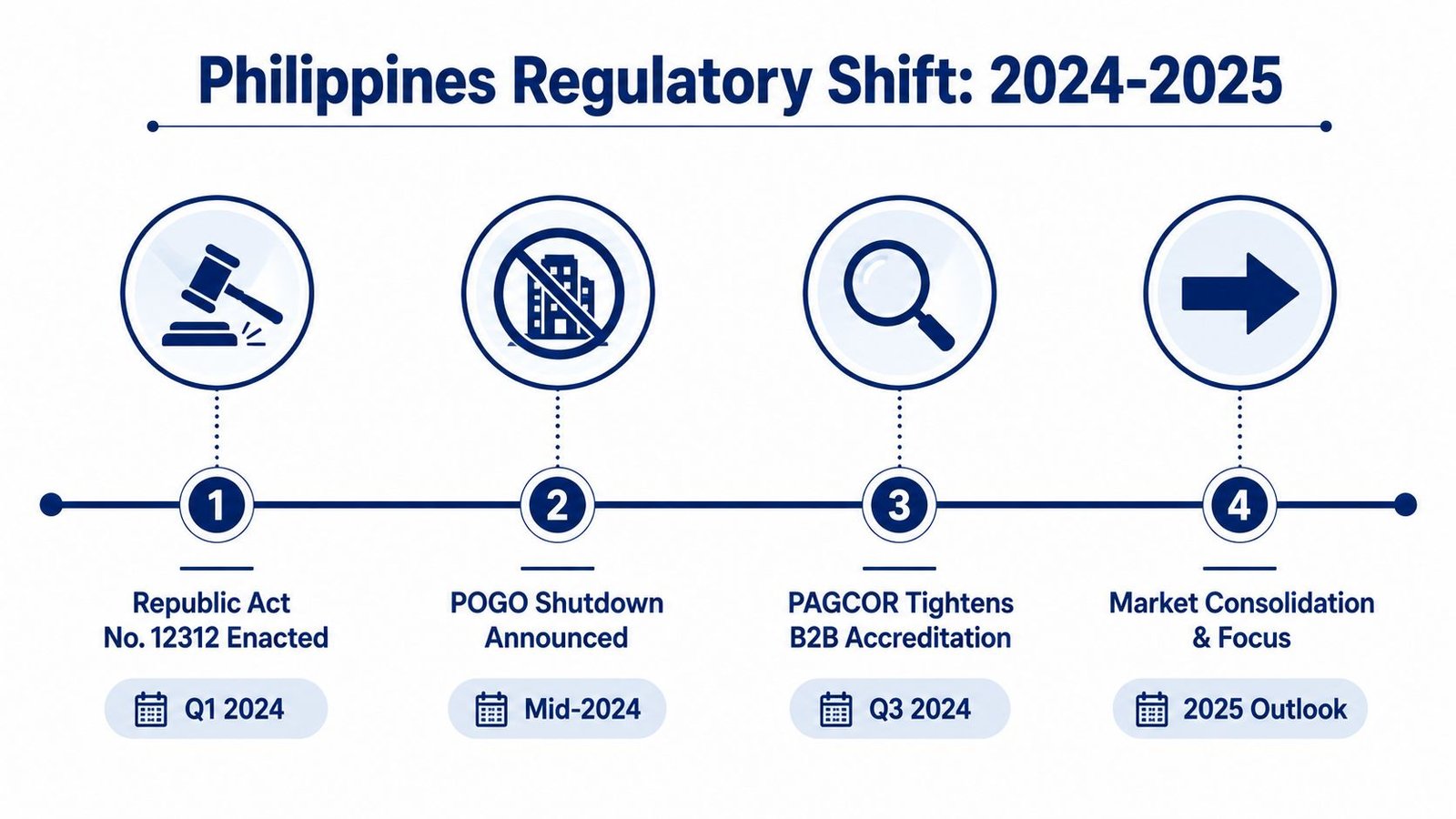
Republic Act No. 12312, signed on October 23, 2025, permanently criminalized offshore gaming operations and repealed the 2021 POGO tax law. It followed Executive Order No. 74, which required the complete cessation and wind-up of Philippine Offshore Gaming Operators and Internet Gaming Licensees by December 31, 2024.
Operators should remove the offshore export model from their plans. A Philippine authorization cannot serve as a general-purpose passport for accepting overseas players. Any business model built on that assumption is based on a route that has been closed.
PAGCOR remains the primary regulator for games of chance and licenses gaming operations within Philippine territory. Its Electronic Gaming Licensing Department oversees local activities including traditional bingo, eBingo, eCasino, sports betting, specialty games, online poker, and numeric games, as stated on PAGCOR's current electronic gaming regulatory page.
The three questions that determine the route
Applicants should settle three commercial and regulatory questions before assembling corporate documents:
- Who are the customers? A domestic-facing operator follows a different approval path from a supplier that does not contract directly with players.
- Where does the business operate? A land-based anchor, domestic online operation, and technology vendor present different regulatory profiles.
- What does the company provide? Game content, aggregation, payments, KYC, testing, and player-facing gaming may each trigger separate approval requirements.
These answers define the correct route. A domestic operator may require authorization for player-facing activity, a land-based business may need to connect approved online operations to its existing presence, and a B2B vendor may need accreditation tied to licensed gaming companies.
The Philippines gaming license is therefore a layered matrix. PAGCOR oversight covers the regulated activity, the offshore ban excludes the former export-facing model, and B2B accreditation governs suppliers supporting the remaining market.
Practical rule: Select the license category only after mapping the business model, player geography, delivery channel, and supplier relationships together.
Inside PAGCOR and the Regulatory Foundation
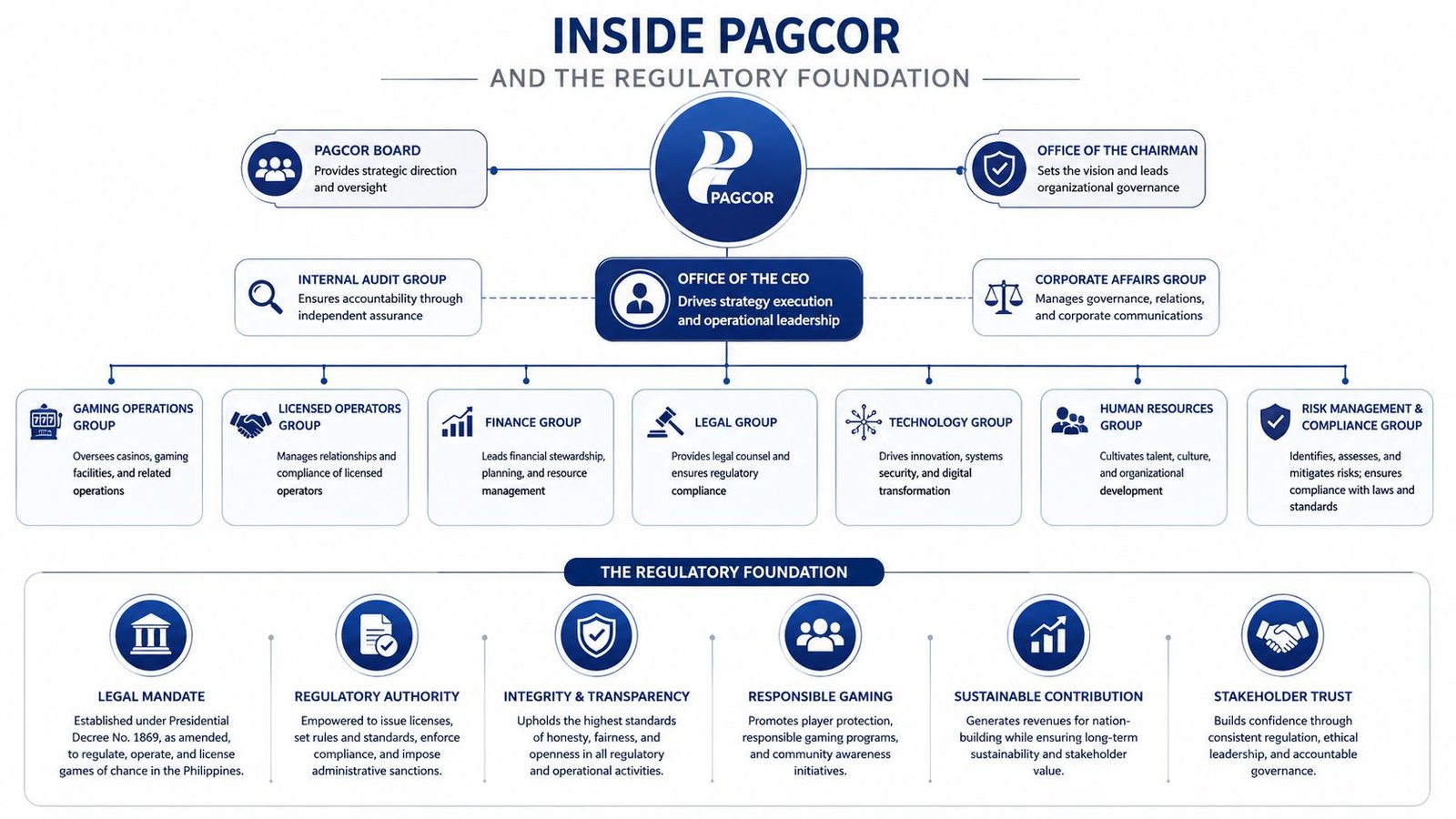
PAGCOR's authority rests on a statutory foundation rather than a simple administrative registration. Presidential Decree No. 1869 granted the corporation the right to operate and license gambling casinos, gaming clubs, and related gaming activities for a 25-year term from July 11, 2008, renewable for another 25 years, as described in the official Supreme Court eLibrary text of the decree. That framework made PAGCOR the central licensing gatekeeper for gaming operations within Philippine territory.
PAGCOR's structure matters because different business models enter through different administrative functions. The agency's regulatory materials identify the Licensing and Regulatory Group and the Internet Gaming Licensing and Regulatory Group as licensing and regulatory units. The Gaming Licensing and Development Department focuses on casino operating licenses and related regulations, according to PAGCOR's organisational overview.
Why institutional history still matters
PAGCOR has historically combined several functions, including operating gaming venues, regulating private gaming activity, and collecting gaming-related revenue. That combination explains why applicants encounter a system that evaluates commercial viability, technical controls, financial security, and regulatory fitness within the same broader authority.
The market has also included other institutional contexts, including special economic zones and the Cagayan Economic Zone Authority. Those arrangements shouldn't be confused with a current PAGCOR authorization for domestic gaming. A special-zone framework and a PAGCOR route may involve different statutory foundations, territorial assumptions, and permitted customers.
Operators reviewing Philippine online casino activity connected with PAGCOR should therefore treat the regulator's organisational labels as decision points, not background terminology. The relevant department, application documents, technical review, and operating restrictions depend on the activity being proposed.
The end of the single-label approach
Older descriptions often grouped casino operations, internet gaming, offshore licensing, and supplier relationships under one broad label. That approach is no longer reliable. The offshore manual itself defined offshore gaming as games of chance or sporting events offered by a PAGCOR licensee exclusively to offshore authorised players, with an Offshore Gaming License tied to a specific site under PAGCOR jurisdiction. It also required a Letter of Intent, forms, and attachments submitted to the Offshore Gaming Licensing Department, demonstrating that the former regime was a formal, site-based process rather than a casual online registration, as shown in PAGCOR's Offshore Gaming Regulatory Manual.
The important conclusion is straightforward. The applicant must identify the applicable PAGCOR function before it spends money on an application package.
License Types Operators Need to Distinguish
The most useful classification separates domestic land-based gaming, domestic online gaming, and B2B accreditation. The POGO category belongs in the historical analysis, not in a current expansion plan, because offshore gaming operations were permanently criminalized by Republic Act No. 12312.
| License Category | Scope of Operations | Typical Operator Profile | Capital Expectation |
|---|---|---|---|
| Domestic land-based casino | Casino gaming conducted through an approved physical operation in Philippine territory | Casino owner, integrated resort, or land-based gaming group | Capital planning must cover premises, gaming systems, staffing, compliance, and security commitments |
| Domestic online gaming | Approved online gaming products serving the permitted domestic market and operating within PAGCOR's framework | Online casino, bingo, sportsbook, poker, or numeric-games operator | Applicant must budget for corporate setup, technology, compliance infrastructure, taxes, and the applicable Performance Cash Deposit |
| B2B accreditation | Provision of approved content, aggregation, platform, payment, KYC, testing, or related gaming services to licensed operators | Game provider, platform supplier, live dealer provider, payment gateway, KYC firm, or testing laboratory | Financial expectations depend on the service and accreditation scope, with compliance controls required before commercial deployment |
Domestic land-based operations
A land-based license is tied to a physical operating model. The applicant's concerns include premises, game offering, surveillance, staffing, internal controls, and the relationship between the venue and any connected digital service. A company seeking a casino licence shouldn't assume that a land-based presence automatically authorises every online product.
Domestic online gaming
Domestic online gaming requires a narrower product and market definition. The operator needs to identify whether it will offer eCasino, eBingo, sports betting, online poker, numeric games, or another category overseen by PAGCOR's electronic gaming function.
The correct question isn't, “Can the company obtain an online license?” It is, “Which approved activity can the company conduct, for which players, through which systems, and under which controls?”
B2B accreditation
B2B suppliers are no longer an afterthought. The current layered model means game aggregators, content providers, payment gateways, KYC firms, and testing laboratories may need local accreditation before serving the regulated market. A supplier that assumes an operator's license covers its own activities creates a compliance gap at the contract and technology layer.
A supplier assessing PAGCOR game content provider accreditation requirements should map every service it delivers, including software access, game hosting, payments, player verification, and technical testing. The accreditation path may be more realistic than a B2C license, but it isn't a substitute for regulatory diligence.
Eligibility and Documentation for Applicants
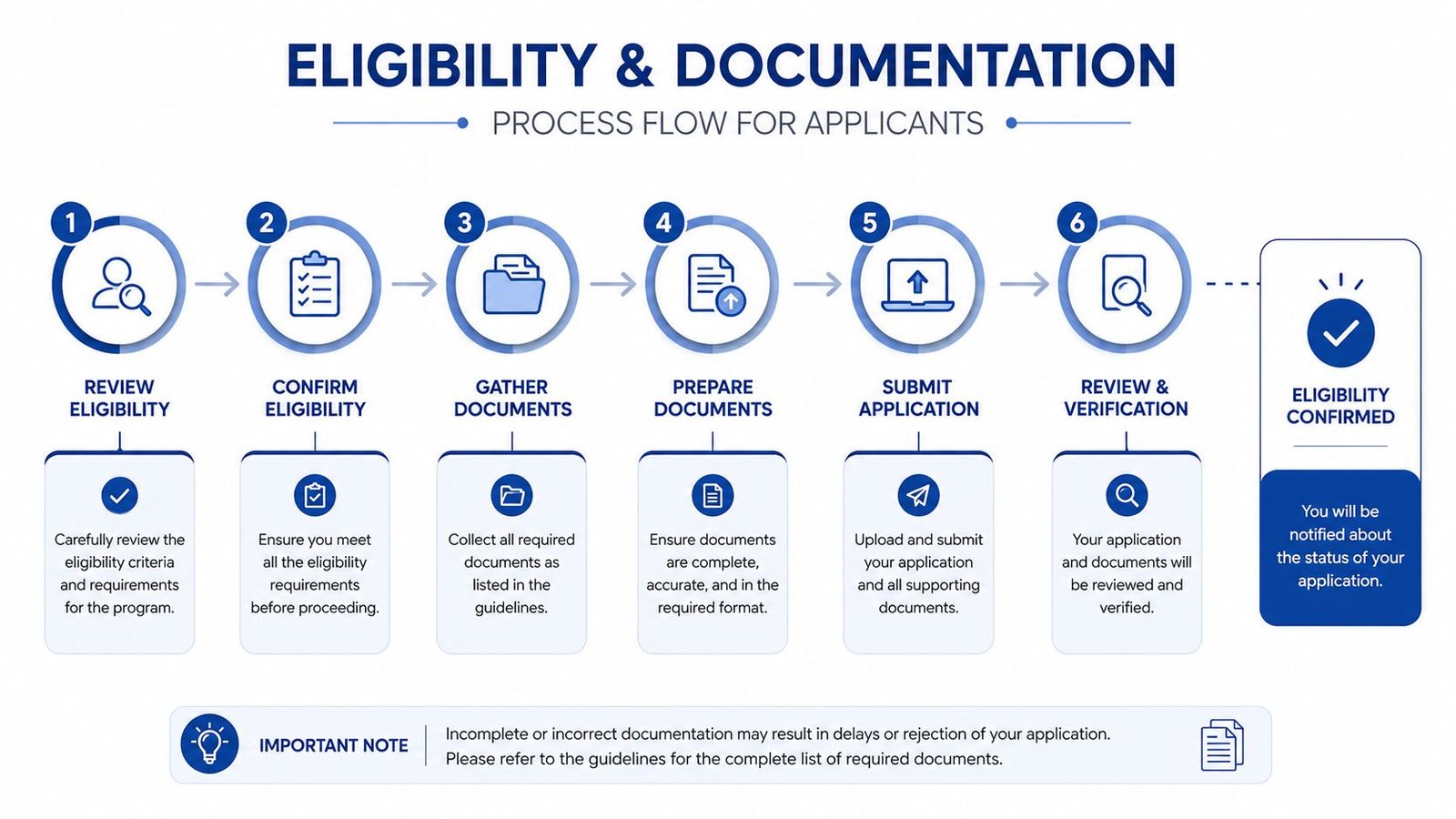
A credible application starts with the applicant's identity, ownership, governance, and source of funds. A corporate vehicle alone doesn't establish eligibility. PAGCOR will need to understand who controls the business, who manages it, how the company is funded, and whether the proposed operation can meet its technical and compliance duties.
Build the corporate and ownership file first
The expected structure may involve a Philippine-incorporated entity or a branch office, depending on the proposed activity and applicable rules. Ownership can include foreign holding companies, but the applicant still needs a transparent controlling-shareholder structure and a complete beneficial ownership disclosure.
The core pack should be assembled as a controlled document project:
- Corporate records: SEC certificates, articles of incorporation, board and ownership records, and relevant BIR registrations.
- Financial evidence: Audited financial statements, capital proof, source-of-funds material, and the financial model supporting the proposed operation.
- Individual due diligence: Background investigation forms, NBI clearances, and police clearances for foreign principals.
- Ownership transparency: A notarised beneficial ownership disclosure that connects the operating entity to the individuals and entities controlling it.
- Operational evidence: Business plans, technical descriptions, internal controls, responsible gambling procedures, and supplier arrangements appropriate to the license category.
The fit-and-proper assessment applies to directors, officers, controlling shareholders, and other key individuals whose role gives them influence over the operation. The company should resolve inconsistencies before filing. A missing document is inconvenient. An unclear ownership chain can undermine the application itself.
Screen for disqualifying risks
Applicants should investigate prior gaming-related convictions in any jurisdiction, unresolved tax liabilities, and directors or beneficial owners flagged on AML watchlists. These checks belong at the start of the project, not after the application has been drafted.
The compliance function should also verify that the proposed server-hosting, payments, KYC, and testing arrangements match the activity being licensed. A supplier entering through the PAGCOR B2B provider application process needs the same discipline around ownership, management, technical capability, and integrity.
The documentation phase can require 60 to 90 days before PAGCOR's review clock starts, based on the practical application workflow described in the brief. That period should be treated as a planning assumption rather than a guaranteed regulator timeline. Corporate setup, KYC collection, capital proof, technical evidence, and internal approvals should be completed before formal filing.
Fees, Taxes, and the Performance Cash Deposit Trap
Headline licensing fees rarely show the full financial burden. The more important question is how much cash the operator must commit before revenue becomes predictable, particularly when PAGCOR requires a Performance Cash Deposit, or PCD, as security against non-compliance.
The PCD amount is set per game offering. PAGCOR's current framework lists Php 500,000 for traditional bingo, Php 1,000,000 for electronic bingo, Php 500,000 for electronic casino games, and Php 200,000 for sports betting, according to the official PAGCOR framework for fees and rates.
| License Class | Application Fee (PHP) | Monthly GGR Share | Performance Cash Deposit | Franchise Tax |
|---|---|---|---|---|
| Traditional bingo | Must be confirmed for the specific application | Must be confirmed for the specific activity | Php 500,000 | Must be confirmed under the applicable tax treatment |
| Electronic bingo | Must be confirmed for the specific application | Must be confirmed for the specific activity | Php 1,000,000 | Must be confirmed under the applicable tax treatment |
| Electronic casino games | Must be confirmed for the specific application | Must be confirmed for the specific activity | Php 500,000 | Must be confirmed under the applicable tax treatment |
| Sports betting | Must be confirmed for the specific application | Must be confirmed for the specific activity | Php 200,000 | Must be confirmed under the applicable tax treatment |
Why the PCD changes the model
The PCD isn't an ordinary operating expense. It is locked-up cash, held in advance as a compliance bond, and that reduces liquidity available for marketing, player acquisition, payout float, staffing, technology, and vendor payments.
The deposit is set by game offering, so a multi-product plan requires careful confirmation of the applicable schedule and the treatment of each offering. The business should also understand the conditions governing release, replenishment, or retention before it treats the deposit as recoverable working capital.
Financial warning: A license model that funds the application fee but ignores the PCD isn't a licensing budget. It's an incomplete cash-flow forecast.
Tax modelling requires the same caution. Operators need professional advice on the applicable franchise tax, gross gaming revenue treatment, VAT exposure on non-gaming activity, documentary stamp tax on chips, withholding tax on payouts to foreign winners, and local franchise fees charged by host local government units. Those obligations can vary with the license class, operating structure, product, and transaction.
The PAGCOR B2B accreditation fee framework should be assessed separately from a B2C operating model. A supplier may avoid player-facing costs while still carrying accreditation, technical, contractual, AML, and audit obligations. The right budget includes cash security, recurring regulatory charges, tax, compliance staff, testing, reporting, and contingency reserves.
Compliance, AML, and Ongoing Operational Duties
A PAGCOR license creates a continuing operating relationship with the regulator. Approval doesn't end the compliance project. It converts the project into a daily control environment covering player protection, AML, reporting, technology, advertising, and supplier oversight.
Player protection is an operating function
Casino operators should prepare for a responsible gambling framework that includes self-exclusion registers, problem-gambling signage, and a designated Player Protection Officer. These controls must connect to customer service, account management, marketing, payments, and incident escalation.
The framework should answer practical questions:
- Who can place a customer on a self-exclusion register?
- How does the operator prevent reactivation?
- Which team receives a problem-gambling escalation?
- How are advertising campaigns screened for vulnerable audiences?
- What records demonstrate that the control worked?
AML controls need ownership
Under the Anti-Money Laundering Act as amended, the operator needs customer due diligence, suspicious transaction reporting, record retention for five years, and a Compliance Officer who reports to senior management. The Anti-Financial Account Scamming Act framework adds further importance to suspicious-account and transaction monitoring.
The Compliance Officer should have authority, staffing, escalation access, and a documented reporting line. A policy stored in a shared folder won't satisfy the underlying need for transaction monitoring, risk classification, case management, and evidence of decisions.
Technical and territorial controls
Licenses operate within defined territorial and product boundaries. Operators must prevent wagers from outside approved jurisdictions and ensure advertising reflects the permitted market. Gaming systems also require technical controls, including RNG certification and testing through recognised laboratories such as GLI or iTech Labs where applicable.
PAGCOR's Monitoring and Enforcement Group can identify failures through inspections, reporting, technical findings, or compliance reviews. Consequences may escalate from warning letters and fines to suspension or revocation.
Recent Regulatory Changes and Where the Market Is Heading
An operator that built its plan around offshore players now faces a closed route. Executive Order No. 74 required POGO and Internet Gaming Licensee operations to cease and wind up by December 31, 2024. Republic Act No. 12312 later permanently criminalized offshore gaming operations and repealed the 2021 POGO tax law. The practical conclusion is direct: a Philippines gaming license must be assessed against a domestic, land-based, or approved supplier model, not treated as a general permit for offshore acquisition.
PAGCOR's framework also gives the companies supporting licensed operations greater regulatory weight. Game suppliers, aggregators, payment providers, KYC firms, and testing laboratories can affect player protection, AML exposure, system integrity, and reporting accuracy. Their accreditation, ownership, technical role, and allocation of compliance responsibility belong in the application and vendor review.
The likely direction for operators
The market will favour operators that can show:
- Transparent ownership: Regulators and partners need a clear view of control and beneficial ownership.
- Domestic alignment: The product, player base, marketing, and operational footprint must fit the permitted local model.
- Supplier accountability: Each critical vendor needs documented regulatory status and a defined responsibility for controls and reporting.
- Financial resilience: The operator must fund security deposits and ongoing compliance without relying on aggressive early acquisition spending.
- Control maturity: AML, responsible gambling, technical testing, data governance, and reporting should be operational before launch.
According to PAGCOR figures, the licensed online gaming sector generated Php69 billion in license fees from January to July 2025. The figure confirms commercial activity, not unrestricted access. The opportunity remains inside a narrower regulatory perimeter, and category selection determines whether an operator can enter it.
Operators reviewing PAGCOR regulatory updates for 2026 should track category-specific changes rather than rely on broad market headlines. Domestic operators, land-based businesses extending into approved digital activity, and compliant B2B suppliers have a clearer planning basis than businesses built around the prohibited offshore model.
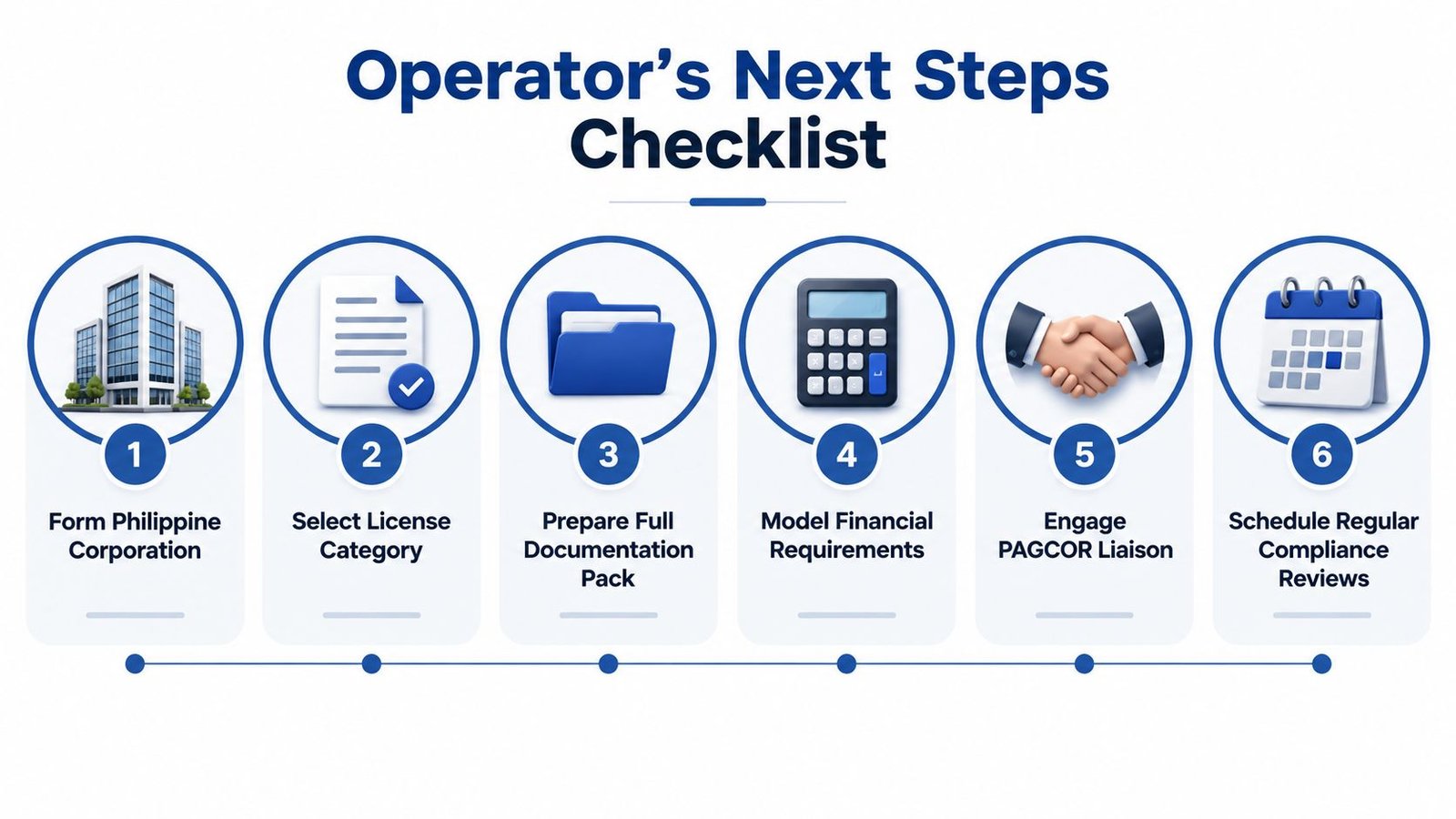
Practical Checklist and Recommended Next Steps
A serious applicant should run the project as a controlled launch programme, not as a fee-paying form submission. The first decision is classification. The company needs to determine whether it will operate domestically, extend a land-based business into approved digital activity, or provide B2B services to licensed operators.
A disciplined 90-day preparation plan
Pre-application diligence: Confirm ownership, directors, beneficial owners, corporate form, tax position, source of funds, and any prior regulatory or criminal issues.
Category selection: Define the exact game or service offering. Avoid applying for a broad concept such as “online gaming” without identifying the relevant PAGCOR category.
Documentation build: Collect SEC records, BIR registrations, audited financials, background forms, clearances, beneficial ownership disclosures, business plans, technical materials, and compliance policies.
Financial model: Include the applicable PCD, licensing charges, tax exposure, local fees, testing, staffing, technology, reporting, and payout liquidity. The deposit must appear as committed cash, not as an ordinary expense.
Formal filing and review: Submit a complete package through the appropriate PAGCOR function and maintain a response log for regulator questions, document requests, and technical clarifications.
Pre-launch readiness: Test KYC, AML monitoring, self-exclusion, responsible gambling escalation, complaints handling, reporting, security, game integrity, and supplier controls before accepting activity.
Common rejection or delay triggers include incomplete beneficial ownership disclosure, weak server-hosting arrangements, inadequate source-of-funds evidence, unresolved tax issues, and an absent responsible gambling framework. These are fixable only when identified early.
A local gaming lawyer or regulatory adviser should validate the route before incorporation and filing. The applicant should also open dialogue with PAGCOR's relevant licensing unit, confirm the current category requirements, and maintain a compliance budget after approval. Top 1 Rank can be used as one source of regulatory and market intelligence alongside official PAGCOR materials, local counsel, technical testing providers, and AML specialists.
The next action should be a written route assessment. It should name the proposed product, player market, corporate applicant, critical suppliers, PAGCOR category, PCD exposure, and unresolved legal questions. If that document can't be completed clearly, the business isn't ready to file.
Operators should commission a Philippines gaming license feasibility review before committing capital to incorporation, technology, or marketing. The review should test the business model against the current domestic, land-based, and B2B pathways, verify the applicable PAGCOR requirements, and produce a documented compliance and cash-flow plan for the intended launch.





Join thousands of gaming professionals receiving the latest iGaming news, regulatory updates, and market insights.
