

Philippine gaming entered 2026 with PHP396.14 billion in total gross gaming revenue, up from PHP372.33 billion in 2024. Electronic and online gaming generated PHP201.12 billion, an increase of 30.04%, and contributed more than half of industry revenue, according to PAGCOR's reported 2025 gaming results. The central question for operators and investors is no longer whether demand exists. It's whether licensed businesses can convert that demand profitably while absorbing a stricter compliance regime.
The Philippines iGaming market outlook 2026 is therefore best read as a regulatory-throughput story. Licensing capacity, minimum guaranteed fees, identity verification, advertising controls, payment restrictions, and enforcement intensity will determine which companies scale and which companies leave. Top 1 Rank's analysis treats revenue as the outcome and regulation as the variable doing most of the work.
Table of Contents
- The 2026 Pivot for Philippines iGaming
- PAGCOR's Regulatory Arc and Market Authority
- How the New Compliance Stack Rewrites Unit Economics
- Revenue Forecasts Between Normalization and Contraction
- Payment, Affiliate, and Product Models That Still Work
- M&A, Investment, and Competitive Positioning
- Strategic Playbook for Operators, Affiliates, and Investors
The 2026 Pivot for Philippines iGaming
The Philippines recorded PHP396.14 billion in total gaming GGR in 2025, including PHP201.12 billion from electronic and online gaming, according to PAGCOR's published industry figures. In the first half of that year, total GGR reached PHP214.75 billion, while electronic gaming generated PHP114.83 billion, or 53.47% of the total.
Those figures establish electronic products, particularly e-games and e-bingo, as the market's main revenue engine. They do not, however, guarantee equivalent profit growth. In 2026, operators must convert demand through licensed payment channels, identity verification, advertising controls, and sufficient transaction volume to absorb compliance costs.
Analyst view: The binding constraint in 2026 is likely to be regulated throughput, not consumer interest.
Forecast dispersion reinforces that interpretation. PAGCOR had previously projected PHP450 billion to PHP480 billion in 2025 GGR, while later outlooks indicated a possible 19% decline in 2026. S&P Global projected a 7% decline after 6% growth in 2025, as reported by Manila Bulletin's coverage of the tightening online gaming environment. The estimates use different assumptions, but they converge on a consolidation scenario. Electronic gaming can remain dominant while the addressable, compliant operator base contracts.
Philippines iGaming headline numbers
| Metric | Value | Note |
|---|---|---|
| Total Philippine gaming GGR in 2025 | PHP396.14 billion | Up from PHP372.33 billion in 2024 |
| Electronic and online GGR in 2025 | PHP201.12 billion | Up 30.04%, more than half of total GGR |
| First-half 2025 total GGR | PHP214.75 billion | Up 26% year on year |
| First-half electronic gaming GGR | PHP114.83 billion | 53.47% of first-half total |
| S&P Global 2026 outlook | 7% decline | Regulatory tightening is a key factor |
| PAGCOR 2026 outlook | Possible 19% decline | Forecast cited at roughly PHP320 billion to PHP350 billion |
For operators, the relevant dashboard is operational rather than promotional. Approval rates, verified deposits, payment completion, compliant acquisition cost, and revenue by licensed product show whether demand is converting under the new rules. Investors should assign greater weight to licence quality and compliance-stack scalability than to registrations or traffic alone. The market's next winners are likely to be those that process regulated volume consistently, not those that attract the most players.
PAGCOR's Regulatory Arc and Market Authority
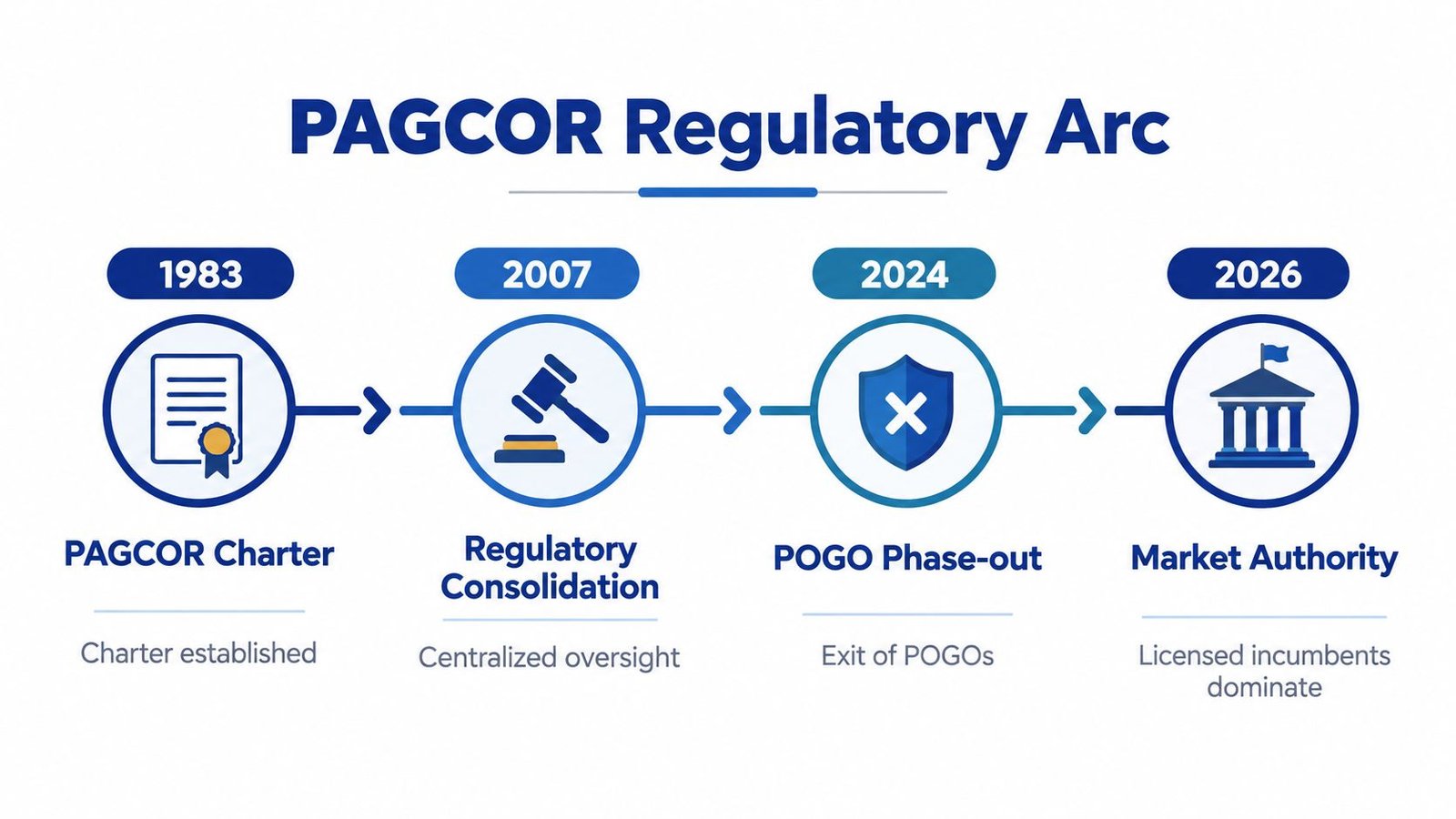
PAGCOR's institutional mandate spans more than four decades. Created under Presidential Decree 1067-A, the agency received a broader charter through Presidential Decree 1869 in 1983 and had its corporate life extended by 25 years under Republic Act No. 9487 in June 2007, according to the official PAGCOR profile from the Governance Commission for GOCCs. Its combined role as regulator and operator placed it at the center of Philippine gaming. In 2026, that history matters because regulatory execution, rather than player demand alone, determines how much activity can remain inside the licensed market.
The offshore model has been removed from the legal growth equation. Executive Order No. 74 directed POGO operations to cease and existing offshore licensing to wind down by 31 December 2024. Later statutory action reinforced the prohibition, as described in the Philippines offshore gaming compliance overview. The result is a narrower market perimeter, with greater importance attached to domestic licensing, traceable payments, approved suppliers, and documented ownership.
Why PAGCOR is the market's central variable
PAGCOR affects operator economics through four linked control points:
- Accreditation throughput: A moratorium on new accreditation, local accreditation requirements for B2B suppliers, and tighter approval standards restrict how quickly new capacity can enter, according to the Chambers Philippines gaming law guide.
- Compliance interpretation: KYC, anti-money-laundering procedures, advertising rules, and payment restrictions shape onboarding speed, retention, and the usable size of the acquisition funnel.
- Fee architecture: Minimum guaranteed fees create a fixed obligation before operators have fully optimized product mix or volume.
- Enforcement intensity: The closure of offshore operations shows that licensing status defines an operating boundary. It is not merely a formal credential.
Operators reviewing PAGCOR regulatory updates for 2026 should measure approval cadence, documentation requirements, payment connectivity, and enforcement consistency. A licence can carry limited economic value if its associated controls delay deposits, constrain acquisition, or increase the cost of serving verified customers.
PAGCOR's authority has therefore shifted from broad sector administration toward active control of the licensed value chain. Incumbents with mature controls and reliable reporting have a clearer path to regulated volume. Businesses dependent on rapid entry, opaque ownership, or offshore traffic face consolidation pressure, even where underlying player demand remains available.
How the New Compliance Stack Rewrites Unit Economics
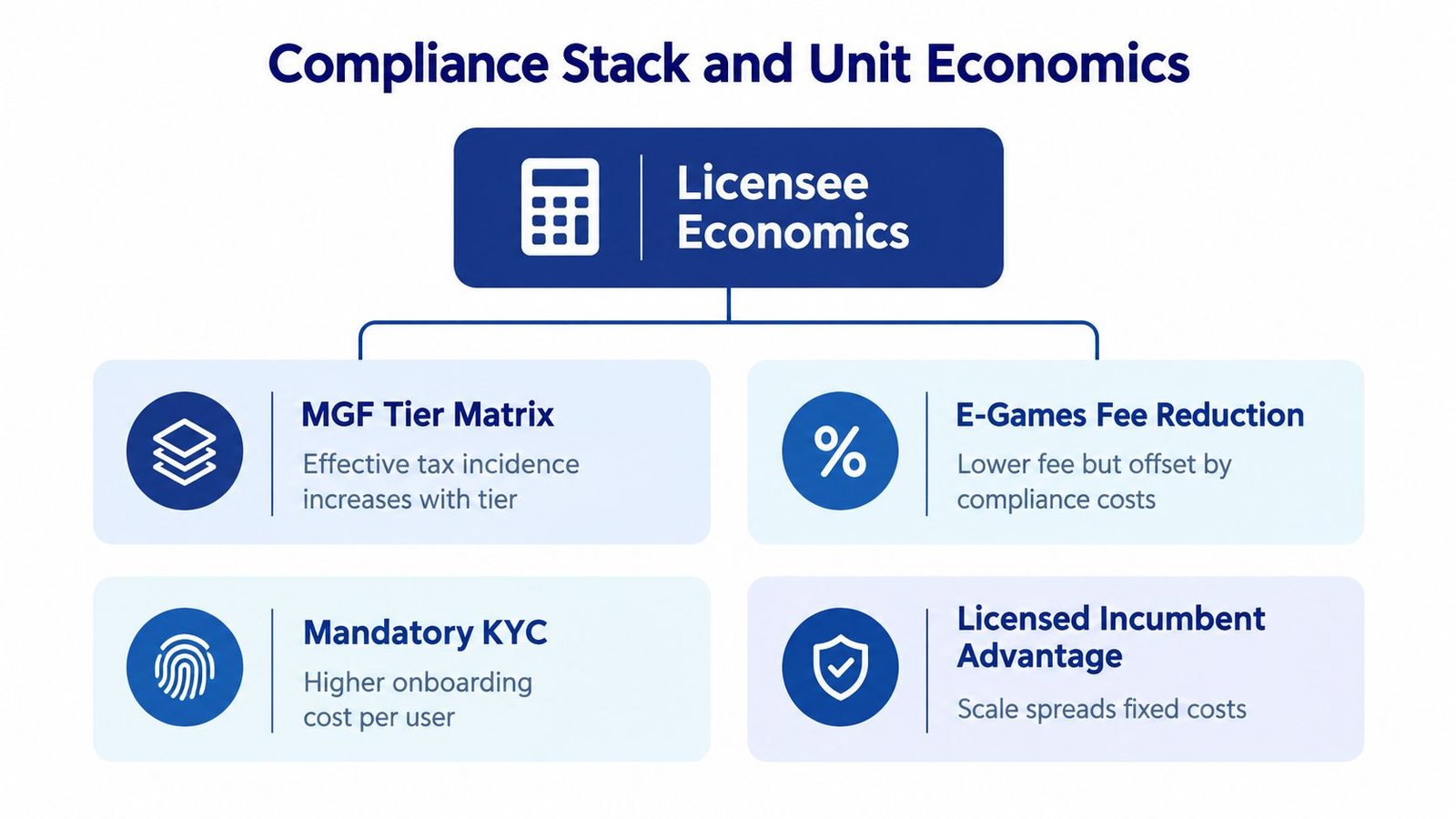
Philippine licensees now price four linked constraints into every customer: guaranteed fees, verification, marketing access, and payment capacity. The relevant question for 2026 is not the headline levy alone, but how much compliant revenue each layer permits an operator to retain.
The first fixed obligation is the Minimum Guaranteed Fee regime. For the period beginning 1 April 2026, eCasino operators must pay PHP9 million monthly against a PHP30 million minimum GGR, while non-eCasino operators pay PHP3 million monthly against PHP15 million minimum GGR. From 1 October 2026, those thresholds are scheduled to rise to PHP10.5 million against PHP35 million for eCasino operators and PHP4 million against PHP20 million for non-eCasino operators, according to the Chambers comparison of PAGCOR's MGF framework.
Four mechanics operators need to model
MGF exposure sets the floor. A subscale operator carries a larger fixed burden relative to actual revenue because the fee is measured against a minimum base. That raises breakeven requirements and favors products capable of generating repeat activity.
The e-games fee reduction improves gross economics, subject to operating costs. PAGCOR reduced the e-games fee to 30% of GGR from 1 January 2025, with a 25% rate for integrated-resort licensees, as detailed in PAGCOR license requirements and fee coverage. The lower rate can support margins, but identity checks, fraud controls, advertising review, payment monitoring, and customer support still determine the net result.
KYC adds cost at account creation. PAGCOR's tighter process requires government identification and a real-time selfie. Verification affects more than compliance staffing. It can reduce conversion, increase support demand, expose fraud losses, and lengthen the time before a customer becomes active.
Marketing and payment controls narrow acquisition choices. Digital advertising rules restrict channels for operators and affiliates, while e-wallet restrictions can reduce payment throughput. High-volume acquisition models therefore face greater pressure than brands with direct payment integrations and retention systems built around verified customers.
Practical rule: A lower statutory fee does not guarantee better net economics if verification, payment, and acquisition costs rise faster than GGR.
Scale now has a direct cost advantage. Mature KYC and fraud systems can support several products, whereas a smaller operator may absorb similar requirements across fewer revenue streams. Suppliers reviewing PAGCOR B2B accreditation fees should model accreditation alongside recurring controls, payment operations, and customer servicing, rather than treating the application expense as the full entry cost.
Revenue Forecasts Between Normalization and Contraction
The available forecasts describe a market under pressure, but they don't prove that electronic gaming is losing its structural importance. PAGCOR reported PHP87.60 billion in Q1 2026 GGR, down 15.87% from PHP104.12 billion in Q1 2025, while electronic gaming remained the largest contributor, according to PAGCOR's official site. The more useful interpretation is that revenue may be normalizing within a market whose channel mix remains online-led.
S&P Global's projected 7% decline and PAGCOR's possible 19% decline imply different degrees of contraction. They shouldn't be blended into a single forecast. Instead, they define a range of outcomes shaped by compliance execution, payment access, and the ability of licensed operators to replace volume that previously depended on offshore or lightly controlled channels.
Three scenario frames
| Scenario | Total gaming revenue in 2026 | Online share | Year-on-year change |
|---|---|---|---|
| Conservative | PHP320 billion to PHP350 billion | Remains the largest segment | Possible 19% decline |
| Base | Below 2025 levels | Electronic gaming remains dominant | Possible 7% decline |
| Upside | Recovery toward prior PAGCOR outlook levels | Online-led mix persists | Normalization rather than a sharp contraction |
The conservative case assumes that e-wallet restrictions, tougher KYC, advertising controls, and the removal of offshore volume reduce monetization faster than licensed operators can adapt. The base case assumes channel substitution. Revenue moves away from weaker or non-compliant participants but remains concentrated in electronic gaming, producing a smaller market with stronger incumbents.
The upside case requires operational improvement rather than a sudden demand shock. Operators would need to preserve payment completion, improve compliant acquisition, and use product breadth to offset weaker performance in restricted channels. It doesn't require online gaming to lose its leadership. It requires licensed businesses to capture enough of the remaining demand to stabilize the sector.
The key forecasting error would be treating a revenue decline as evidence that the online model has failed. Q1 performance points to pressure, but the electronic segment's continued position as the largest contributor shows that the primary issue is who can monetize demand under the new rules. Investors should separate market contraction from share transfer.
Payment, Affiliate, and Product Models That Still Work
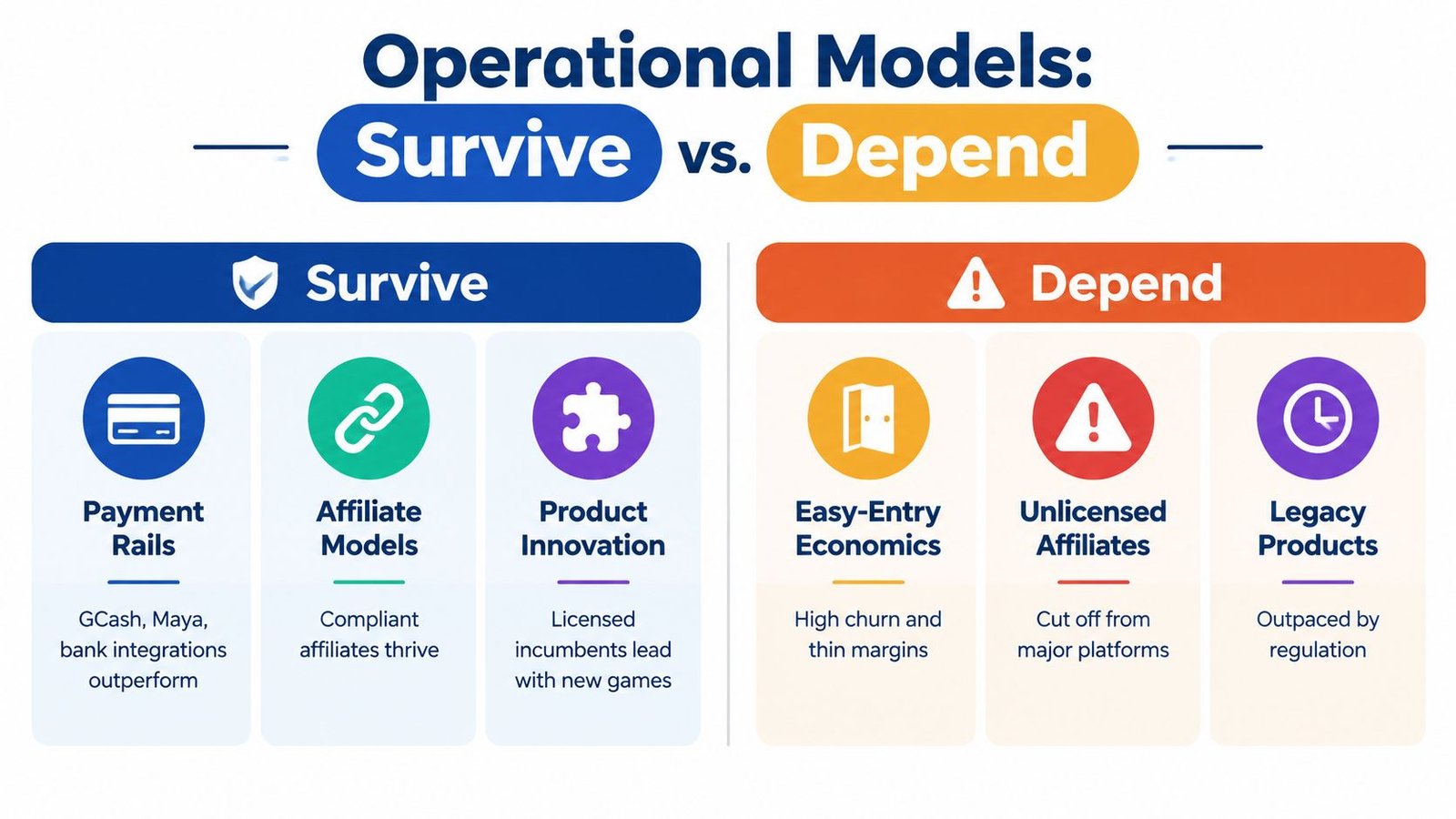
Regulatory throughput now determines whether payment, affiliate, and product models generate durable revenue. Operators must connect verified onboarding, traceable transactions, compliant promotion, and retention. A strong casino product can underperform if deposits or withdrawals fail, while an affiliate can create liability when its traffic depends on restricted advertising.
Payment rails
GCash, Maya, and direct bank integrations provide a clearer operating base than payment stacks built around opaque or crypto-heavy routes. Regulated operators need transaction records, identity alignment, dispute handling, and monitoring that can withstand regulatory scrutiny.
Approval rates are only one measure. Operators should test whether each rail verifies account ownership, supports responsible-gambling controls, permits accurate reconciliation, and delivers dependable withdrawals. A fragmented stack may expand deposit options while creating gaps between payments, KYC, fraud review, and customer records. Guidance on GCash withdrawals at Philippine online casinos can also inform how payment instructions affect customer trust and conversion.
Affiliate models
Mass-market bonus arbitrage fits poorly with advertising restrictions and stricter KYC. Localized content, visible license information, responsible-gambling messaging, and traffic sent to licensed operators offer affiliates a more defensible acquisition model.
Product diversification can reduce dependence on one traffic source. Casino, sports betting, bingo, and esports content each require promotion of products holding valid authorization, so expansion does not remove the need for vertical-level compliance. The affiliate advantage is qualified traffic that does not create avoidable regulatory exposure, rather than volume alone.
Product configurations
Live dealer, bingo variants, and specialty games give licensed operators ways to differentiate through experience and retention. RNG-heavy portfolios may face more pressure when fee compression and acquisition restrictions leave less room for aggressive volume strategies. Product breadth therefore helps only when the operating model can retain customers without relying on mass bonuses.
| Model | 2026 viability | Main reason |
|---|---|---|
| Integrated e-wallet and bank payments | Stronger | Better alignment with traceable transactions |
| Licensed bingo platforms | Stronger | Product fit with electronic gaming demand |
| Compliant local affiliates | Stronger | Lower regulatory exposure |
| Unregulated crypto casinos | Weak | Payment and licensing risk |
| High-CPA affiliate networks | Weak | Acquisition economics become harder to absorb |
| Product portfolios dependent on mass bonuses | Weakening | Advertising and retention restrictions reduce flexibility |
The stronger model is an integrated one. Payment controls support verified onboarding, local content improves acquisition quality, and differentiated products protect retention. In 2026, that connection matters more than the size of a catalogue or the volume of registrations.
M&A, Investment, and Competitive Positioning
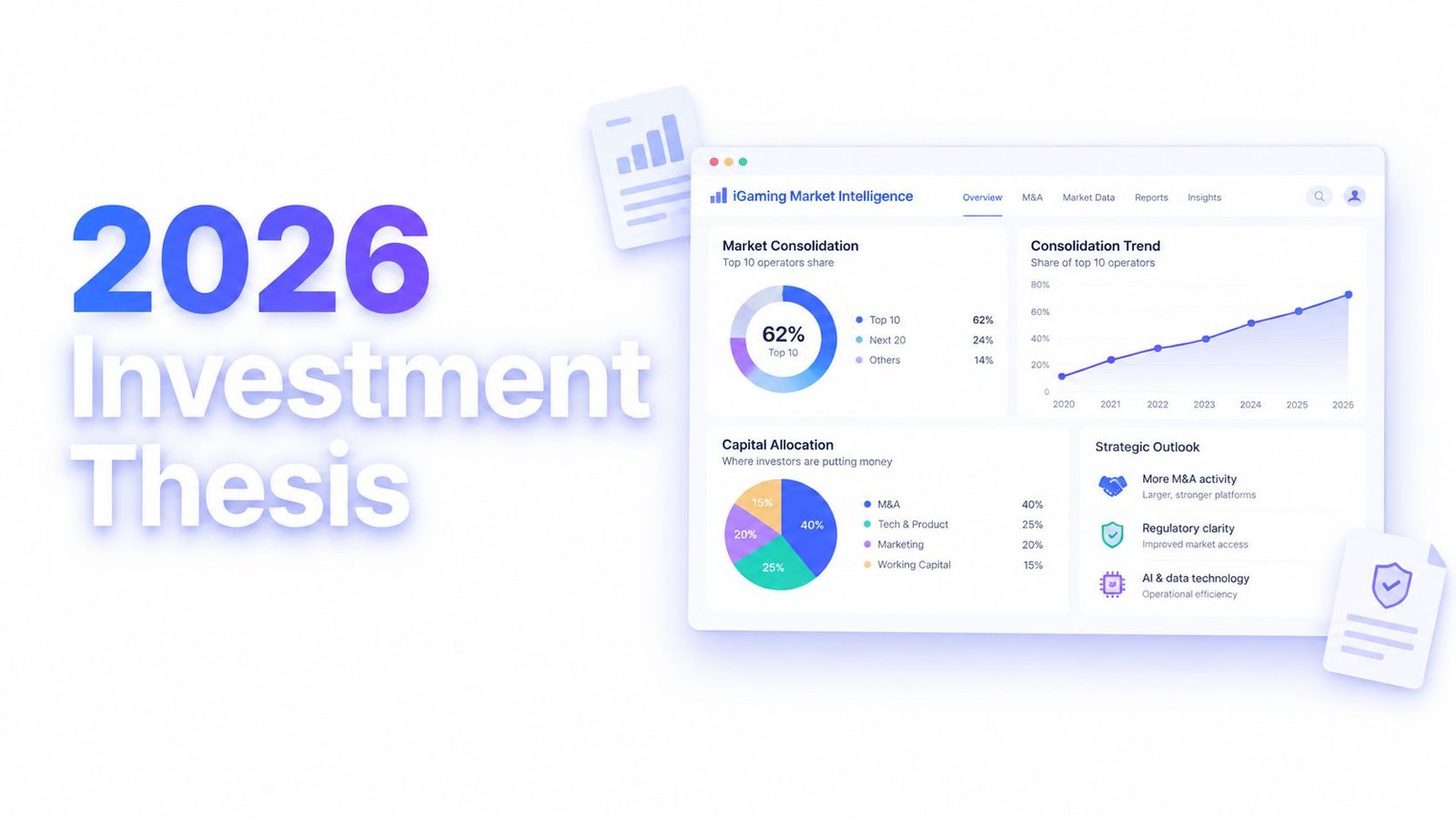
The 2026 investment case rests on consolidation around licensed incumbents, not headline player demand. MGF obligations, government-ID and selfie verification, advertising audits, payment controls, fraud monitoring, and supplier accreditation create fixed or semi-fixed costs. Larger businesses can spread these costs across products and markets, while smaller operators may struggle to convert gross revenue into contribution after compliance and payment expenses.
Scale therefore has a regulatory dimension. A licensee with established KYC, risk, reconciliation, and reporting systems can add products without rebuilding its control environment. Buyers should value that operating infrastructure separately from registrations, because regulatory throughput increasingly determines how quickly an asset can grow.
Where capital is likely to move
Strategic acquirers are positioned to buy compliant operators, payment capabilities, content relationships, or supplier infrastructure. The target's value comes from shortening the path to compliant market access and improving execution, rather than adding registrations.
Platform suppliers may also consolidate. Local B2B accreditation and tighter technical controls make a wide supplier roster harder to maintain. Buyers are likely to favor vendors that can document player protection, reporting, identity controls, and product governance.
Private equity investors need to separate domestic licensed assets from distressed offshore-linked businesses. The end of the POGO regime removes much of the value previously associated with offshore licensing access. A compliant domestic electronic gaming operator with proven controls may attract strategic interest, while a business dependent on grey-market distribution may require restructuring.
The PAGCOR B2B provider application process shows why supplier accreditation has commercial significance. It is a condition of market access and an indicator of whether a provider can operate within the regulator's preferred architecture.
Investment filter: Capital should follow demonstrable compliance capacity, payment resilience, and repeatable licensed revenue, not historical volume alone.
Competitive defensibility now sits in systems that take time to reproduce: clean customer data, reliable KYC decisions, fraud intelligence, payment redundancy, responsible marketing controls, and supplier relationships valid under local accreditation rules. Valuation should recognize these assets and discount businesses whose economics depend on regulatory gaps.
Strategic Playbook for Operators, Affiliates, and Investors
The central 2026 KPI is compliant contribution, not gross volume. Management teams should read performance through four linked measures: licensed revenue, verification completion, payment reliability, and the cost of meeting MGF and control requirements.
| Stakeholder | Priority action | Regulatory trigger | 2026 KPI to monitor |
|---|---|---|---|
| Operators | Complete renewal, KYC, AML, and payment-readiness work | Tighter identity and payment controls | Verified deposit completion and compliant GGR |
| Affiliates | Shift traffic to licensed operators and audited partners | Advertising restrictions and enforcement | Qualified depositing users by compliant channel |
| Suppliers | Maintain local accreditation and reporting capability | B2B accreditation requirements | Active licensed distribution and support cost |
| Investors | Favor incumbents with scalable control systems | MGF regime and offshore prohibition | Contribution after compliance and payment costs |
Operators
Operators should complete licence renewal and documentation readiness before expanding commercial activity. KYC and AML systems must cover government identification, real-time selfie checks, transaction monitoring, fraud review, and auditable decisions. The operating question is whether these controls protect conversion quality while producing records that can withstand regulatory review.
Marketing should be rebuilt around permitted channels and verified partners. Payment teams should reduce dependence on any single e-wallet route, then test direct bank connectivity, reconciliation, withdrawals, and escalation procedures. Product teams should prioritize electronic formats with durable engagement rather than relying on unrestricted bonuses to support activity.
Each licence obligation should have a corresponding P&L line. That mapping makes the effect of MGF payments, verification friction, payment failures, and compliant acquisition visible before management commits to additional volume.
Affiliates
Affiliates should direct traffic toward licensed incumbents and make compliance information usable in their content. Licence status, payment explanations, responsible-gambling information, and transparent terms can support conversion when customers face more verification steps.
Traffic diversification should remain controlled. Casino, sports betting, bingo, and esports coverage can broaden exposure, while localized editorial content may reduce reliance on mass-market acquisition. Affiliates also need to audit sub-partners and promotional claims because operator risk can extend through the marketing chain.
The relevant test is channel quality after compliance costs. A campaign that produces fewer users but stronger verification, payment completion, and retention may be more valuable than high-volume traffic with weak documentation.
Investors
Investors should test whether a target can absorb MGF obligations at its current scale, whether KYC infrastructure is proprietary or outsourced, and whether payment access depends on fragile arrangements. Supplier consolidation may offer stronger defensibility than buying revenue without control of the compliance layer.
Top 1 Rank provides market intelligence covering iGaming news, regulation, operator performance, supplier developments, and Philippine market analysis. Any intelligence provider should be checked against official PAGCOR and government materials before a licensing or capital-allocation decision.
Investors should also distinguish a temporary revenue decline from a structurally unviable cost base. The key evidence is contribution after compliance and payment costs, supported by repeatable licensed revenue and reliable control systems.
Decision points for the rest of 2026
Management teams should monitor three questions. Do PAGCOR's quarterly revenue releases show stabilization after the Q1 decline? Do MGF fees or thresholds alter the break-even point for different licensee classes? Does electronic gaming retain its dominant contribution as volume is reallocated?
Customer acquisition still matters, but user acquisition cost analysis should be paired with verification pass rates, payment completion, fraud losses, and retention by licensed product. A higher acquisition cost can be acceptable when the cohort remains durable and compliant. A lower cost can conceal enforcement exposure, failed deposits, or weak retention.
Operators, affiliates, suppliers, and investors should benchmark licence readiness, MGF exposure, KYC performance, advertising controls, and payment continuity against those measures. The strongest 2026 position will belong to businesses that can show compliant scale, not headline demand. They should direct capital toward systems that preserve licensed revenue through regulatory change, then reassess expansion, acquisition, and marketing commitments after each PAGCOR revenue and regulatory update.




Join thousands of gaming professionals receiving the latest iGaming news, regulatory updates, and market insights.
