

The Philippines generated PHP 396.14 billion in gross gaming revenue in 2025, but PAGCOR indicated that 2026 GGR could fall 19% to roughly PHP 320 billion. The central story is therefore not simple expansion, but a regulated market restructuring around digital concentration, payment friction, the POGO exit, and tighter enforcement.
That tension defines the Philippines iGaming market report 2026. Online and electronic gaming already represented PHP 201.12 billion, or 50.8% of total 2025 GGR, while first-quarter performance showed how quickly digital demand can weaken when access, payments, and compliance conditions change. The market remains substantial, but operators can no longer rely on topline growth to protect margins.
Table of Contents
- Market Size and the 2026 Reset
- Regulatory and Licensing Framework After the POGO Exit
- Segment Outlook Across Sports Betting, Casino, Live Casino and Esports
- Payments, Fintech and Enforcement as the Core Access Layer
- Operator, Supplier and Aggregator Ecosystem in Transition
- Consumer Behavior, Demand Friction and Substitution Risk
- Actionable Recommendations for Operators and Investors in 2026
Market Size and the 2026 Reset
PAGCOR's 2025 figures establish a large but increasingly regulated market. Total GGR reached PHP 396.14 billion, up from PHP 372.33 billion in 2024, while online gaming alone generated PHP 201.12 billion. Digital play therefore overtook traditional casino activity in the market structure, a shift that matters to operators, suppliers, affiliates, and investors because more than half of industry revenue now depends on digital access and compliant payment infrastructure. PAGCOR's market figures and 2026 outlook provide the baseline.
The opening quarter of 2026 delivered a different signal. Industry GGR fell to PHP 87.60 billion, down from PHP 104.12 billion in Q1 2025. Electronic gaming declined 22.43% year on year to PHP 39.90 billion, while licensed casinos generated PHP 44.52 billion, or 50.83% of quarterly GGR. PAGCOR's Q1 2026 release shows a temporary reversal in channel mix, with land-based casinos regaining share as digital volumes softened.
The channel picture is less complete than the headline total
The available verified data supports a clear distinction between total GGR, online and electronic gaming, and licensed casino activity. It doesn't support a precise 2026E channel-by-channel forecast for e-games, onshore licensing, or offshore residual volume. A responsible market model should therefore avoid presenting unsupported estimates as established fact.
| Channel | 2024 (PHP bn) | 2025 (PHP bn) | 2026E (PHP bn) | YoY 2026 |
|---|---|---|---|---|
| Total industry GGR | 372.33 | 396.14 | Around 320 | Forecast decline of 19% |
| Online and electronic gaming | 154.70 in electronic and online gaming growth baseline | 201.12 | Not separately disclosed | Not separately disclosed |
| Licensed casinos | Not separately disclosed | Not separately disclosed | Not separately disclosed | Not separately disclosed |
| Offshore or residual component | Not separately disclosed | Not separately disclosed | Not separately disclosed | Not separately disclosed |
The most useful conclusion is qualitative. The shrinking pool isn't necessarily digital gaming itself. It is the portion of digital demand that can't survive licensing, payment, tax, and enforcement requirements. The regulated onshore pool may capture some displaced activity, but the first-quarter contraction shows that substitution isn't automatic.
Analyst view: Gross gaming revenue measures market activity, not the cash available for reinvestment. Payment reliability, licensing cost, compliance staffing, acquisition efficiency, and player retention determine the usable economics.
PAGCOR's fee reset and the offshore gaming ban make 2026 a structural reset rather than a normal downturn. The Philippines user acquisition cost analysis is relevant because acquisition economics now depend on whether a platform can convert compliant traffic efficiently, not whether it can buy more reach. Any recovery beyond 2026 will depend on clearer payment rails and consistent enforcement, but no verified data establishes a specific 2027 or 2028 CAGR.
Regulatory and Licensing Framework After the POGO Exit
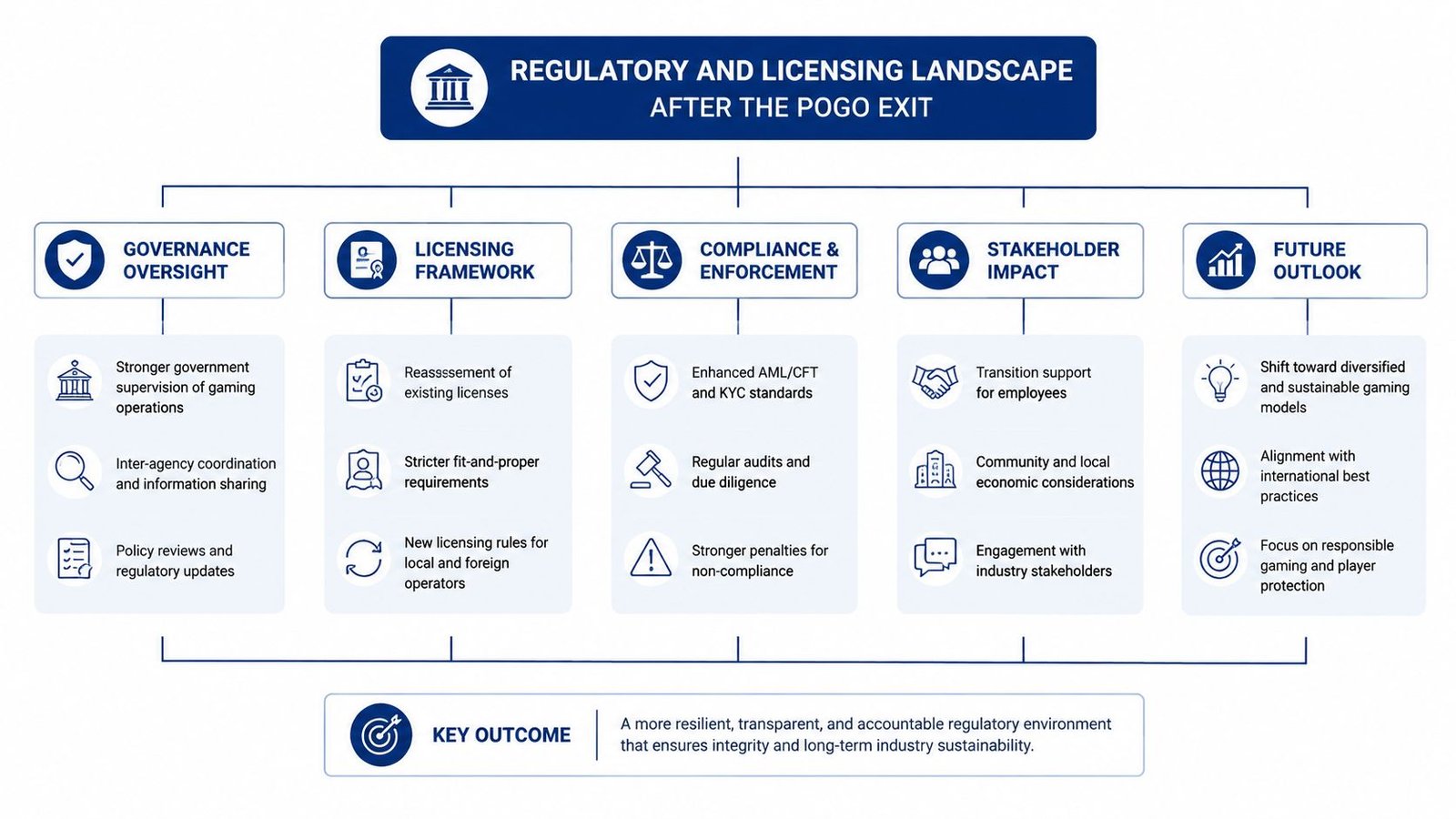
The post-POGO framework puts PAGCOR at the centre of Philippine gaming regulation while the agency also operates gaming activities. That dual role gives it direct visibility into revenue, licensing, fees, and enforcement. For operators, regulatory interpretation is therefore an operating variable, not a formality handled after product design.
The key division is between the licensed onshore market and offshore-facing activity. E-games licensing now provides the relevant framework for regulated digital gaming, while legacy POGO operations remain subject to the offshore gaming ban. PAGCOR reset its fee framework for gaming system administrator licensees effective 1 January 2025. E-games license fees fell to 30% of GGR, from a previous 50% to 55% range, according to PAGCOR's fee framework announcement.
Entry requirements depend on the role in the chain
A B2C operator requires the licence authorizing direct gaming activity and player relationships. A B2B supplier may need authorization, accreditation, or a compliant relationship with a licensed operator, depending on its service. Testing laboratories, technology vendors, payment partners, affiliates, agents, and marketing intermediaries face different forms of exposure. Working outside the player-facing layer does not remove compliance risk.
The POGO exit leaves demand for infrastructure and specialist services, but it narrows the routes through which that demand can be served. Former offshore-facing providers may pursue work in licensed e-games, technology outsourcing, customer support, content distribution, or compliance services. Each layer now needs an auditable connection to a lawful licensee, which raises documentation and counterparty-screening requirements.
Marketing restrictions change the operating perimeter
Offshore licence holders face a January 2026 ban on iGaming marketing to Philippine residents under the framework described in the market plan. The restriction reaches beyond an operator's own website. Agents, junkets, influencer funnels, comparison publishers, and media buyers can each become routes for a prohibited offer to reach local consumers.
The PAGCOR B2B provider application process should sit within a broader control framework. Suppliers need documented counterparties, defined market permissions, campaign approval procedures, and escalation rules for suspicious acquisition activity. A licence does not make every distribution method lawful, and a commercial contract cannot remove the risk created by an unapproved local funnel. These controls directly affect acquisition cost, supplier margins, and the viability of cross-border service models.
Segment Outlook Across Sports Betting, Casino, Live Casino and Esports
The verified data doesn't provide Philippines-specific 2025 GGR shares or 2026 growth rates for sports betting, online casino, live casino, or esports. Any table that assigns exact shares, mid-teen growth, or a specific esports runway would overstate the evidence. The segment outlook is still useful, but it should be read through market structure and regulatory exposure rather than unsupported forecasts.
Online and electronic gaming was the dominant digital growth engine in 2025, reaching PHP 201.12 billion and accounting for 50.8% of total GGR. That fact supports online casino's position as a central commercial category, but it doesn't establish a verified split between slots, live dealer, table games, sports, or esports. PAGCOR's 2025 market reporting confirms the importance of electronic and online gaming without providing the narrower vertical shares required for a precise comparison.
Four verticals, four different risk profiles
| Vertical | 2025 GGR Share | 2026E Growth | Regulatory Risk | Margin Outlook |
|---|---|---|---|---|
| Sports betting | Not separately disclosed | Direction depends on payment access and marketing permissions | High where campaigns reach Philippine residents | Under pressure if acquisition and compliance costs rise |
| Online casino | Included within online and electronic gaming, exact share not disclosed | Large addressable digital category, but exposed to payment friction | High AML and payment scrutiny | Sensitive to fees, retention, and payment success |
| Live casino | Not separately disclosed | Potentially resilient as a product format, but no verified Philippines forecast | Subject to the same licensing and marketing controls | Depends on content costs, utilization, and compliant acquisition |
| Esports betting | Not separately disclosed | Emerging category with no verified local growth rate | Exposed to advertising, age, integrity, and licensing controls | Requires disciplined targeting and strong integrity processes |
Sports betting can benefit from established consumer familiarity and links to land-based casino ecosystems, but the verified data doesn't substantiate a claim that it remains the largest onshore segment. Online casino has stronger evidence as part of the dominant digital pool, yet that scale brings direct exposure to payment controls and AML scrutiny.
Live casino deserves attention as a product strategy, not because a specific growth rate has been verified. It can offer a more differentiated experience than undifferentiated RNG inventory, while live-dealer casino games may help operators build session depth when acquisition becomes more expensive. Esports betting remains a specialist opportunity. Its viability will depend on approved market access, publisher and league integrity, age controls, and advertising discipline.
The winning vertical in 2026 won't simply be the one with the highest volume. It will be the one that converts compliant demand with the least payment and regulatory leakage.
Payments, Fintech and Enforcement as the Core Access Layer
Licensing no longer determines market access by itself. Payment providers, app stores, hosting infrastructure, search visibility, and enforcement systems shape whether users can discover, fund, and withdraw from an operator. In 2026, these controls are reshaping unit economics across the chain, from acquisition and deposits to settlement and retention.
In August 2025, the Bangko Sentral ng Pilipinas ordered e-wallet operators to remove gambling links. Later reporting said online gaming transactions fell by as much as 50% after the order, according to Asia Online Gambling Regulation and Enforcement coverage. The figure signals a major access shock, but it does not show how much displaced demand moved to licensed operators, illegal sites, alternative payment rails, or other entertainment.
PAGCOR also moved toward AI-assisted detection of illicit sites and prepared recommendations to the central bank on restoring regulated payment channels. Reporting on PAGCOR's enforcement and payment work indicates that compliance now reaches technical monitoring and financial infrastructure. Enforcement therefore affects traffic quality and payment continuity, not only licensing status.
Licensed and unlicensed checkout flows diverge
The requested CAC estimates, including a move from 12% to 18% in 2024 toward 22% to 30% in 2026, are absent from the verified data and cannot be treated as market facts. The defensible conclusion is narrower: compliant acquisition is becoming more operationally demanding as payment access narrows and enforcement removes unlicensed routes.
| Payment Method | Licensed Operator Status | Unlicensed Operator Status |
|---|---|---|
| GCash | Availability depends on approved merchant and gaming arrangements | Gambling links and transactions face removal or restriction |
| Maya | Availability depends on compliance approval and monitoring | Exposed to the same blocking and account-control environment |
| InstaPay and PESONet | Potentially usable where the operator and transaction purpose are approved | Vulnerable to closure, rejection, or monitoring |
| Direct debit cards | Subject to issuer, merchant, and compliance controls | Higher risk of declines, reversals, and account action |
| Alternative digital wallets and informal rails | Must be assessed through licensing and AML controls | May remain available temporarily, but carry enforcement and customer-risk exposure |
The payment problem is asymmetric. A licensed operator may lose conversion when an approved rail is unavailable, while an unlicensed operator faces sudden closure, frozen balances, or domain disruption. Payment redundancy can protect conversion, but only within documented licensing and AML boundaries.
The PAGCOR payment gateway accreditation process is therefore an operating and investment issue, not merely an implementation task. Operators should track approval status, transaction failure reasons, reconciliation timing, chargeback patterns, and suspicious funding behavior as one connected access-control system. Payment friction is now a direct test of whether a business model can operate inside the regulated market.
Operator, Supplier and Aggregator Ecosystem in Transition
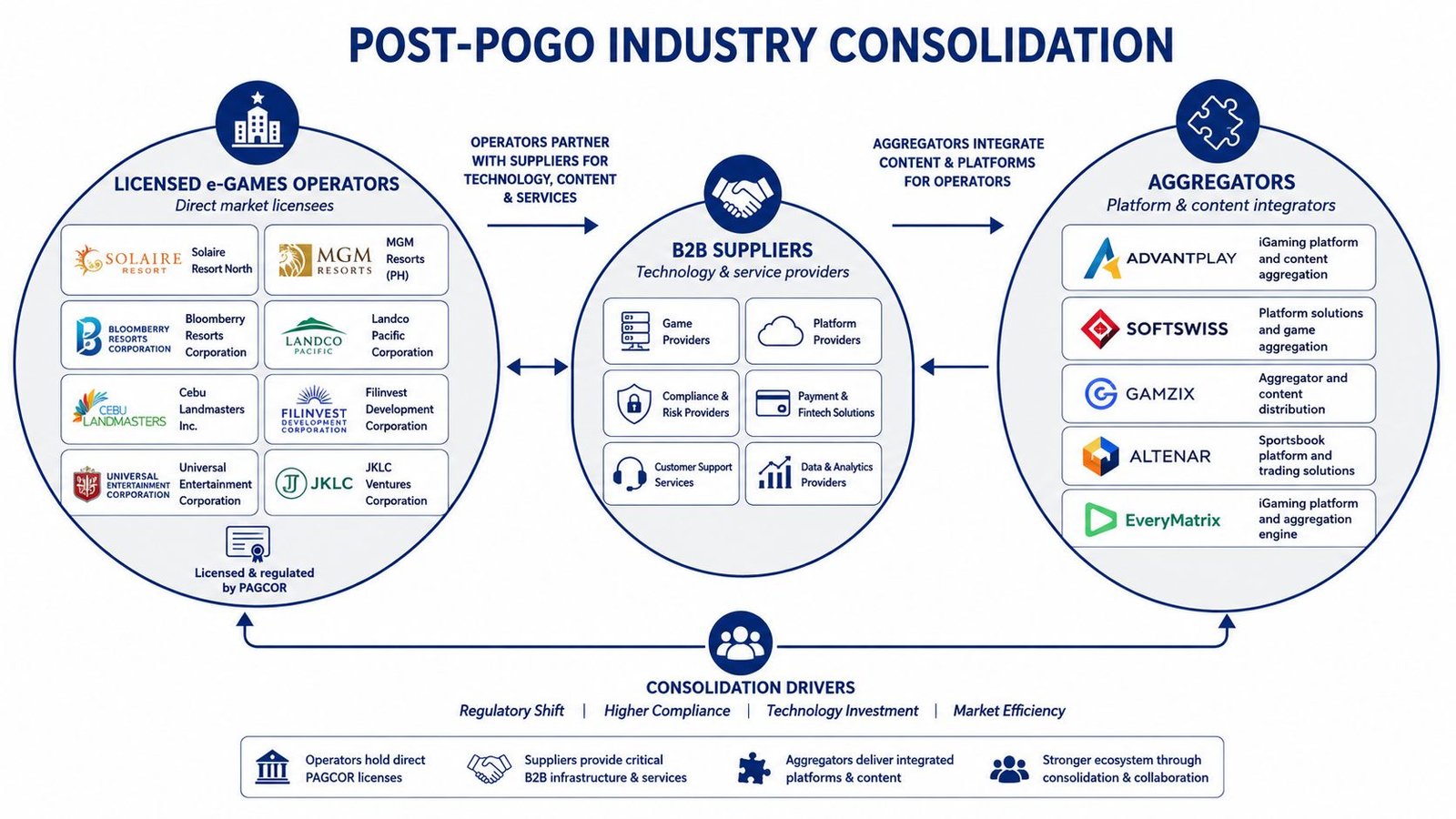
The POGO exit is sorting the supply chain by regulatory usefulness. Companies built around offshore volume must now choose whether to support licensed e-games, supply technology within documented controls, or shift into general outsourcing and compliance services without preserving prohibited market access.
PAGCOR-licensed e-games operators hold the direct relationship with the regulated market. Aggregators and platform vendors can combine content, wallet functions, reporting, and operational tools, but that convenience has value only when the licensee can document each commercial and technical connection. The structural reset therefore shifts bargaining power toward providers that can make compliance visible, not merely those that can add inventory or reduce launch time.
Repositioning is more credible than simple consolidation claims
Available data does not establish an active licensed operator count, a named aggregator roster, white-label transaction volume, or Philippine-specific M&A and funding rounds. Those gaps should not be filled with assumptions or figures from unrelated markets. The post-POGO market is still assessable through the functions companies are trying to perform and the controls those functions require.
Former POGO service providers may reposition toward:
- Licensed e-games support: Technology, customer operations, fraud monitoring, and payment reconciliation for approved licensees.
- Content licensing: Distribution of casino content through documented B2B relationships instead of direct offshore acquisition.
- Outsourcing hubs: Non-gaming business process services that do not depend on prohibited player targeting.
- Compliance infrastructure: KYC, transaction monitoring, responsible gambling controls, and domain-risk intelligence.
The commercial test is auditability
White-label and turnkey arrangements can shorten market entry while concentrating accountability. If the platform, affiliate network, payment stack, and operator brand come from connected parties, regulators and investors need a clear record of who controls player funds, KYC decisions, marketing approvals, game certification, and suspicious-activity escalation.
The PAGCOR game aggregator accreditation requirements should sit alongside contract governance. Suppliers need defined service boundaries, data-access rules, incident reporting, and exit procedures. Aggregators must show that their distribution model does not reproduce the access channels enforcement is intended to remove.
For investors, the strongest transition candidates may not be the largest former providers. They are more likely to be businesses with transferable technology, documented compliance, diversified revenue, and customers able to operate legally under the revised structure. That combination supports more durable unit economics than offshore volume alone.
Consumer Behavior, Demand Friction and Substitution Risk
Removing an access point doesn't prove that demand moves to a licensed replacement. It creates a decision tree. Some players may shift to approved operators, some may search for offshore or illegal alternatives, and others may stop gambling or redirect entertainment spending elsewhere.
The strongest verified evidence comes from the payment shock after the BSP order. Reporting said online gaming transactions fell by as much as 50%, while PAGCOR emphasized the financial contribution of licensed operators and collected PHP 69 billion in fees during the first seven months of 2025. The enforcement analysis frames the unresolved substitution problem clearly: the market needs to know whether friction improves channel quality or displaces activity.
Substitution has several destinations
Offshore gray-market sites may remain attractive to players who prioritize familiar games, fewer payment steps, or promotional access. VPNs, crypto deposit wallets, and informal agent networks can reduce visible friction, but they introduce serious risks around identity, source of funds, dispute resolution, and withdrawal reliability. These mechanisms are also precisely the type of access behavior that enforcement teams may investigate.
A second path is direct churn. Players can move toward mobile gaming, retail sweepstakes, or other entertainment products without transferring their spend to another gambling operator. The verified data doesn't quantify the share of demand taking each route, so operators shouldn't build acquisition plans around a precise substitution percentage.
Why demographic assumptions need restraint
The available verified data doesn't provide player age cohorts, regional concentration, or a quantified mobile-first profile for the Philippines. Those characteristics may be useful for internal segmentation when supported by an operator's own consented data, but they shouldn't be presented as national market facts without a primary source.
The operational implication is still clear. Operators need to measure failed deposits, abandoned registrations, payment-method switching, withdrawal delays, dormant-account reactivation, and customer-service contacts after every access or policy change. Those signals distinguish genuine migration into the licensed channel from apparent traffic that never becomes funded play.
Risk control: A player who reaches a licensed registration page isn't a recovered customer. Recovery begins only after compliant verification, successful funding, responsible play monitoring, and a reliable withdrawal.
Actionable Recommendations for Operators and Investors in 2026
The 2026 playbook should prioritize resilience over aggressive volume acquisition. PAGCOR's 2025 baseline, the Q1 contraction, payment restrictions, and the POGO-related revenue disruption all point toward a market where execution quality matters more than a broad growth narrative.
The requested assumptions around a new 5% licence fee, a 7.5% GGR levy, a PHP 305 billion to PHP 335 billion underwriting band, a 12 to 18 month recovery period, and a 5.4% esports growth runway aren't supported by the verified data. Investors and operators should use scenario analysis, but those figures must be labeled as internal assumptions rather than market facts.

Four stakeholder tracks
Licensed operators
- Build payment resilience: Prioritize approved PHP payment integrations, reconciliation controls, fallback workflows, and clear failure monitoring.
- Protect compliant yield: Segment CRM by verified behavior, deposit reliability, product preference, and responsible gambling indicators rather than relying on broad promotional targeting.
- Audit every acquisition path: Review affiliates, influencers, agents, and landing pages for local marketing exposure and license consistency.
New entrants
- Start with the license perimeter: Define the exact role of the business before selecting platform, content, payment, or affiliate partners.
- Budget for controls: Treat KYC, AML, responsible gambling, testing, reporting, and legal review as operating infrastructure.
- Avoid offshore ambiguity: A low-friction route that depends on unclear Philippine targeting can create more downside than commercial value.
Investors
- Model volatility explicitly: Use the verified 2025 GGR baseline and the official 2026 downside indication as scenario anchors, rather than assuming a straight-line recovery.
- Test revenue quality: Separate licensed onshore activity from revenue exposed to payment closure, offshore enforcement, or legacy POGO relationships.
- Review transition evidence: A target's customer contracts, license status, payment approvals, compliance staffing, and audit trail matter more than a large historical revenue figure.
Suppliers and aggregators
- Sell compliance capacity: KYC orchestration, transaction monitoring, geolocation controls, reporting, and responsible gambling tooling are more defensible than undifferentiated turnkey access.
- Keep content lightweight and adaptable: Product portfolios should support mobile delivery, clear certification, and efficient localization without creating unnecessary technical or licensing complexity.
- Document the chain: Map operator, aggregator, supplier, affiliate, payment, and hosting relationships so every party can explain its role to PAGCOR and financial partners.
Top 1 Rank can serve as one information source for operators, affiliates, investors, and suppliers tracking Philippine regulation, market intelligence, payments, and compliance developments. Decision-makers should pair editorial analysis with PAGCOR, BSP, legal, financial, and license-specific due diligence before committing capital.
The immediate call to action is practical: operators should audit payment and marketing dependencies, suppliers should document their regulated-market positioning, affiliates should remove ambiguous Philippine campaigns, and investors should rebuild forecasts around licensed revenue quality rather than headline GGR alone.





Join thousands of gaming professionals receiving the latest iGaming news, regulatory updates, and market insights.
