
Licensed jurisdictions captured 68% of global iGaming gross gaming revenue in 2026, equal to $78 billion, while grey and unregulated markets accounted for the remaining 32%, or $37 billion (Track360's Q1 2026 industry data). That split changes the central question for operators and investors. The issue is no longer where online gambling is legal. It's where licensed demand can be captured after enforcement, payment access, product restrictions, tax, advertising rules, and compliance costs are applied.
Table of Contents
- Introduction to Regulated iGaming Markets in 2026
- How Regulated iGaming Markets Work in Practice
- Market Size Forecasts and Tax Fragmentation in 2026
- Jurisdiction by Jurisdiction Regulatory Developments and Timelines
- Licence and Compliance Requirements for Operators and Suppliers
- Commercial Opportunities Risks and Strategic Choices for 2026
- Strategic Recommendations and Next Steps for Regulated Growth
Introduction to Regulated iGaming Markets in 2026
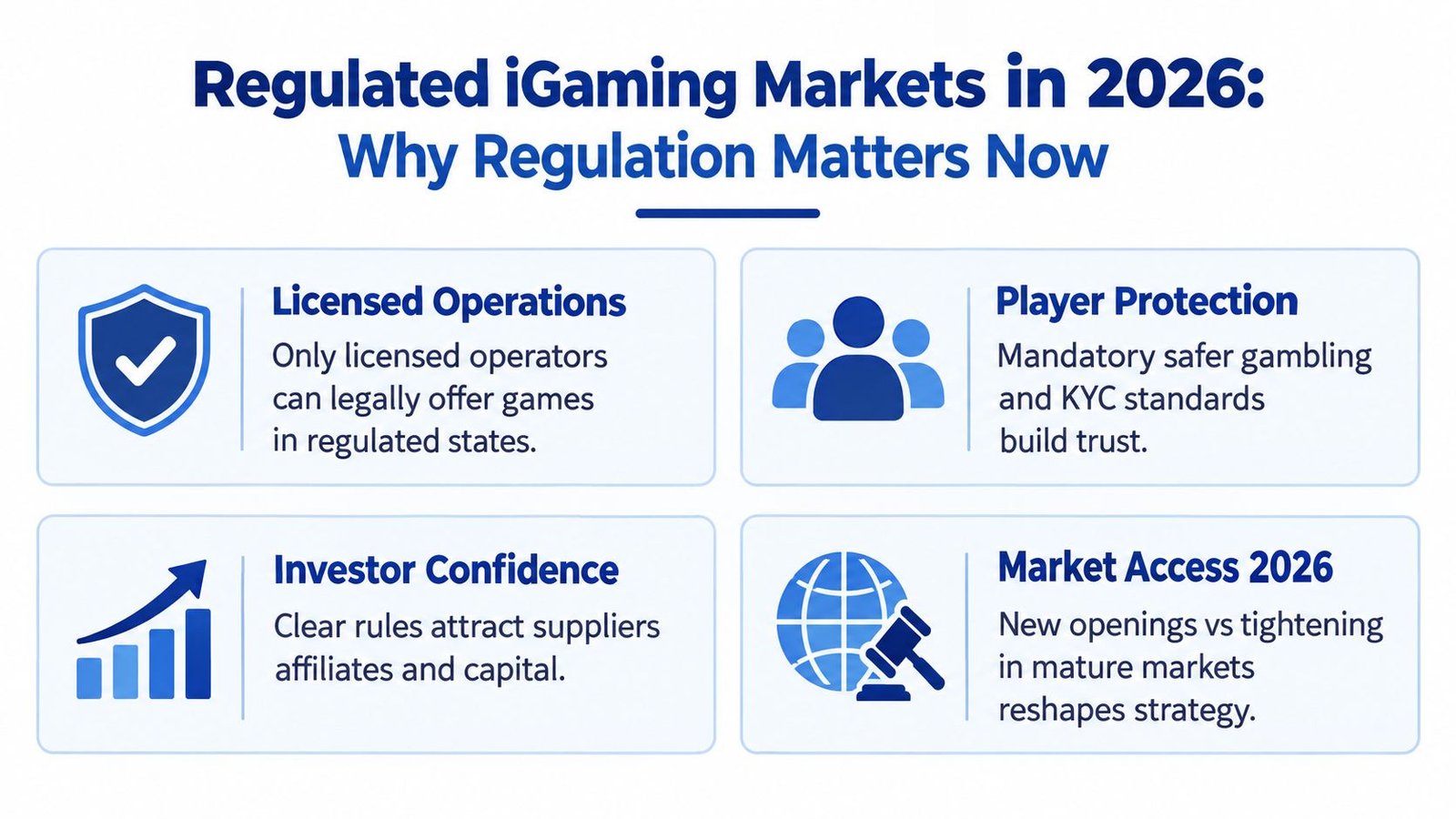
The $115 billion global iGaming GGR recorded in 2026, up 12% year over year, shows regulation becoming the industry's primary commercial framework (Track360). Regulated operators now control more than two-thirds of reported online gambling revenue. Regulation therefore shapes player protection, taxation, product access, payment flows, and the commercial terms governing competition.
The commercial impact extends across the value chain. Operators must test whether licensed demand can cover local tax, technology, and compliance costs. Game providers and platform suppliers need certification, reporting, responsible-gambling controls, and jurisdiction-specific integrations. Affiliates face narrower advertising routes and greater exposure to operator conduct. Investors must separate a large legal market from one where licensed businesses can convert demand efficiently.
Regulation is becoming a market-capture issue
Global regulation rates conceal different levels of commercially accessible revenue. Market tracking places Asia-Pacific at about 41% regulated, compared with 95% in North America and 82% in Europe (Track360's 2026 market-size analysis). These figures indicate the distance between demand and licensed capture. Enforcement intensity, payment availability, advertising permissions, and consumer trust in licensed brands determine how much activity operators can monetise.
Market-entry decisions should therefore assess capture conditions, not licence status alone. A new licence window may provide first-mover access while weak payment infrastructure or offshore competition limits conversion. A mature market may offer stronger channelization and predictable supervision, yet tax and compliance costs can compress margins.
For regional evaluation, PAGCOR's Philippine online casino framework demonstrates why licensing must be assessed alongside practical market access. Operators need to determine whether they can acquire, verify, serve, retain, and report on players under the jurisdiction's actual rules. Investors should apply the same test to revenue quality and scalability.
Analyst view: Regulation establishes legal access. Enforcement, payments, and tax compression determine the revenue that operators can capture.
How Regulated iGaming Markets Work in Practice
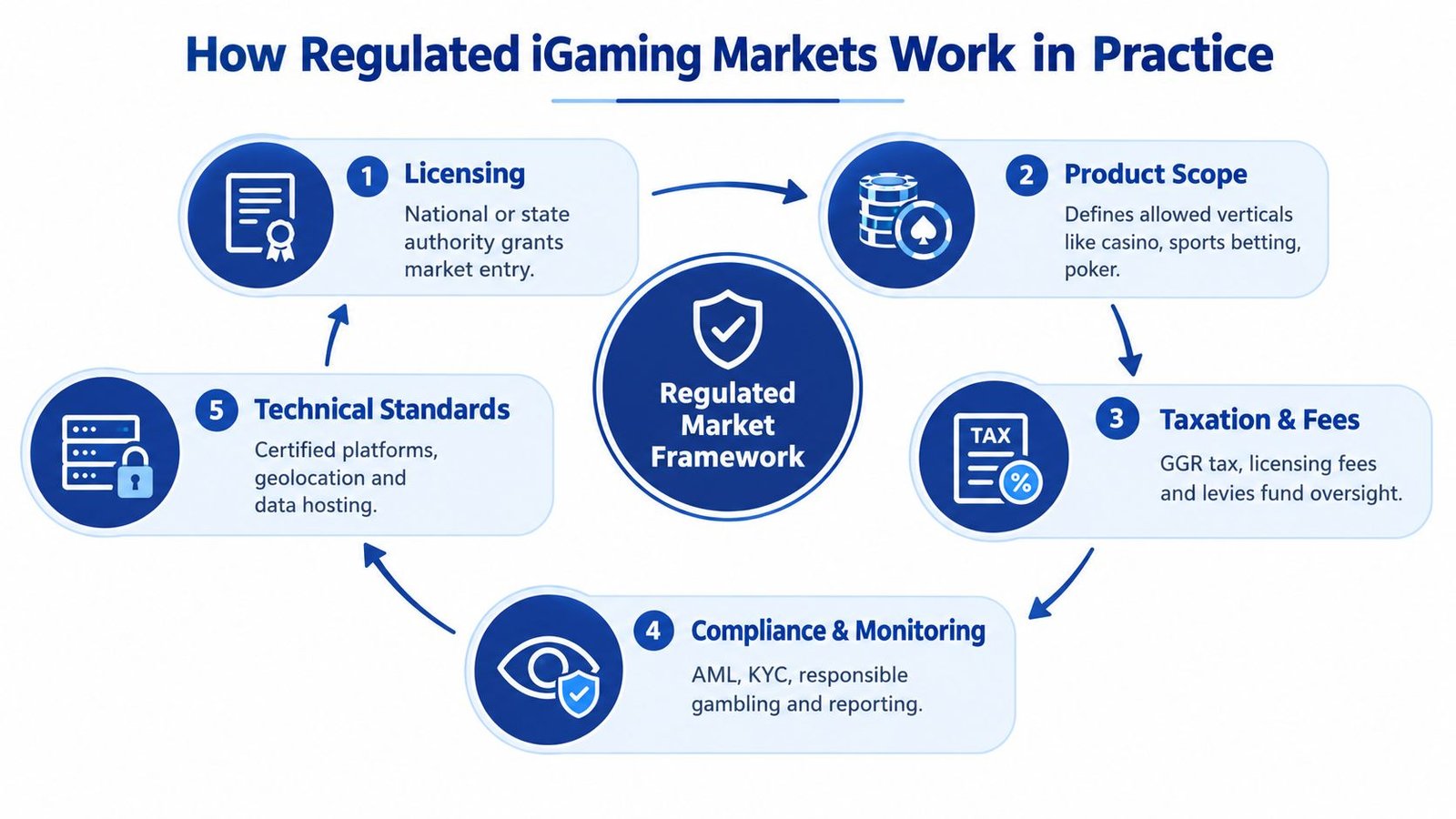
A regulated iGaming market operates through connected controls rather than a single permission. The licence provides market access, while separate requirements govern products, technical standards, taxation, player protection, payments, reporting, and supervision. Each jurisdiction combines these controls differently, so legal entry does not automatically equal commercially accessible revenue.
Market entry is the first layer. A national or state authority determines which businesses may operate, which ownership structures are acceptable, and which individuals must pass suitability checks. Product scope follows. Casino, sportsbook, poker, bingo, and lottery products may receive different treatment, meaning operators must match the licence to the intended catalogue.
Five layers shape the operating model
Taxation and fees determine part of the commercial outcome. Operators may face GGR taxes, licence fees, supervisory charges, product levies, or other jurisdiction-specific costs. These obligations affect pricing, bonuses, media budgets, supplier negotiations, and the viability of lower-margin acquisition channels. Tax compression can therefore limit the revenue captured from otherwise legal demand.
Compliance and monitoring continue after approval. KYC, AML, responsible gambling, transaction monitoring, marketing controls, complaints handling, and regulatory reporting require assigned ownership and documented evidence. Compliance teams must connect policy with player-account workflows, payment decisions, and escalation procedures. Enforcement intensity determines whether these controls remain formal requirements or shape day-to-day competition.
Technical standards provide the assurance layer. Platforms, games, random-number generators, geolocation systems, and reporting interfaces may require certification or testing by approved laboratories. Data and hosting rules can also differ, creating implementation work beyond the customer-facing website. Payment access and advertising permissions then influence whether an approved operator can acquire and retain customers at viable cost.
A useful classification separates fully regulated, partially regulated, and transitioning markets. In 2026, one industry review identified 27 of 35 monitored jurisdictions as fully regulated, with 5 partially regulated and 3 in transition (Track360's 2026 regulatory market report). This describes regulatory maturity, not the amount of revenue operators can capture.
Practical rule: After confirming legal status, assess enforcement intensity, payment access, advertising freedom, and expected margin after tax.
Suppliers face the same modular structure. A platform built for one regulator's reporting format may need configuration before serving another. PAGCOR's B2B provider application process shows why accreditation, documentation, technical controls, and local approval belong in product delivery planning, not only in post-sale administration.
Market Size Forecasts and Tax Fragmentation in 2026
Global iGaming GGR reached $115 billion in 2026. Regulated markets generated $78 billion, while grey or unregulated markets generated $37 billion (Track360). The split matters less as a legal classification than as a measure of revenue operators can capture through licensed payments, compliant advertising, and enforceable customer relationships.
Product concentration reinforces that point. Online casino represented 52% of global revenue, and sportsbook represented 35% in the same data set. These verticals create different exposure to identity checks, payment controls, game certification, responsible gambling rules, and reporting obligations. Their revenue share therefore needs to be assessed alongside the cost of maintaining compliant access.
Regional capture is not uniform
Regional regulation produces very different commercial conditions. Asia-Pacific was approximately 41% regulated, compared with 95% in North America and 82% in Europe (Track360). North American and European operators generally benefit from stronger licensed channelization, but they also face established compliance systems and higher operating discipline. In Asia-Pacific, demand outside licensed channels can increase the addressable opportunity while reducing certainty around payment reliability, enforcement, and advertising access.
| Region | Regulated Share of GGR | Headline GGR Tax Signal |
|---|---|---|
| Global | 68% | Median tax rate of 20% across 33 markets with published headline rates |
| North America | 95% | Tax conditions vary sharply by jurisdiction |
| Europe | 82% | Tax rates range from 0.1% in Gibraltar to 61% in Rhode Island |
| Asia-Pacific | 41% | Lower regulated capture leaves more demand outside licensed channels |
Tax determines how much of regulated demand remains commercially usable. The median headline GGR tax rate was 20% across 33 markets, with rates ranging from 0.1% in Gibraltar to 61% in Rhode Island (Track360). The range affects bonus budgets, affiliate payments, supplier pricing, staffing, and marketing returns. A market with high channelization can still produce weaker operator margins if tax and compliance absorb too much GGR.
The operating question is therefore market size versus accessible margin. A large regulated pool may offer reliable payment access and enforceable competition, yet compress returns through tax and compliance costs. A partially captured market may show stronger apparent upside, but payment friction, offshore competitors, and uncertain enforcement must be priced into entry decisions. Operators should also monitor policy changes, not only demand forecasts. The PAGCOR's 2026 regulatory updates illustrate why rule changes can alter the commercial value of an otherwise attractive market.
Jurisdiction by Jurisdiction Regulatory Developments and Timelines
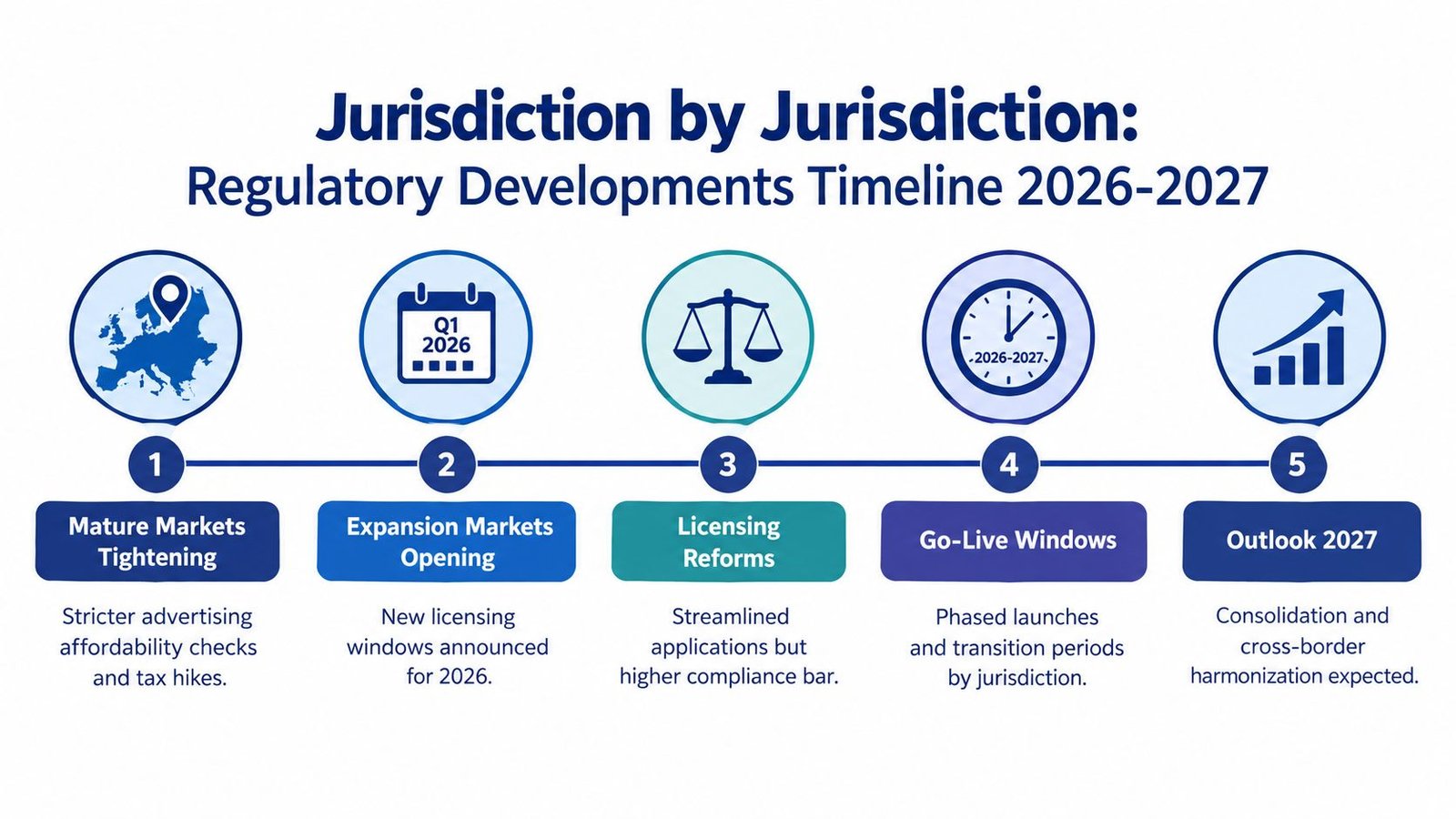
Regulated iGaming markets in 2026 are separating into two commercial groups. Mature jurisdictions are tightening tax, affordability, deposit, and advertising rules, while expansion markets are opening new licensing routes. The relevant question for operators is not only whether a licence is available, but how much revenue can be captured after enforcement, payment access, compliance, and tax.
The United Kingdom illustrates mature-market compression. Remote operators serving Great Britain need a Gambling Commission licence, and Remote Gaming Duty rose to 40% from 1 April 2026, compared with 21% previously (iGamingHub's UK market analysis). That change reduces the portion of GGR available for acquisition, bonuses, supplier contracts, and operating overhead. Established demand therefore does not guarantee attractive post-tax returns.
Mature markets are raising the cost of access
The Netherlands moved to a 37.8% GGR tax rate from January 2026, placing further pressure on operator economics (NuxGame's overview of iGaming regulation). Germany retains a restrictive framework that includes a 1,000 cross-operator deposit cap, affecting wallet design, payment operations, player journeys, and retention (NuxGame). Demand in both markets must be assessed alongside the rules governing deposits, staking, promotions, and payment access.
Italy has reset market access through concessions. Its 2026 concession process awarded 52 nine-year concessions to 46 operators, with a €7 million licence fee (NuxGame). This structure gives an advantage to operators with sufficient capital and compliance capacity to absorb entry costs, maintain local readiness, and withstand slower payback periods.
Expansion markets create timing advantages and delays
Finland is opening in stages. Licence applications began on 1 March 2026, and licensed operators are scheduled to be able to start no earlier than 1 July 2027, according to the current Finnish timetable. A uniform 22% lottery tax applies to Veikkaus and licensed operators (Nordialaw's Finland market guide). Separate software licences and an annual supervisory fee add cost and preparation requirements for suppliers and platform businesses.
The 2026 mapping identifies Finland, New Zealand, Ireland, Chile, and Alberta among major expansion or transition markets for 2026 and 2027 (iGamerHQ's state of iGaming review). Each requires diligence on application windows, projected launch timing, product scope, payment rails, local reporting, and enforcement intensity. A favourable legal route has limited value if payment access is weak or technical obligations delay market entry.
| Market type | Commercial advantage | Primary constraint |
|---|---|---|
| Mature regulated market | Established licensed demand and clearer operating precedent | Tax compression and tighter player or advertising controls |
| Transitioning market | Potential first-mover positioning and new licence access | Launch uncertainty and evolving technical requirements |
| Partially captured market | Significant demand may remain available to licensed brands | Offshore competition and weaker conversion into regulated play |
Jurisdictions should therefore be ranked by entry timing, capture potential, payment access, enforcement intensity, and post-tax margin, not legal availability alone. That ranking shows where regulated revenue is accessible in practice, rather than merely permitted in law.
Licence and Compliance Requirements for Operators and Suppliers
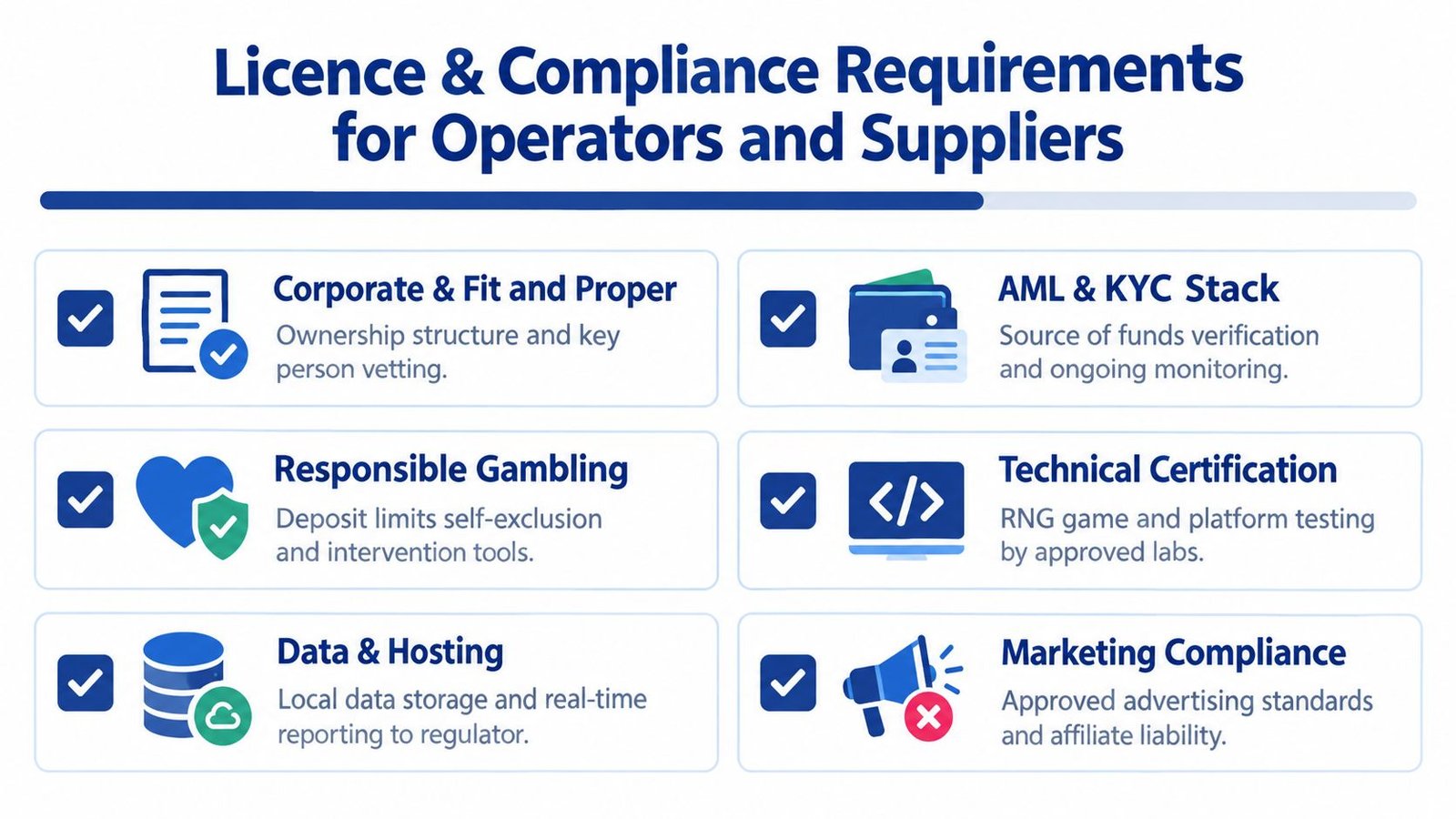
Compliance determines how much licensed demand an operator can capture. The workflow starts before the first deposit: regulated markets increasingly require KYC at onboarding, and source-of-funds reviews may apply at cumulative thresholds such as €2,000 in Malta and £2,000 in Great Britain, according to Shufti Pro's iGaming KYC guidance. Larger deposits can trigger enhanced review, so identity, payment ownership, risk scoring, and escalation must operate as one process.
The player journey is a compliance pipeline
Each control should produce evidence that can support an audit:
- Identity and age verification: Confirm identity before the account reaches the deposit stage, using documents and automated checks accepted in the relevant jurisdiction.
- Payment ownership: Establish that the payment instrument belongs to the player or satisfies local requirements before funds enter or leave the wallet.
- Sanctions and PEP screening: Screen customers and relevant parties, then send possible matches to documented human review.
- Transaction monitoring: Track deposits, withdrawals, velocity, unusual patterns, and source-of-funds concerns. Rules should escalate suitable cases to enhanced due diligence.
- Responsible-gambling controls: Apply deposit limits, self-exclusion, affordability or risk interventions, and account restrictions required by the market.
- Evidence retention: Preserve documents and decision histories for regulatory review. The same KYC guidance identifies at least five years as a practical retention benchmark.
Control quality affects both enforcement exposure and conversion. Rules set too aggressively can produce false positives, account abandonment, and avoidable manual work. Operators therefore need an MLRO-led escalation route, written decision logic, and regular tuning against local thresholds.
Modular controls outperform one global configuration
A single policy rarely fits multiple regulated markets. Operators and suppliers need local configurations for game certification, payment restrictions, deposit limits, marketing consent, reporting formats, and responsible-gambling interventions. A central policy engine can retain shared player-management functions while applying country-specific controls without rebuilding the platform.
This structure also reduces transition risk. Changes to tax, advertising, or technical rules can be handled through configuration and updated evidence workflows instead of a full platform redesign. Suppliers assessing content approval and technical readiness can consult PAGCOR's game content provider accreditation requirements, which illustrate how accreditation fits into a regulated market entry plan.
The commercial test is clear: controls should satisfy enforcement requirements while preserving payment access and usable conversion. A licence creates market permission, but documented, adaptable compliance determines whether that permission becomes revenue.
Control standard: Every automated decision should leave an audit trail showing the rule applied, the data considered, the action taken, and the person responsible for escalation.
Commercial Opportunities Risks and Strategic Choices for 2026
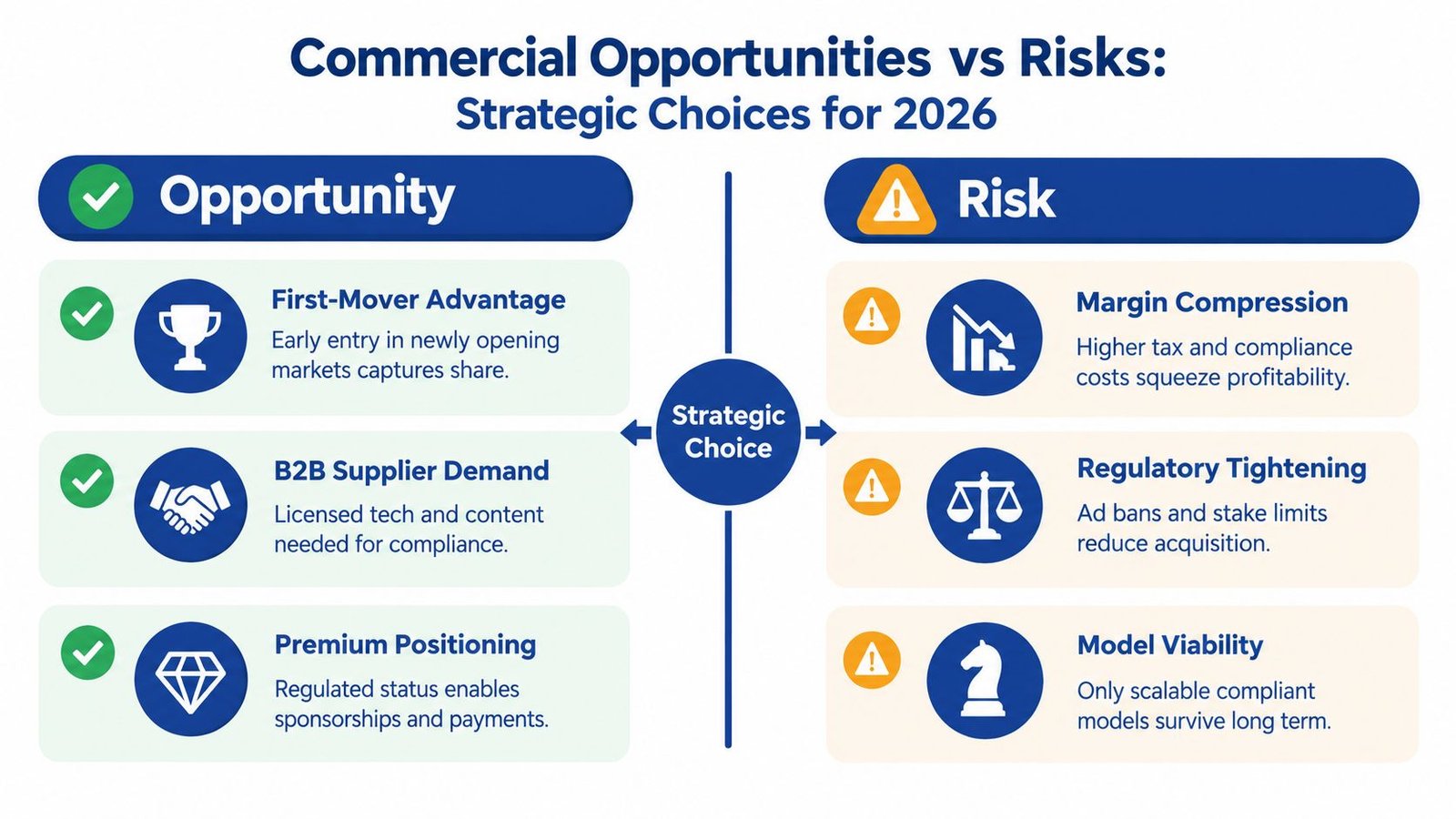
Regulation does not automatically create attractive revenue. It determines which demand can be captured through licensed channels, how reliably payments clear, and how much margin survives tax, compliance, and acquisition costs. Higher GGR taxes reduce funds available for operations and marketing. Deposit caps, advertising restrictions, stake limits, bonus rules, and verification requirements further constrain conversion and retention.
As detailed in the jurisdiction timeline above, the UK duty rise to 40% and the Netherlands' 37.8% rate compress margins. Germany's deposit structure and Italy's concession fee apply pressure through different mechanisms. The commercial question is therefore whether enforcement redirects players to licensed operators, whether payment access remains dependable, and whether post-tax contribution margin covers the cost of acquiring and servicing verified customers.
Stakeholders face different versions of the same trade-off
Operators may gain from stronger channelization and more durable payment access, but scale is needed to absorb compliance staffing, certification, local legal work, and tax. Bonus-led acquisition becomes less effective as promotional flexibility narrows and verified onboarding becomes more expensive.
Suppliers can find demand for certification, geolocation, risk engines, payment orchestration, and reporting tools. The strongest opportunity lies in products that support reusable jurisdiction modules rather than one-off integrations. Affiliates face less inventory as advertising rules tighten. Compliant SEO, clear disclosures, and market-specific operator screening matter more than broad promotional reach.
Investors should treat regulatory capability as an operating asset. A platform that deploys local rule sets, records decisions, and adjusts payment and marketing controls may have greater strategic value than a larger but less compliant revenue base. Top 1 Rank publishes regulatory, compliance, market, and operator intelligence that can support monitoring alongside regulator notices and legal review.
| Decision factor | More attractive condition | Warning signal |
|---|---|---|
| Legal access | Clear licence pathway and defined product scope | Transition rules remain unsettled |
| Enforcement | Consistent action against unlicensed competitors | Offshore activity remains easy to access |
| Payments | Reliable licensed payment rails | Frequent declines, blocking, or limited instruments |
| Tax and fees | Viable post-tax margin | High tax stacked with expensive licensing |
| Acquisition | Permitted, measurable marketing channels | Ad bans and affiliate restrictions limit reach |
| Technology | Modular controls and reusable certification | Each market requires a separate rebuild |
The second-order effect is consolidation. Rising compliance and tax costs favor larger, better-capitalized platforms, while smaller entrants and bonus-dependent models face a narrower route to sustainable returns. Opportunity remains, but value shifts toward payment reliability, evidence quality, reusable technology, and disciplined market selection.
Acquisition planning should combine verification cost, payment friction, responsible-gambling interventions, and jurisdiction-specific advertising limits with standard user acquisition cost analysis. A market can be legally open yet commercially inaccessible if permitted acquisition channels cannot support the required payback period. The investable opportunity is the portion of regulated demand that survives enforcement, reaches a licensed payment rail, and produces acceptable margin after tax and operating controls.
Strategic Recommendations and Next Steps for Regulated Growth
Market selection should start with capturable revenue, not legal status. Build a jurisdiction model covering licensed demand, enforcement intensity, payment access, product scope, tax, licence fees, advertising rules, and compliance cost. Record the source and date for each regulatory assumption, separating verified conditions from scenarios.
Prepare modular technology before entering additional markets. A central policy engine, local rule sets, traceable KYC and AML decisions, certified content workflows, and durable reporting reduce the cost of regulatory change. Finland's staged pathway, with applications beginning in 2026 and operations scheduled for no earlier than July 2027 under the current proposal, shows why licence timing and technical preparation must be planned together.
A pre-investment checklist should test:
- Capture: Estimate demand that can move through licensed channels after enforcement and payment constraints.
- Economics: Model post-tax margin after licence, compliance, payments, bonuses, and acquisition costs.
- Readiness: Verify KYC, AML, responsible-gambling, certification, reporting, and evidence-retention capabilities.
- Timing: Map application windows, transition periods, and planned go-live dates.
- Monitoring: Assign responsibility for regulator updates, enforcement notices, tax changes, and technical reforms.
Investment test: Prioritize markets where legal access, payment reach, enforcement, and sustainable margin align.
Top 1 Rank will continue tracking regulated iGaming markets 2026 through regulatory updates, market intelligence, compliance analysis, supplier developments, and operator strategy. Before committing capital or submitting an application, decision-makers should verify assumptions against the relevant regulator, licence documents, tax authority guidance, and qualified local counsel.
Operators, suppliers, affiliates, and investors should maintain a jurisdiction scorecard, then revalidate regulatory and tax inputs before launch. This converts regulation from a legal-status question into a revenue-capture decision, showing where demand can reach licensed rails and retain margin in 2026.




Join thousands of gaming professionals receiving the latest iGaming news, regulatory updates, and market insights.
