

A game studio has completed its mathematics, passed internal quality assurance, and scheduled a release across several regulated markets. Then a small platform update changes the random-number service, or an operator discovers that an existing certificate names a different build. The launch pauses while compliance teams determine whether the change requires a new laboratory assessment.
That situation captures the operational reality behind RNG certification requirements for casino games. Certification isn't a statement that a generator produces random-looking results. It connects statistical testing, source-code review, game mathematics, laboratory accreditation, jurisdictional rules, version control, and post-launch governance. For suppliers and operators, the central question isn't only whether a game is fair. It's whether the deployed game is the exact game that was tested, by a laboratory accepted in the relevant market, under a certificate that remains valid.
Table of Contents
- The Reality of RNG Compliance in Regulated Markets
- Technical Standards and the Statistical Testing Process
- Accredited Laboratories and Jurisdictional Variations
- Documentation Requirements and Certification Timelines
- Common Failure Modes and Remediation Strategies
- Version Control and the Scope of Certification
- Strategic Best Practices for Operators and Providers
The Reality of RNG Compliance in Regulated Markets
A casino game can pass internal quality assurance and still remain unavailable to a regulated market. The obstacle may be a laboratory report that names an earlier build, excludes a platform component, or comes from a testing body the target jurisdiction does not accept. In practice, RNG certification requirements for casino games connect statistical evidence with release governance, laboratory accreditation, game mathematics, version control, and market-specific rules.
Independent certification has become a de facto global compliance gate. Regulators and operators expect evidence that a generator produces uniformly distributed, unpredictable, non-synchronizing output and resists predictable seeding. The regulatory overview of RNG certification sets out these core expectations.
The UK Gambling Commission requires RNG output to be demonstrated “to a high degree of confidence” using generally accepted statistical tests. The commercial implication is precise: suppliers must support the specific game implementation submitted for approval, rather than rely on a general statement that the product is fair.
Certification controls market access
Certification affects every stage of distribution. Product managers need a valid assessment before placing a release into a regulated pipeline. Operators review certificates during supplier onboarding and technical due diligence. Compliance teams must confirm that the report covers the intended jurisdiction, game version, platform configuration, and relevant mathematical components. Commercial partners may also view certification status as evidence of a studio's ability to supply regulated content consistently.
For Philippines-specific requirements and changes, consult the PAGCOR regulatory updates for 2026.
The operational shift is from launch approval to lifecycle control. Denmark's national RNG requirements call for certification at intervals of no more than 12 months, so certification becomes a recurring obligation rather than a one-time release event. It requires budget, laboratory capacity, document ownership, and renewal tracking. The UK Gambling Commission's RNG guidance places RNG within wider technical oversight, reinforcing that certification must remain connected to ongoing controls.
A product may therefore be commercially ready without being compliance-ready. Release plans that account for development and integration but omit laboratory queues, remediation, report review, and renewal work leave a material gap.
Operational rule: Treat a game as market-ready only when its certificate, tested build, game mathematics, laboratory scope, and jurisdictional approval path match the planned deployment.
The cost of treating certification as a checkbox
The most disruptive issue may be an approval mismatch rather than a failed statistical test. A valid report can relate to an earlier build, a different platform configuration, or a narrower component than the operator believes it covers. That gap can delay launch and trigger further testing.
RNG governance therefore belongs in release management. Version identifiers, source repositories, mathematics documents, configuration files, laboratory reports, and deployment approvals should remain linked. If that evidence chain breaks, compliance staff may spend more time proving equivalence than engineers spent implementing the change.
Certification is a recurring operating obligation, not a decorative trust badge. It determines which content can launch, which markets can receive it, and whether a seemingly minor technical change starts another assessment cycle.
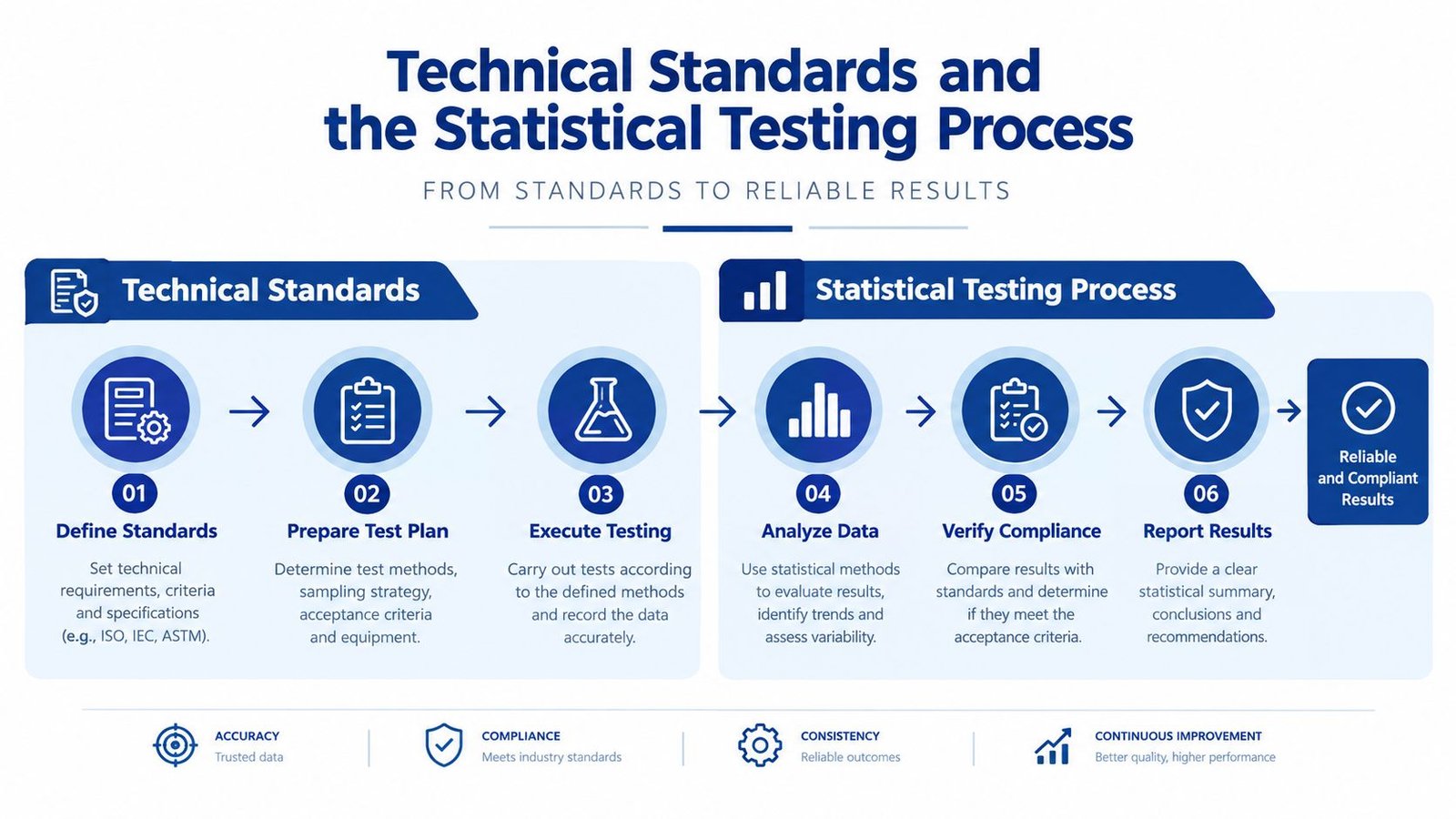
Technical Standards and the Statistical Testing Process
A game can pass an isolated statistical review and still require further work before release. A laboratory must assess whether the RNG, its implementation, game mathematics, and production environment work together within the intended compliance scope. That assessment determines which build and configuration the evidence supports, not every future version of the product.
The testing process should therefore be prepared as a controlled evidence package rather than treated as a single test request. Version identifiers, parameter files, source materials, and deployment details need to describe the same implementation.
What laboratories examine
The first layer is the raw output. Laboratories apply recognized statistical tests to determine whether results follow the required distribution and whether apparent patterns suggest bias or dependency. Producing different values is not enough. The output must suit the game's declared use.
The second layer is unpredictability. A sequence may appear varied while weaknesses in its seed or initialization remain exposed. Laboratories review seeding logic and related controls because predictable initialization can compromise an otherwise complex algorithm.
The third layer is game integration. The generator's output is mapped to reels, cards, wheel positions, selections, or other player-facing events. That mapping must follow the declared mathematics and must not create bias between raw random output and the final result. A report covering the generator alone may not establish compliance for the complete game.
The GLI RNG testing requirements describe the submission of hardware and software needed to collect random data, the use of hardware identical to the field environment where possible, and detailed documentation of game parameters. The package should identify selection counts, relevant ranges, and whether outcomes are drawn with or without replacement.
For system-level controls that complement RNG testing, review the PAGCOR gaming system administrator requirements. These controls help operators connect technical testing with wider system administration responsibilities.
Why the test environment matters
A component cannot always be assessed reliably in isolation when production adds another software layer, hardware dependency, or configuration setting. Changes in the runtime environment may affect data collection, generator calls, or the application of game parameters. Matching or representative hardware gives the laboratory a clearer basis for relating test results to production behavior.
Technical teams should prepare:
- Source and build materials: Provide relevant code, compiled components, configuration, and dependencies in a controlled package.
- Seeding documentation: Explain initialization and the controls intended to prevent predictable seeding.
- Game-parameter records: Define selection counts, ranges, replacement rules, and the mapping from output to game events.
- Environment details: Identify the production hardware and software configuration, or the closest available equivalent.
- Mathematical specifications: Describe how random output connects to probabilities, outcomes, and payouts.
Each item clarifies what the laboratory tested. It also reduces the risk that a later build, platform change, or configuration adjustment falls outside the report's scope and requires additional assessment.
Continuous cycling and confidence
A GLI card-shuffler and dealer-shoe standard calls for statistical independence, the desired random distribution, recognized statistical test results, and continued unpredictability. It also describes testing at a 99% confidence level, as documented in the card-shuffler and dealer-shoe RNG guidance.
The same guidance addresses operational behavior. The RNG should cycle continuously in the background and receive a random change in process after every game. Testing therefore extends beyond the instant a player initiates an action. Background operation, state transitions, and movement from one round to the next can affect the evidence.
An internal test suite should reproduce those conditions as closely as practical. It should collect output under representative settings, compare results with the declared distribution, inspect state changes, and preserve reproducible records. Internal testing does not replace independent certification. It gives engineers a way to identify inconsistencies before submission, while helping compliance teams determine whether a proposed change remains within the certified scope.
Certification maintenance is therefore a recurring engineering and compliance task. Each supported platform or market can create another combination of build, environment, parameters, and evidence that must remain aligned throughout the product lifecycle.
Accredited Laboratories and Jurisdictional Variations
A technically sound RNG isn't enough if the assessment comes from a laboratory that the relevant regulator won't accept. Independent testing exists to separate the evidence producer from the game developer and operator. That separation supports credibility, repeatability, and a review trail that an internal quality team can't provide on its own.
The central laboratory benchmark is ISO/IEC 17025, the international standard for testing and calibration laboratory competence. Regulatory and industry guidance commonly expects accreditation for the relevant gaming scope, not merely a general statement that a laboratory is experienced in software testing. Recognized assessors used as examples include Gaming Laboratories International, BMM Testlabs, iTech Labs, and eCOGRA, as outlined in the fair-play requirements guidance.
Baseline standards versus local controls
International laboratory competence creates a common foundation, but it doesn't remove jurisdictional differences. One market may focus on the accepted laboratory and the technical scope of the report. Another may impose a defined renewal interval, approval procedure, or pre-launch submission requirement. A certificate can therefore be technically credible yet insufficient for a particular deployment.
| Framework / Regulator | Core Requirement | Renewal / Audit Cycle |
|---|---|---|
| ISO/IEC 17025 laboratory framework | Testing should be performed by a competent, accredited laboratory within the relevant scope | Accreditation and technical oversight operate as an ongoing control |
| GLI-19 technical framework | Online gaming RNG implementations are assessed through technical requirements and laboratory testing | The tested implementation remains the reference point for later review |
| UK Gambling Commission | RNG output must demonstrate randomness and unpredictability through generally accepted statistical tests | Ongoing regulatory control applies, with testing and reporting tied to the approved implementation |
| Denmark national requirements | RNG certification is required at intervals of no more than 12 months | Recertification at intervals no longer than 12 months |
The table illustrates why a single global certificate doesn't automatically solve every market-access problem. It may establish a strong technical baseline, but the operator still needs to verify local acceptance, renewal expectations, and the exact product or system covered.
Choosing an assessor
Laboratory selection should begin with the target market, not with brand familiarity. A supplier should ask whether the lab holds ISO/IEC 17025 accreditation for the relevant gaming scope, whether the intended regulator recognizes its reports, and whether the lab can assess the full implementation rather than only a detached generator.
The commercial trade-off is between consistency and jurisdictional flexibility. Using one recognized assessor can simplify documentation and supplier relationships. However, a market may require a local process or additional approval that makes a single report insufficient. Compliance teams should map those requirements before development reaches final submission.
A certificate proves what an accredited laboratory examined. It doesn't automatically prove that every later build, jurisdiction, or platform configuration is covered.
Operators can reduce ambiguity during onboarding by requesting the certificate, report, scope statement, tested version, jurisdictional references, and any conditions attached to the approval. The game content provider accreditation requirements can serve as part of a broader supplier due-diligence workflow, but it shouldn't replace direct review of the laboratory evidence.
Documentation Requirements and Certification Timelines
A release can reach laboratory review with the code complete and still fail to produce a usable certification record. The laboratory needs a precise account of what was built, how the game maps random values to outcomes, which components generate randomness, and which environment must be reproduced. Missing detail at this stage creates questions before testing begins.
The documentation package should connect engineering artifacts to compliance decisions. A source repository without a build identifier makes the assessed version unclear. A mathematical model without its matching configuration leaves uncertainty about the deployed game. A certificate without a defined scope may not support operator onboarding or later change assessment.
The submission file
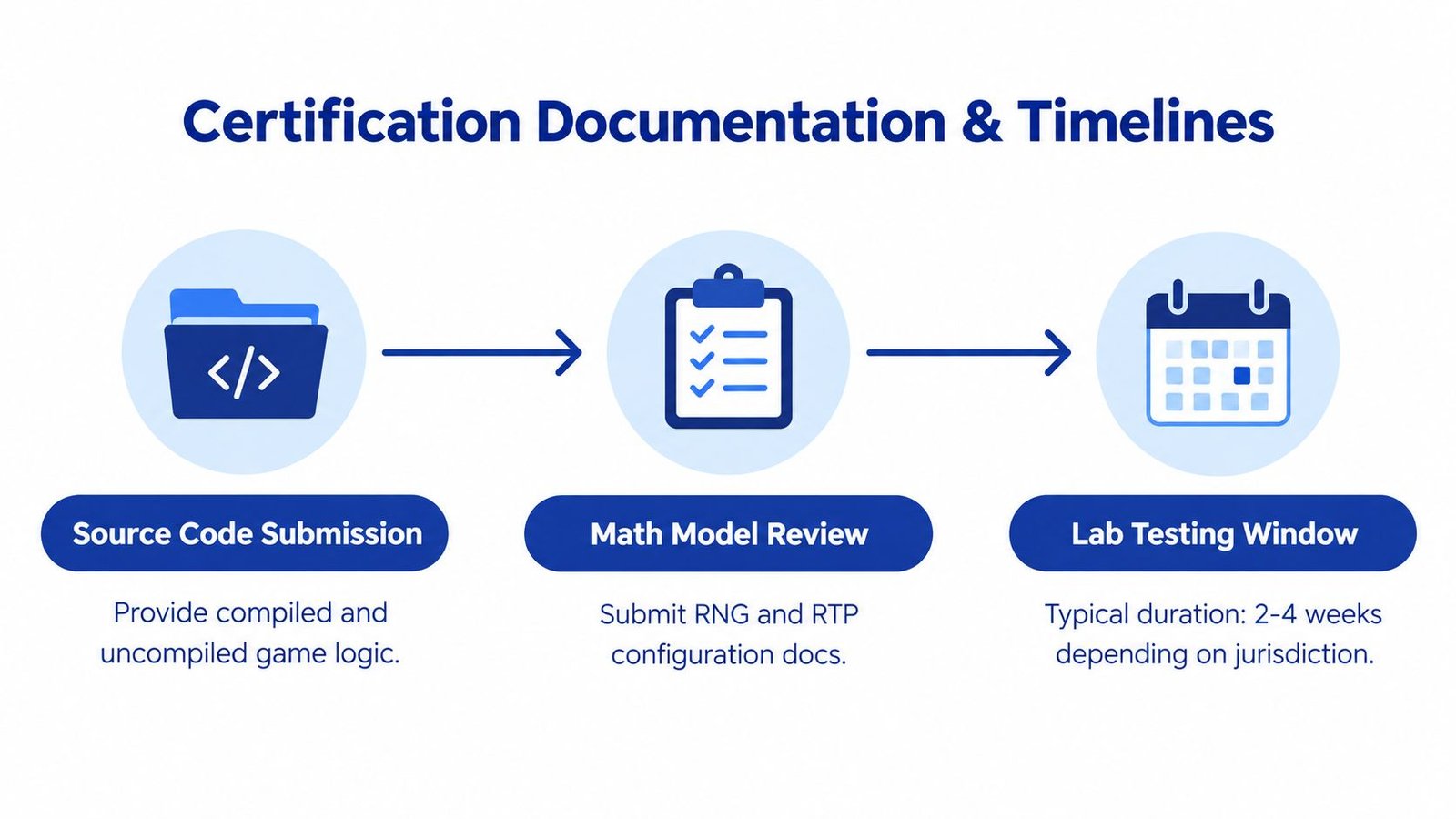
A practical submission package brings together several evidence types:
- Build identity: The precise version, configuration, and deployment target under assessment.
- Implementation materials: Source and compiled code, libraries, dependencies, and hardware details needed to reproduce the tested environment.
- RNG design records: The algorithm description, seeding logic, state handling, and output-collection method.
- Mathematical model: Game rules, outcome mapping, selection mechanics, payout logic, and configuration values.
- Change history: A record of modifications made after internal testing and before laboratory submission.
- Operational instructions: The information required to execute the game and collect representative output.
This structure also makes scope review more precise. It shows whether the report covers the generator alone, the game logic that consumes its output, or a wider implementation. That distinction affects how confidently the certificate can be used across platforms, deployments, and operator integrations.
Why the timeline is difficult to predict
Recognized laboratory standards provide a framework for assessment, but they do not produce a uniform schedule. Timing depends on the completeness of the submission, laboratory availability, game complexity, the number of environments, the review scope, and whether initial results require remediation.
Version control is a major source of friction. If the tested build differs from the build prepared for release, the studio may need to explain the change, repeat affected checks, or obtain a new assessment. A certification timeline therefore includes evidence preparation and version reconciliation, not only the laboratory's testing period.
The budget has similar uncertainty. Laboratory fees are only one component. Teams may also spend engineering and compliance time preparing evidence, recreating the test environment, correcting implementation issues, running regression tests, reviewing reports, and preparing market-specific submissions. A delayed approval can also affect integration and launch scheduling.
Certification should be treated as a recurring lifecycle cost rather than a one-time release task. Each material change, new deployment configuration, or additional jurisdiction can create another scope decision, even when the underlying RNG remains unchanged.
Roadmap implications
Product leadership should place certification dependencies into the release plan before the commercial date is fixed. The development branch, mathematical model, test environment, and evidence package need controlled ownership and clear version references.
A practical governance sequence is:
- Define the intended assessment scope.
- Complete internal statistical and mathematical checks.
- Assemble the versioned evidence package.
- Confirm laboratory and jurisdictional acceptance.
- Submit the exact release candidate.
- Reserve time for questions, remediation, and report review.
- Lock the approved release against unauthorized changes.
The B2B provider application process illustrates why certification planning must align with provider approval, integration, and market entry. Coordinating those dependencies reduces the risk that a certified build is unavailable when commercial onboarding begins.
Common Failure Modes and Remediation Strategies
A first assessment can fail even when the RNG performs as expected in internal testing. The failure often lies in the implementation, documentation, mathematical mapping, or evidence package. Internal QA is designed to confirm product behavior. A laboratory must determine whether the tested evidence supports a controlled fairness claim for a defined build and operating context.
Distribution problems
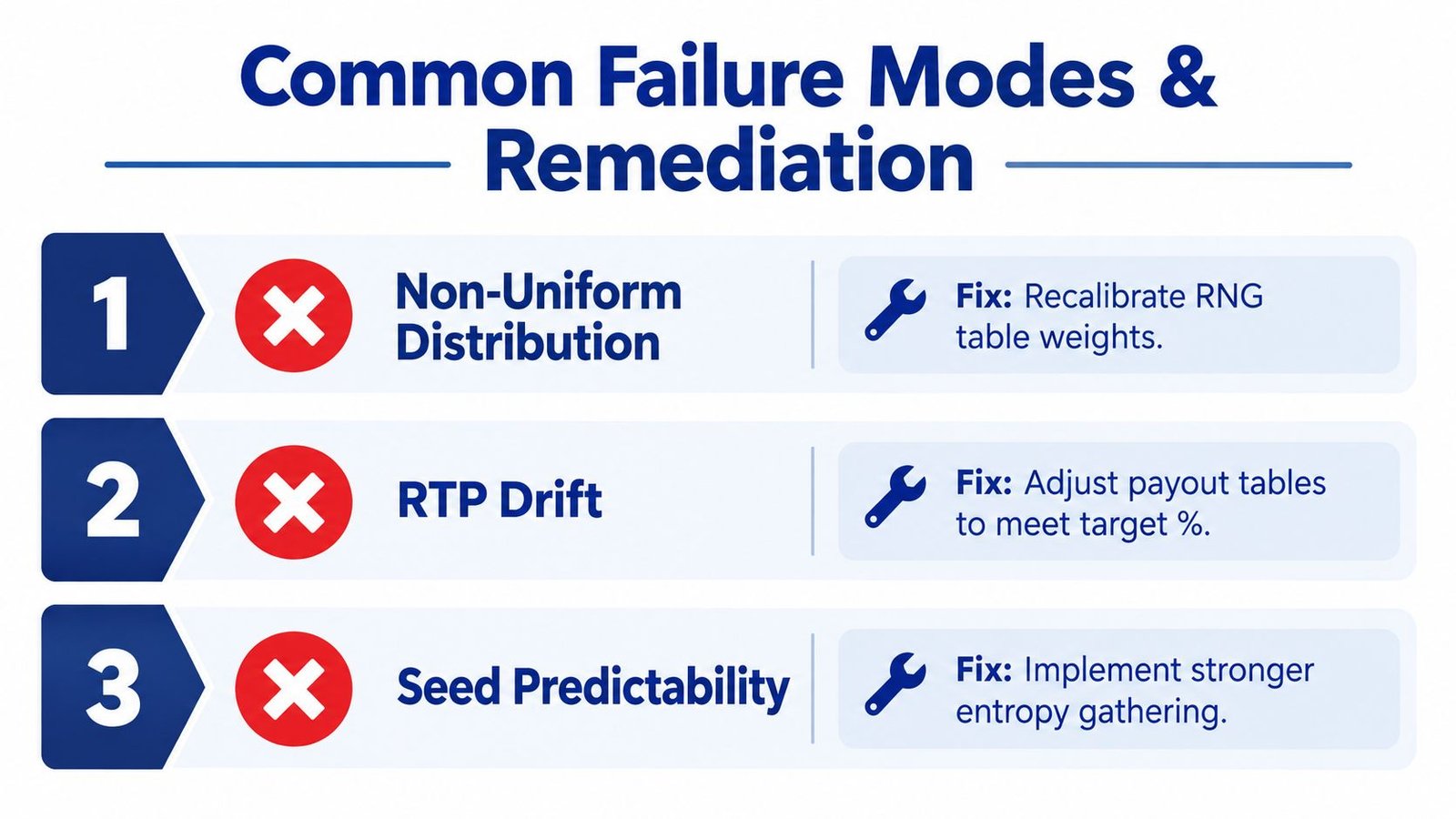
Non-uniform output can result from converting random values into game selections. The generator may produce acceptable raw values while range handling, scaling, or selection logic gives certain outcomes more weight. Incorrect replacement rules can create the same result.
Remediation starts by isolating the affected layer. Engineers should test the generator, conversion method, game table, and test harness separately, then identify where the deviation first appears. The team can correct that component, repeat testing under the laboratory's expected conditions, and submit the controlled build for re-evaluation. Testing only the revised function can leave an integration defect undetected.
Mathematical drift
A game may also fail when its declared mathematics differ from the implemented configuration. Payout tables, outcome weights, bonus logic, and production files can each introduce a mismatch. The compliance issue is consistency between the approved model and the behavior of the tested build.
The remediation record should compare the approved mathematical model with source code, configuration, and output evidence. Product and engineering owners should approve the corrected version together. A mathematical change can alter the statistical interpretation and may also affect the boundaries of the certification already obtained.
Predictable seeding
Weak or predictable seeding can compromise unpredictability even when basic distribution tests pass. Laboratories therefore examine seed sources, initialization behavior, state transitions, and controls that prevent predictable reuse. Apparent variation alone does not establish adequate protection.
The studio should document the seed source and initialization path, test the corrected implementation under representative operating conditions, and preserve the results for review. It should also record which deployment configurations use that logic, since a technically correct fix may still require refreshed evidence for another environment.
The support service provider accreditation requirements illustrate the operational consequence. Code remediation can affect provider documentation, integration controls, and the materials submitted to an approval process. Certification work therefore creates recurring coordination costs across engineering, compliance, laboratories, and market-entry teams.
Remediation principle: Fix the layer that created the deviation, then retest the complete implementation. A patch to the generator cannot compensate for a biased outcome-mapping table.
Card-shuffler and dealer-shoe testing also considers statistical independence, the intended distribution, recognized statistical-test performance, and unpredictability. These controls should be assessed together at the required confidence level. Passing one dimension does not resolve a weakness in another, and a successful retest does not automatically extend approval to an unassessed build or jurisdiction.
Version Control and the Scope of Certification
The certificate's title is rarely enough to determine what a studio or operator can deploy. The critical question is scope. Does the report cover the generator alone, the game implementation, the mathematical model, the platform version, or the complete build?
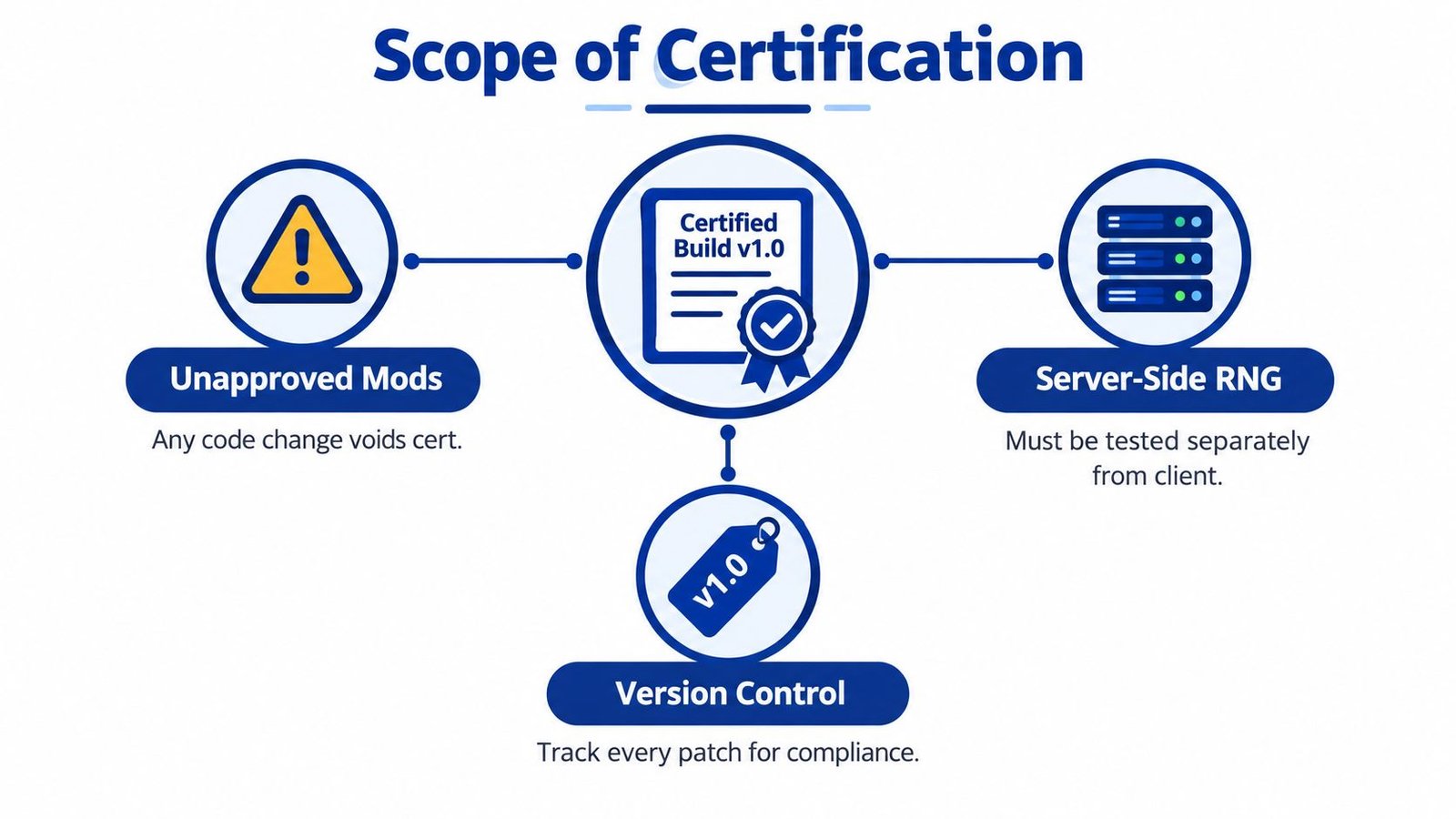
That distinction remains one of the most overlooked parts of RNG compliance. The RNG certification scope guidance identifies this precise problem: coverage may differ between the generator, the implementation, the math model, the platform, and the full build. Each interpretation creates a different change-control obligation.
Build identity is a compliance control
Certification is commonly tied to a specific software build or version and jurisdiction. A minor change to RNG logic, scaling, seeding, game mathematics, or related platform behavior can therefore trigger a new certification cycle. The risk is highest when release teams classify a change as a harmless bug fix without checking whether it touches an assessed component.
A strong control model treats the approved build as an immutable reference. The release record should connect:
- Certificate identifier: The report and approval documents associated with the release.
- Version fingerprint: The build, package, and configuration assessed by the laboratory.
- Scope statement: The components the certificate explicitly covers.
- Jurisdiction list: The markets in which the evidence is intended to support deployment.
- Change assessment: A compliance decision for every later modification.
- Deployment record: The production environment and release date for each approved version.
This structure lets a compliance officer answer the most important audit question quickly: what is running, and where is the evidence that this exact version was tested?
Generator versus full game
A generator certificate may establish properties of the random source without proving that a particular game maps output correctly. Conversely, a game-level assessment may cover the generator, mapping, mathematics, and platform context within a defined build. Those are materially different approvals.
The distinction affects live operations. A client-side visual correction may fall outside the assessed randomness path, while a server-side change to scaling or outcome selection may directly affect the tested implementation. No universal assumption can replace the scope language in the laboratory report and the regulator's requirements.
Managing post-certification changes
Release governance should classify changes by compliance impact before deployment. A cosmetic client change may require evidence that the random-selection path is untouched. A platform-engine change may require laboratory consultation. A change to math configuration or server-side RNG behavior should be presumed material until the compliance assessment establishes otherwise.
Release gate: No patch should enter a regulated production environment until its relationship to the certificate has been documented and approved.
This approach can slow certain releases, but it prevents a faster engineering cycle from creating a slower regulatory response. The hidden cost of weak version control is not only re-testing. It can include emergency rollback, operator notifications, market withdrawal, and an investigation into which version players received.
Strategic Best Practices for Operators and Providers
A provider can hold a valid certificate while an operator deploys a configuration the certificate does not cover. Preventing that gap requires shared responsibility with clear boundaries. Providers control the implementation, source materials, mathematical model, and laboratory submission. Operators control onboarding, deployment, market allocation, and the check that supplied evidence matches the production release.
The certificate should function as a maintained product record. Store it with release notes, security records, test evidence, and deployment approvals. A document that remains in an isolated compliance folder will not reliably govern later releases.
Provider controls
Suppliers should establish traceability during development, not reconstruct it before an assessment. Each assessed component needs an owner, version identity, and change history. Internal testing should reproduce the declared environment and retain evidence that helps the laboratory understand the implementation and any later amendments.
Useful controls include:
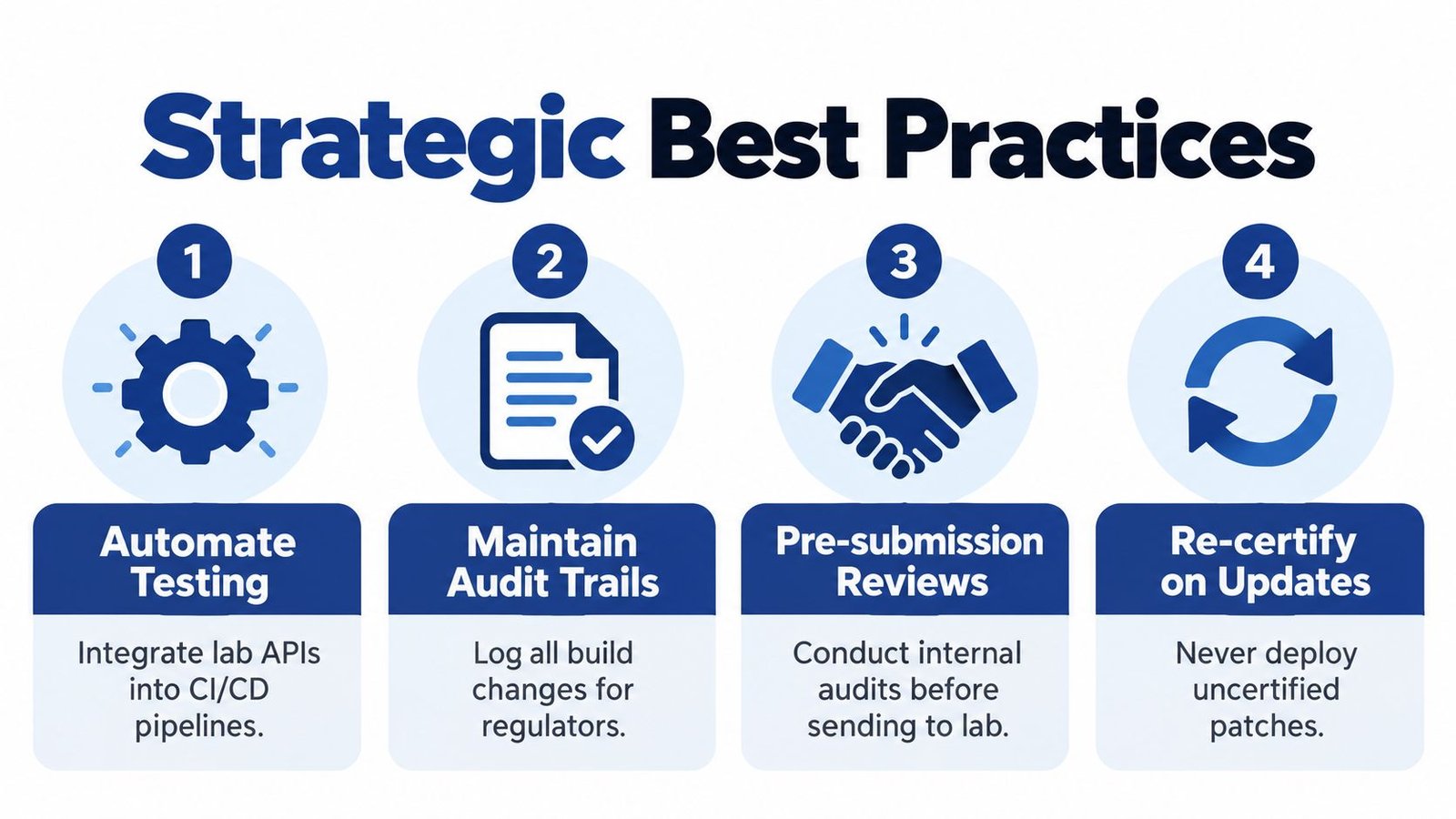
- Automated regression testing: Run statistical and mathematical checks whenever RNG logic, outcome mapping, or configuration changes.
- Pre-submission review: Require engineering, mathematics, QA, and compliance to approve the evidence package before laboratory delivery.
- Immutable release candidates: Lock the assessed build and block untracked changes between submission, certification, and deployment.
- Scope registers: Record whether each certificate covers the generator, game, mathematics, platform, or complete build.
- Renewal calendar: Track jurisdiction-specific obligations, including Denmark's requirement for certification at intervals of no more than 12 months, as described in the RNG compliance overview.
Operator due diligence
Operators should treat a certificate as evidence tied to defined software and market conditions, not as a generic vendor credential. During onboarding, compare it with the exact game version, platform integration, jurisdiction, and production configuration.
A practical review should establish:
- Which laboratory performed the assessment?
- Does the laboratory hold ISO/IEC 17025 accreditation for the relevant gaming scope?
- Does the certificate identify the tested build and game version?
- Does the report cover the generator only, or the complete implementation?
- Does the evidence support every intended market?
- Which changes require notification, review, or re-certification?
- How does the supplier document annual or periodic renewal?
Recognized laboratories such as GLI, BMM Testlabs, iTech Labs, and eCOGRA appear in industry guidance, but their names do not establish acceptance for every jurisdiction or deployment. The operator must verify both the laboratory's relevant scope and the relationship between the assessed build and the live configuration.
Turning compliance into operating intelligence
A supplier portal, governance platform, or intelligence service can track certificates, versions, jurisdictions, and renewal dates. Top 1 Rank is an iGaming intelligence publication covering regulatory developments and market information. Technical compliance systems remain responsible for the underlying build records, evidence, and certification status.
The operational benefit is faster resolution at each handoff. Providers can answer scope questions during onboarding instead of rebuilding the evidence trail. Operators can identify certification gaps before integration or release. Clear records also give regulators a defensible audit trail and help demonstrate that the deployed game remains connected to the assessed implementation.
RNG certification is therefore a quality, market-access, and risk-control function. Connecting laboratory evidence with release governance lets teams determine which changes are material, which markets are covered, and which documents support the product in production. It also makes recurring renewal work visible across jurisdictions rather than treating each request as an isolated administrative task.
Operators and providers should audit their RNG inventory now. For every live title, record the certificate, laboratory, accredited scope, tested build, jurisdiction, renewal date, and post-certification changes. Turn each missing field into a tracked compliance action before the next release, renewal, or market launch.





Join thousands of gaming professionals receiving the latest iGaming news, regulatory updates, and market insights.
